Welcome to “Building of the Day” (BOTD), our dedicated segment offering an unvarnished look at fascinating architectural structures across New York City’s diverse neighborhoods. From the grandeur of forgotten mansions to the understated elegance of modern designs, we spotlight buildings that capture our imagination. Whether old or new, prominent or overlooked, public or private, each chosen structure tells a unique story, reflecting the rich tapestry of urban development and design. We invite you to join us on this architectural journey, celebrating the artistry and history embedded within the city’s built environment.
Building of the Day: Unveiling 1290 Pacific Street in Crown Heights North
Architectural Snapshot: 1290 Pacific Street
- Address:
- 1290 Pacific Street, between Nostrand and New York Avenues
- Name:
- Private House
- Neighborhood:
- Crown Heights North, Brooklyn
- Year Built:
- 1890
- Architectural Style:
- Renaissance Revival, with Northern Italian and Colonial Revival influences
- Architects:
- J.C. Cady & Co.
- Landmarked:
- Yes
A Legacy in Brick and Stone: The Genius of J.C. Cady
Our selection for today, the striking private residence at 1290 Pacific Street, stands as a testament to the exceptional talent of its architect, J.C. Cady. Seldom does one encounter a builder whose diverse portfolio spans such a breadth of significant public and private commissions, yet Cady’s firm, J.C. Cady & Co., left an indelible mark across the New York metropolitan area. His contributions were not merely structures but foundational pieces of the city’s cultural and institutional landscape, demonstrating a profound understanding of monumental design alongside a subtle touch for residential artistry.
Cady’s New York Masterpieces: Beyond Brooklyn
Cady’s renown extends far beyond the charming streets of Brooklyn. He was the visionary behind some of Manhattan’s most iconic buildings, structures that continue to define the city’s architectural grandeur. Perhaps his most famous contribution was the original Metropolitan Opera House, a grand edifice on Broadway and 40th Street that served as the cultural heart of New York for decades. This colossal project showcased his ability to craft opulent, acoustically advanced spaces for public performance, reflecting the city’s burgeoning artistic ambitions. Furthermore, Cady was instrumental in shaping the American Museum of Natural History, designing its distinctive south wing, which still forms a crucial part of this sprawling complex. His work on this institution highlighted his versatility, creating functional yet architecturally distinguished spaces for scientific exploration and public education. Not to be overlooked, his involvement with the New York Presbyterian Hospital underscores his commitment to designing facilities that combined aesthetic appeal with critical functionality, contributing to the city’s evolving healthcare infrastructure. These projects alone would secure any architect’s place in history, but Cady’s influence reached even further.
Cady’s Brooklyn Churches: A Local Touch
While his Manhattan projects were grand in scale, Cady’s work in Brooklyn often took on a more intimate, spiritual dimension. He was responsible for some of the borough’s most exceptionally fine churches, each a unique expression of his architectural philosophy. The German Lutheran Church in Brooklyn Heights, for instance, remains a magnificent example of his ecclesiastical design, blending historical reverence with his signature detailing. Similarly, St. Paul’s Evangelical Lutheran Church in Williamsburg showcases his ability to adapt grand architectural styles to the more specific needs and contexts of local congregations, creating enduring symbols of community faith. One of the most cherished examples, and a personal favorite, is the Union United Methodist Church, situated just around the corner from 1290 Pacific Street on New York Avenue. Its robust and inviting design embodies a sense of enduring strength and community spirit, reflecting Cady’s profound empathy for the purposes his buildings served. These churches, with their intricate details and commanding presence, are vital threads in the rich historical fabric of Brooklyn, often serving as neighborhood anchors for over a century.
Architectural Tapestry: Unpacking 1290 Pacific Street’s Unique Style
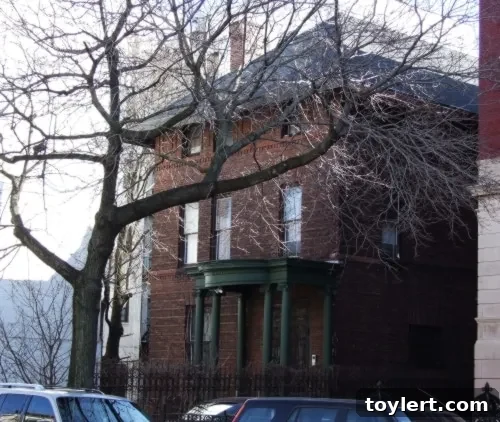
The house at 1290 Pacific Street is a remarkable synthesis of architectural styles, a characteristic often found in the late 19th century as architects experimented with historical revivals. While the Landmarks Preservation Commission (LPC) officially lists it as a Renaissance Revival building, a deeper look reveals layers of sophisticated influence. One could accurately describe it as embodying a profound Northern Italian Renaissance aesthetic, subtly transitioning into what some might term a “classic four-square” design. This intriguing blend, coupled with distinctive features, sets it apart as a significant piece of Crown Heights North’s architectural heritage.
Renaissance Revival: A Grand Foundation
Renaissance Revival architecture, popular in the United States during the late 19th century, drew inspiration from the classical forms and harmonious proportions of 15th and 16th-century Italian Renaissance palaces. Key characteristics typically include a strong sense of symmetry, rusticated stone at the base, projecting cornices, and detailed classical ornamentation. At 1290 Pacific Street, these elements are evident in the building’s balanced facade and overall sense of dignified grandeur. The use of a very dark brick, a choice that lends the house a formidable and stately appearance, provides a modern interpretation of the traditional stone-clad Renaissance palazzi. This dark palette allows the architectural details to emerge with a striking contrast, emphasizing the craftsmanship and the play of light and shadow.
The Northern Italian Influence and Classic Four-Square Elements
The “profound Northern Italian Renaissance” influence suggests a focus on certain stylistic nuances—perhaps a more austere elegance, less ornate than some Roman or Florentine interpretations, but with a robust and earthy quality. This could manifest in the building’s strong massing, the particular treatment of its windows, or the use of durable materials. What makes 1290 Pacific Street particularly fascinating is its almost transitional nature, hinting at the emerging “classic four-square” style. Typically characterized by a broadly pitched roof and a generally square footprint, the four-square became a popular, simpler, and more economical architectural form in the early 20th century. While 1290 Pacific is notably taller than a typical four-square, its broad pitched roof, combined with its overall square-ish shape, gives a nod to this future trend, showcasing Cady’s forward-thinking approach even while rooted in historical revivalism. This juxtaposition of a grand, historic style with hints of a more modern, pragmatic form creates a compelling visual narrative.
Distinctive Details: Colonial Revival Porch and Turret
Adding another layer to this architectural fusion is the very Colonial Revival porch. Colonial Revival, gaining traction around the same period, emphasized simpler, more residential forms inspired by American colonial architecture, often featuring classical columns, balustrades, and inviting entryways. The porch at 1290 Pacific Street, with its elegant design, provides a welcoming counterpoint to the more imposing brick facade and the formal Renaissance Revival elements. It softens the building’s presence, lending it a touch of domestic charm. Completing this unique stylistic blend is the turret on the left side of the house. Turrets, often associated with Queen Anne or Chateauesque styles, introduce a vertical flourish and a touch of romanticism. In the context of 1290 Pacific, the turret doesn’t dominate but rather serves as an interesting accent, contributing to the house’s dynamic silhouette and reinforcing its “interesting combination of styles.” This thoughtful amalgamation prevents the house from being easily pigeonholed into a single category, making it a continuous subject of architectural appreciation.
Echoes of the Past: 1290 Pacific Street in Crown Heights North
Stepping back in time, the block on Pacific Street where this grand house resides once presented a vastly different streetscape. In the late 19th century, Crown Heights North was a prime residential area, characterized by a proliferation of magnificent, free-standing mansions. These were the stately homes of Brooklyn’s affluent class, who sought spaciousness and a touch of suburban tranquility while remaining connected to the urban core. Indeed, 1290 Pacific Street was originally flanked by similar large houses on either side, and even across the street, creating an enclave of architectural splendor. This context highlights the rapid urbanization and changing demographics of Brooklyn over the past century.
Today, the urban landscape of this specific block has evolved considerably. Of the numerous mansions that once graced Pacific Street, only a precious few remain. The house at 1290 stands as a proud survivor of this bygone era, alongside just one other original neighbor: 1284 Pacific Street. This five-story residence, built in 1893, stands immediately to the right of our featured building. It too has a rich history and, significantly, has recently undergone a comprehensive rehabilitation, transforming its historic interiors into modern rental apartments. This trend of adaptive reuse is common in landmarked districts like Crown Heights North, balancing the preservation of external architectural integrity with the demands of contemporary living. The fact that 1290 Pacific Street remains a single-family home, remarkably intact and well-cared for over its 130-plus year history, underscores its exceptional preservation.
The Crown Heights North Historic District, in which 1290 Pacific Street is a proud participant, is celebrated for its remarkably cohesive collection of late 19th and early 20th-century residential architecture. The district’s landmark designation ensures the protection of these irreplaceable structures, maintaining the area’s distinctive character and historical significance for future generations. Buildings like 1290 Pacific Street are not just private residences; they are vital components of Brooklyn’s architectural narrative, reflecting the prosperity, aspirations, and artistic tastes of a pivotal era in the city’s development.
Enduring Charm: A Testament to Time and Craftsmanship
Despite the passage of time and the shifting urban fabric around it, 1290 Pacific Street remains a profoundly impressive house. Its original charm and architectural integrity are remarkably preserved, a testament to its robust construction and the care it has received throughout its existence. The blend of Renaissance Revival formality, Northern Italian influence, Colonial Revival elements, and the distinct turret creates a captivating visual dialogue, making it a standout even in a neighborhood rich with architectural marvels.
It’s worth noting that this magnificent private residence has occasionally appeared on the real estate market over the years. Such occurrences highlight the cyclical nature of historic homeownership, where these grand properties pass through generations, each stewardship contributing to their ongoing story. For potential homeowners, acquiring a property like 1290 Pacific Street offers more than just a place to live; it represents an opportunity to become a custodian of Brooklyn’s architectural heritage, to live within a piece of living history designed by a master architect like J.C. Cady. Its enduring appeal lies not only in its beauty but also in its profound connection to the past, reminding us of the timeless value of exceptional design and dedicated preservation.