Jackie Robinson’s Brooklyn Home: A Glimpse into the Private Life of a Public Hero
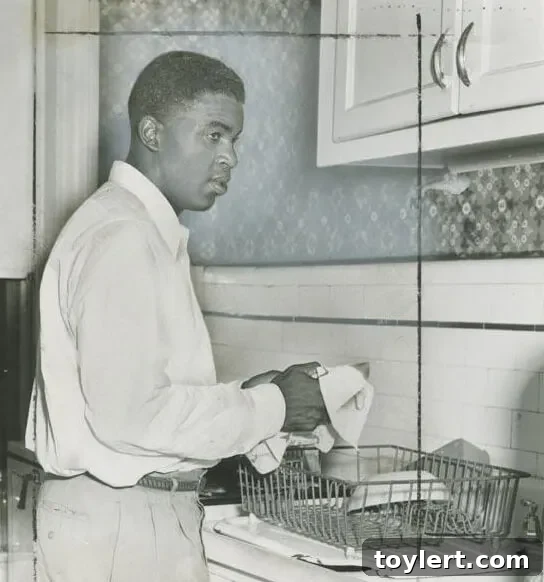
The annals of American history are replete with iconic figures, but few command the respect and admiration bestowed upon Jackie Robinson. More than just a baseball player, Robinson was a monumental figure whose courage transcended the realm of sports, impacting the very fabric of society. His name is synonymous with breaking barriers, resilience, and a pivotal moment in the nation’s civil rights journey. Yet, amidst the grand narratives of his on-field heroics and societal contributions, there exist more intimate, almost forgotten, snapshots that offer a unique window into the personal world of this extraordinary man. One such indelible moment, captured in 1949 by the lens of the *Brooklyn Daily Eagle*, reveals a charmingly domestic scene: Jackie Robinson, the iconic Brooklyn Dodger, at home in his East Flatbush kitchen, dutifully doing the dishes.
This evocative image, simple yet profoundly powerful, transports us back to a defining era when the Brooklyn Dodgers were not merely a baseball team, but the beating heart of a borough, embodying its spirit, hopes, and dreams. It was a time when the last World Series appearance by the Cubs was anchored in the memory of a Brooklyn that still housed its beloved Dodgers – a stark contrast to today’s baseball landscape. The *Brooklyn Daily Eagle*, a venerable institution of local journalism, embarked on a unique series that year. Its mission was to visit the homes of Dodgers players, offering their loyal readership an unprecedented glimpse into the private lives of their heroes, far removed from the deafening roar of Ebbets Field. These candid domestic scenes, particularly those capturing players and their families within the warmth of their kitchens, served to humanize these larger-than-life figures, transforming them into relatable symbols of post-war American family life.
The Historic Residence at 5224 Tilden Avenue: A Sanctuary for a Legend
The precise setting for this iconic and revealing photograph was the East Flatbush residence of Jackie and Rachel Robinson, located at 5224 Tilden Avenue. From 1947, the very year he courageously shattered baseball’s color barrier, until 1949, this house served as a cherished sanctuary for the Robinson family. It was within these walls, amidst the tree-lined, quiet residential streets of Brooklyn, that Jackie could momentarily retreat from the immense pressures, relentless scrutiny, and constant public gaze that inevitably defined his groundbreaking career. The intimate image of him diligently attending to household chores in his vintage kitchen beautifully illustrates a man deeply engaged in the ordinary rhythms of family life, starkly contrasting with his extraordinarily public and challenging role on the national stage.
Constructed sometime between 1912 and 1916, this charming house predates the Robinsons’ residency, possessing its own unique architectural heritage and neighborhood story. However, its true national significance, which resonates so powerfully today, stems directly and unequivocally from its profound association with Jackie Robinson. Recognizing its pivotal role in housing a central figure in American history, the residence has been justly listed on the National Register of Historic Places. This prestigious designation underscores not merely the physical structure itself, but the immense human story it contains, marking it as a site of immeasurable cultural and historical importance. The house at 5224 Tilden Avenue stands today as a silent yet eloquent testament to the personal life of a man whose public actions reverberated across the entire nation, transforming it into a poignant pilgrimage site for those seeking to connect with his enduring legacy beyond the confines of the baseball diamond.
Breaking the Color Barrier: Jackie Robinson’s Enduring Legacy on Baseball and Civil Rights
The story of Jackie Robinson is fundamentally intertwined with the arduous struggle for civil rights in 20th-century America. On April 15, 1947, he stepped onto the hallowed grounds of Ebbets Field, not merely as an exceptionally talented infielder for the Brooklyn Dodgers, but as the inaugural African-American player in Major League Baseball’s modern era. This epoch-making event, meticulously orchestrated by the visionary Dodgers General Manager Branch Rickey, was famously dubbed “baseball’s great experiment.” However, its profound implications extended far beyond the confines of the baseball diamond, sparking a movement that would reshape the nation.
Robinson’s journey was fraught with unimaginable adversity and immense personal sacrifice. He faced an unrelenting barrage of racial slurs, endured discriminatory housing and travel conditions, confronted hostile crowds, and even encountered prejudice from some of his own teammates. Yet, guided by Rickey’s stern injunction to “turn the other cheek,” he bore these indignities with an unparalleled grace, dignity, and unwavering resilience. He allowed his exceptional talent, indomitable spirit, and impeccable character to speak for themselves. Robinson wasn’t merely playing baseball; he was engaged in a profound battle for equality, one stolen base, one diving catch, and one dignified silence at a time. His phenomenal performance on the field, coupled with his quiet strength and unwavering resolve off it, slowly but surely chipped away at the formidable walls of prejudice. The cumulative effect of his brave presence fundamentally altered the landscape of American sports and contributed immeasurably to the burgeoning Civil Rights Movement of the mid-20th century, setting a precedent that inspired change in countless other spheres of American life.
The Brooklyn Dodgers: A Golden Era of Pennants and a World Championship Triumph
During Jackie Robinson’s transformative tenure, the Brooklyn Dodgers, affectionately immortalized as “The Boys of Summer,” ascended to become one of baseball’s most dominant, captivating, and universally beloved franchises. Their cherished home, the intimate and perpetually raucous Ebbets Field, transcended its status as a mere ballpark; it became a veritable cathedral where the collective dreams and aspirations of an entire borough were passionately played out. Robinson was undeniably a cornerstone of this golden era, his electrifying athleticism, fierce competitive spirit, and quiet leadership profoundly inspiring his teammates and utterly captivating the fervent Brooklyn faithful. The team’s achievements throughout this period were nothing short of remarkable, etching memories that would forever be cherished by their dedicated fans.
Between 1947 and 1955, the Dodgers emerged as a perennial powerhouse, consistently contending for and often capturing the coveted National League pennant. They secured this prestigious title an impressive five times during Robinson’s impactful years: in his electrifying rookie year of 1947, once more in 1949 (the very year of the famous kitchen photo), and subsequently in 1952, 1953, and finally in 1955. Each pennant represented a hard-fought battle, a testament to their skill and grit, and brought the thrilling anticipation of the World Series to the bustling streets of Brooklyn. The absolute pinnacle of this illustrious era arrived in 1955, when the Dodgers, after years of heartbreaking and often agonizing losses to their formidable crosstown rivals, the New York Yankees, finally clinched their sole World Series championship while proudly representing Brooklyn. This monumental victory was a triumph not just for the team itself, but for the entire borough, cementing Robinson’s indelible legacy as a central figure in one of baseball’s most iconic and cherished dynasties before the team’s eventual and controversial relocation to Los Angeles.
Brooklyn in 1949: A Post-War Portrait and the Power of Local Journalism
The year 1949, when the *Brooklyn Daily Eagle* featured Jackie Robinson in the intimate setting of his kitchen, marked a fascinating and dynamic juncture in American history. World War II had concluded just four years prior, and the nation was undergoing a significant and multifaceted transformation, pivoting from wartime austerity to post-war prosperity and evolving social norms. Brooklyn, then a bustling hub of industry, diverse communities, and vibrant cultural life, was certainly no exception to these profound shifts. It was a borough brimming with an intoxicating mix of optimism, unwavering community spirit, and a deep-seated, almost tribal, love for its local heroes, especially the beloved Dodgers. The *Eagle*’s innovative initiative to photograph players in the comfort of their own homes was a powerful testament to the extraordinarily close bond that existed between the team and its devoted fanbase, offering a more personal and intimate connection than ever before imagined.
These captivating kitchen scenes, meticulously showcasing the domestic realities of celebrated athletes, resonated deeply and powerfully with the newspaper’s vast readership. They skillfully reflected a national post-war yearning for a return to normalcy, stability, and the idealized image of the thriving American family. For Jackie Robinson, whose every public move was relentlessly scrutinized and often heavily politicized, such a photograph offered a rare and precious moment of relaxed humanity, a genuine glimpse into the everyday life he so cherished and shared with his devoted wife, Rachel, far away from the intense spotlight of professional baseball and the ongoing, arduous fight for racial equality. It profoundly underscored the truth that even trailblazers of his magnitude, individuals who fundamentally changed the course of history, were also loving husbands and dedicated homeowners, engaged in the mundane yet deeply meaningful tasks of daily living, further endearing him to a public eager to see their heroes as relatable, flesh-and-blood individuals.
The Enduring Significance of Jackie Robinson’s Brooklyn Legacy
Jackie Robinson’s time at 5224 Tilden Avenue, though comparatively brief spanning from 1947 to 1949, encapsulates a period of profound personal growth and monumental societal change within his extraordinary life. It was more than just a house; it was a home that bore witness to the early, formative years of his family life in Brooklyn, even as he courageously navigated the most challenging, impactful, and scrutinized phase of his unparalleled professional career. The subsequent move to Queens after 1949 indeed marked a new chapter for the Robinson family, both geographically and personally, but their foundational roots in East Flatbush left an indelible and permanent mark on Brooklyn’s rich historical landscape.
Today, the house on Tilden Avenue stands as a silent, yet extraordinarily powerful, monument to an American hero. Its rightful inclusion on the National Register of Historic Places ensures that its invaluable connection to Robinson will be meticulously preserved and celebrated for countless future generations, serving as a tangible, living link to a pivotal and transformative era in the nation’s past. The iconic photograph of him doing dishes in his vintage kitchen remains a poignant and timeless reminder of the complete man behind the legendary figure: a courageous pioneer, a tireless activist, a devoted husband, a loving father, and a proud Brooklynite who, through his quiet resilience, unwavering determination, and unparalleled talent, did far more than simply play a game – he profoundly changed the world. His enduring legacy continues to inspire crucial conversations about equity, courage, perseverance, and the relentless pursuit of justice, echoing vibrantly from the hallowed halls of baseball to the most ordinary, everyday kitchens across America.