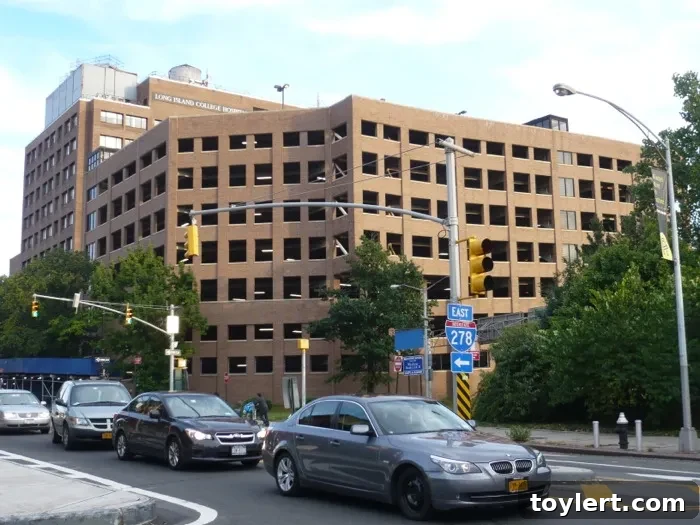
Transforming Cobble Hill: The Future of Long Island College Hospital and the Vision for 50-Story Towers
The venerable Long Island College Hospital (LICH) site in Cobble Hill, Brooklyn, has long been a focal point of community aspirations and development discussions. What began as a critical healthcare institution has evolved into a complex narrative of financial challenges, community advocacy, and ambitious real estate proposals. At the heart of this ongoing saga is a recent revelation that has sent ripples through the historic Brooklyn neighborhood: the prospective developer for the LICH site is reportedly contemplating the construction of two towering 50-story residential buildings.
This striking proposal, initially brought to light by Crain’s, outlines a strategy by the chosen firm, Brooklyn Health Partners (BHP), to finance the retention of a full-service hospital at the site. The audacious height of these planned structures stands in stark contrast to the existing architectural fabric of Cobble Hill, a neighborhood renowned for its charming brownstones and a relatively low-rise skyline, where current LICH buildings typically do not exceed 12 stories. The potential visual and infrastructural impact of such a development marks a pivotal moment for urban planning in one of Brooklyn’s most cherished districts.
The LICH Legacy: A Battle for Healthcare and Community Character
To fully grasp the magnitude of BHP’s proposal, it is essential to revisit the tumultuous history of Long Island College Hospital. For over 150 years, LICH served as a cornerstone of healthcare for the rapidly expanding population of Brooklyn, evolving from its founding in 1858 into a significant medical center. However, like many urban hospitals, LICH faced mounting financial difficulties in the 21st century. These struggles eventually led to its closure by the State University of New York (SUNY) in 2014, despite fervent protests and protracted legal battles waged by a coalition of community groups, healthcare workers, and local politicians.
The community’s fight was not merely to keep a hospital open; it was a desperate plea to preserve essential healthcare access for hundreds of thousands of Brooklyn residents. The closure of LICH left a significant void, particularly in a borough where healthcare resources were already strained. The subsequent bidding process for the sprawling waterfront property became a high-stakes competition, with the promise of future healthcare provision being a key criterion. BHP emerged as the preferred developer, ostensibly committing to integrating a new, modern medical facility with whatever residential or commercial components would fund it.
Brooklyn Health Partners’ Vision and the Economic Imperative
BHP’s winning bid was predicated on a hybrid model: a commitment to establishing a full-service hospital alongside a substantial real estate development. The rationale behind the proposed 50-story towers, as indicated by financial advisor documents and emails cited by Crain’s, is rooted in economic pragmatism. The immense cost of building, equipping, and sustaining a state-of-the-art healthcare facility in a prime New York City location necessitates a significant financial offset. High-density residential towers, particularly luxury units, represent a proven strategy for generating the substantial capital required for such ambitious projects.
For a developer, maximizing the buildable area and potential revenue from the residential component is often seen as the only viable path to making a full-service hospital financially sustainable in today’s highly competitive and costly urban real estate market. This economic reality frequently puts developers at odds with local communities who prioritize neighborhood character, infrastructure capacity, and quality of life over raw development potential.
Community Shockwaves: The Impact of Unprecedented Heights
The news of potential 50-story towers has understandably ignited a firestorm of concern within Cobble Hill and surrounding neighborhoods. Cobble Hill is largely characterized by its designation as a historic district, boasting meticulously preserved 19th-century architecture, tree-lined streets, and a low-key, residential charm. The average building height in the area hovers around four to six stories, with even the tallest existing structures, including the former LICH buildings, reaching a modest 12 stories. Introducing structures more than four times that height would fundamentally alter the neighborhood’s skyline and urban fabric.
Concerns extend far beyond aesthetics. Residents fear that such towering developments would:
- Overshadow historic blocks: Creating literal shadows that would block sunlight for large portions of the day, diminishing the quality of life for residents.
- Strain existing infrastructure: A significant influx of new residents would place immense pressure on already stretched resources, including local schools, public transportation (subways and buses), sanitation services, and road networks. Traffic congestion, particularly on narrow Cobble Hill streets, is a major worry.
- Alter neighborhood character: The serene, intimate feel of Cobble Hill could be irrevocably changed by the presence of massive high-rises, potentially leading to increased noise, congestion, and a loss of community cohesion.
- Exacerbate affordability issues: Such luxury towers often cater to an ultra-wealthy demographic, further driving up property values in the surrounding area and making it increasingly difficult for long-term residents and middle-income families to afford to live in Brooklyn.
For many residents, the introduction of these towering structures feels like a potential betrayal of the original promise – that the site would primarily serve the community’s healthcare needs, not become another high-end residential complex dominating their skyline.
The Developer’s Measured Response and Future Engagement
In response to the Crain’s report, Brooklyn Health Partners offered a carefully worded statement that downplayed, but crucially did not deny, the residential tower specifics. A BHP spokeswoman indicated that the firm’s immediate “sole focus is closing with the State University of New York so it can begin to provide medical services to the citizens of Brooklyn, as promised.” This emphasizes their commitment to the healthcare component, which was the primary driver of their initial selection.
The spokeswoman further stated, “When the time is appropriate, we will sit with the various community stakeholders and discuss how we will build a 21st-century collaborative product that all of New York can be proud of.” This suggests a recognition of the need for community input, even if the specific details of the residential development remain fluid or undisclosed at this early stage. However, for many community members, the timing of these “discussions” following the emergence of such a dramatic proposal feels belated.
Urban Planning Challenges and Precedents
The situation at LICH is emblematic of broader urban planning challenges in rapidly growing cities like New York. The integration of essential public services, such as healthcare, with large-scale commercial or residential developments is a recurring theme. Developers often argue that without the financial returns from high-density residential units, it becomes economically unfeasible to provide desired public amenities or services, especially on high-value land.
Brooklyn, in particular, has seen its skyline dramatically transformed in recent decades, with significant high-rise developments in areas like Downtown Brooklyn, Williamsburg, and Dumbo. While these areas often have different zoning regulations and pre-existing architectural contexts than Cobble Hill, the LICH proposal represents a further extension of this trend into a historically low-rise district. The question then becomes: where are the boundaries for such development, and how are the unique characteristics of each neighborhood protected amidst the pressure for growth and profitability?
The role of financial advisors in these mega-projects is also critical. Their analyses often prioritize maximizing return on investment, which can lead to development schemes that push the limits of existing zoning or community acceptance. The disclosure of such internal planning documents, as in the Crain’s report, can serve as an early warning system for communities, allowing them to organize and voice their concerns before proposals become too entrenched.
The Road Ahead: Navigating Approvals and Community Dialogue
The path forward for the LICH site, particularly regarding the residential towers, promises to be complex and contentious. Any proposal for structures of this height in Cobble Hill would almost certainly require significant zoning variances and potentially approvals from the Landmarks Preservation Commission, given the area’s historic status. These processes involve extensive public review, community board hearings, and decisions by the City Planning Commission and the City Council.
Local politicians, who have historically championed the preservation of LICH as a healthcare facility, will face pressure to balance their commitment to healthcare access with their constituents’ demands for preserving neighborhood character. Advocacy groups, empowered by this early information, are likely to mobilize, preparing to scrutinize every detail of BHP’s eventual formal plans. Transparency from the developer and genuine, proactive engagement with the community will be paramount to building trust and finding a solution that respects both the economic necessities of a healthcare facility and the cherished identity of Cobble Hill.
In conclusion, the Long Island College Hospital site remains a crucible where the urgent need for accessible healthcare intersects with the powerful forces of urban development and the profound desire of a community to safeguard its unique character. The vision of 50-story residential towers looms large, symbolizing the immense financial stakes and the challenging balance New York City must strike between progress, preservation, and the collective well-being of its diverse neighborhoods.