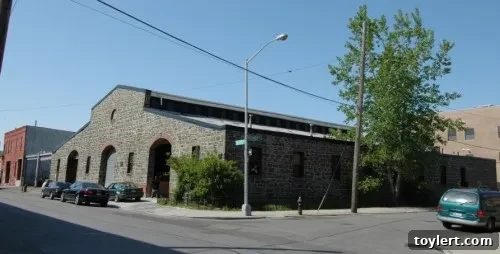
Exploring Brooklyn’s Industrial Heritage: The Story of 76 Van Dyke Street
Brooklyn, a borough renowned for its diverse architecture and rich history, tells countless stories through its buildings. Each structure, from grand brownstones to utilitarian warehouses, holds a piece of the city’s past, evolving with the changing tides of industry, culture, and community. In our ongoing exploration of Brooklyn’s architectural gems, we turn our gaze to a remarkable building that stands as a testament to the borough’s enduring industrial spirit: the former Brooklyn Clay Retort and Fire Bricks Works Storehouse at 76 Van Dyke Street in the vibrant neighborhood of Red Hook.
This building, now home to the innovative Carvart Glass Company, embodies the essence of adaptive reuse, seamlessly blending a storied past with a dynamic present. It represents not just a physical structure but a symbol of Red Hook’s remarkable transformation from a bustling industrial port to a thriving hub of creativity and modern enterprise. Its journey reflects Brooklyn’s broader narrative: a continuous cycle of reinvention, where the echoes of manufacturing prowess meet the demands of contemporary design and living.
A Glimpse into the Past: The Brooklyn Clay Retort and Fire Bricks Works
To truly appreciate 76 Van Dyke Street, one must journey back to a time when Red Hook was a global powerhouse of trade and manufacturing. In the late 19th and early 20th centuries, this waterfront district was a hive of activity, with ships docking from around the world and factories churning out goods that fueled a rapidly industrializing nation. The Brooklyn Clay Retort and Fire Bricks Works was a significant player in this industrial landscape, providing essential materials for a wide array of industries.
Fire bricks, known for their ability to withstand extremely high temperatures, were indispensable in the construction of kilns, furnaces, and ovens used in everything from steel production and glass manufacturing to sugar refining and chemical processing. Clay retorts, specialized vessels often made from refractory clay, were crucial for high-temperature chemical reactions, particularly in gas production, where coal gas was distilled for lighting and heating. The presence of such a facility in Red Hook underscores Brooklyn’s vital role in supplying the foundational elements for America’s industrial growth.
The original storehouse building at 76 Van Dyke Street would have been designed with pure functionality in mind. Characterized by robust construction, thick brick walls, and large, utilitarian windows, these structures were built to endure the rigors of heavy industrial operations. Their architecture, though seemingly simple, speaks volumes about the pragmatic elegance of late 19th-century industrial design. These buildings were not merely shelters; they were integral components of a complex manufacturing ecosystem, facilitating the storage, movement, and processing of raw materials and finished goods.
The strategic location of the Brooklyn Clay Retort and Fire Bricks Works near the waterfront was no accident. Red Hook’s deep-water port provided unparalleled access for importing raw materials, such as specific types of clay, and for exporting heavy, finished products to markets far and wide. This synergy between land-based manufacturing and maritime transport was the lifeblood of Red Hook, making it a pivotal economic engine for Brooklyn and beyond. The building at 76 Van Dyke Street, therefore, stands as a silent witness to an era when Brooklyn’s shores buzzed with the sounds of industry and innovation.
The Evolution of Red Hook and the Building’s Transition
As the 20th century progressed, economic landscapes shifted dramatically. The decline of heavy manufacturing in New York City and the rise of container shipping, which favored larger, more automated ports, led to a gradual downturn in Red Hook’s traditional industrial activity. Many factories and warehouses, once teeming with workers, fell silent or were abandoned. For decades, Red Hook faced economic challenges, with its magnificent industrial infrastructure sitting underutilized, a relic of a bygone era.
However, the inherent strength and character of these industrial buildings, including the former Brooklyn Clay Retort and Fire Bricks Works Storehouse, proved to be their salvation. Their sturdy construction, generous floor plans, and authentic architectural charm began to attract a new wave of entrepreneurs, artists, and residents looking for unique spaces with character. This marked the beginning of Red Hook’s slow but steady revitalization, driven by a spirit of creative adaptation and community resilience.
The building at 76 Van Dyke Street perfectly exemplifies this transformative trend. Its transition from a storehouse for fire bricks and clay retorts to a modern showroom and manufacturing facility for architectural glass is a narrative of rebirth. This adaptive reuse not only preserves the historical fabric of the neighborhood but also injects new life and purpose into structures that might otherwise have been demolished or left to decay. It showcases a forward-thinking approach to urban development, valuing the embodied history and structural integrity of existing buildings.
Carvart Glass Company: A Modern Legacy at 76 Van Dyke Street
Today, the venerable structure at 76 Van Dyke Street proudly houses Carvart Glass Company, a leading innovator in architectural glass. Carvart specializes in designing, fabricating, and installing custom glass solutions for commercial and residential projects, ranging from elegant partitions and doors to sophisticated railing systems and decorative panels. Their work is at the forefront of contemporary interior design and architecture, emphasizing both aesthetics and functionality.
The choice of 76 Van Dyke Street as Carvart’s headquarters and primary operational base is highly symbolic. The building’s industrial heritage provides a dramatic and inspiring backdrop for a company that pushes the boundaries of modern design and material science. The rough, textured brick walls, high ceilings, and expansive windows—features typical of old factory buildings—create an ideal environment for showcasing the sleek, refined beauty of glass. The juxtaposition of industrial grit and modern transparency is visually striking and conceptually rich, telling a story of continuous innovation and respect for craftsmanship across different eras.
Carvart’s presence in Red Hook is also a testament to the neighborhood’s resurgence as a hub for creative industries and specialized manufacturing. Companies like Carvart, which combine high-tech processes with bespoke artistry, find a natural home in Red Hook, benefiting from its unique character, artistic community, and convenient access to both Manhattan and other parts of Brooklyn. They contribute to the local economy, provide skilled jobs, and reinforce Red Hook’s identity as a place where heritage and innovation coexist.
The interior of 76 Van Dyke Street, under Carvart’s stewardship, has likely been thoughtfully renovated to meet the demands of a modern glass company while retaining many of its original architectural features. Exposed brick, structural elements, and the building’s robust industrial bones would be carefully preserved and integrated into a contemporary design scheme. This approach not only honors the building’s past but also creates a unique, inspiring workspace that reflects Carvart’s commitment to quality, design, and a connection to its surroundings.
The Enduring Significance of Adaptive Reuse and Red Hook’s Future
The story of 76 Van Dyke Street, from the Brooklyn Clay Retort and Fire Bricks Works Storehouse to the Carvart Glass Company, is a powerful example of adaptive reuse. This practice is crucial for sustainable urban development, reducing waste, preserving embodied energy in existing structures, and maintaining the historical character of neighborhoods. It allows cities to evolve without erasing their past, creating layered environments that are both functional and rich in narrative.
Red Hook, with its distinct waterfront charm, cobblestone streets, and iconic industrial buildings, stands out as one of Brooklyn’s most unique neighborhoods. Its journey from a forgotten port to a destination for artists, designers, small businesses, and discerning residents is a testament to its enduring appeal. Buildings like 76 Van Dyke Street are more than just structures; they are vital threads in the tapestry of Red Hook’s identity, connecting its gritty, industrious past to its vibrant, creative present and promising future.
As visitors and locals alike wander through Red Hook, they encounter a landscape where history is palpable, yet innovation thrives. The former Brooklyn Clay Retort and Fire Bricks Works Storehouse, now the home of Carvart Glass Company, serves as a beacon of this transformation. It reminds us that Brooklyn’s strength lies not just in its new constructions, but in its ability to reimagine and repurpose its venerable foundations, ensuring that each building, one at a time, continues to tell its remarkable story.