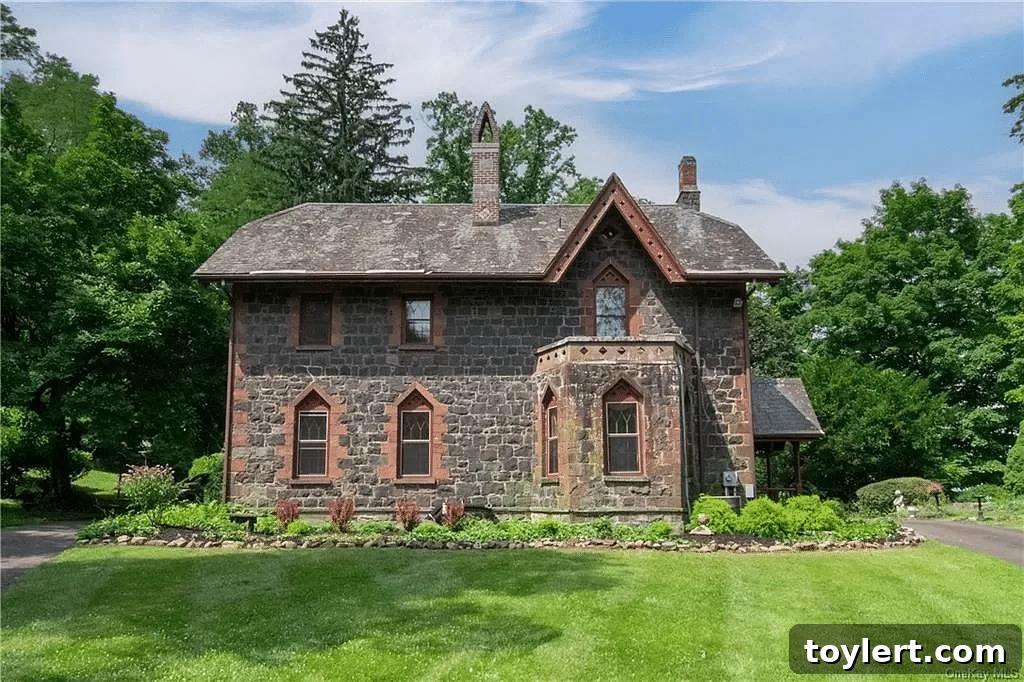
Stonehurst: A Gothic Revival Masterpiece in Historic Sparkill, NY
Nestled within the picturesque hamlet of Sparkill, New York, stands a magnificent stone cottage that whispers tales of a bygone era. Even without a precisely etched construction date, the distinct design details of this remarkable property unequivocally point to its origins in 1865. This exquisite Gothic-inspired cottage represents a pivotal moment in American architectural history, when visionary architects championed a new aesthetic – the Picturesque style. Influential figures such as Andrew Jackson Downing, Alexander Jackson Davis, Calvert Vaux, and Frederick Clarke Withers shaped a national vision for homes that blended seamlessly with nature, exuding charm and character rather than rigid formality. Stonehurst, as this exceptional property is known, is a living testament to their enduring legacy, offering a rare glimpse into a romantic and artistically rich period of American domestic architecture.
The Enduring Appeal of Picturesque Style Architecture
The mid-19th century witnessed a significant shift in architectural tastes across America. Moving away from the neoclassical symmetry that had long dominated, a new movement embraced irregularity, natural materials, and an organic connection to the landscape. This was the Picturesque style, a movement eloquently articulated and popularized by prominent architects and landscape designers. Andrew Jackson Downing, through his influential writings, advocated for homes that were not merely functional but also aesthetically pleasing, inspiring contemplation and a sense of harmony with their surroundings. His contemporary, Alexander Jackson Davis, brought these concepts to life with stunning designs, while Calvert Vaux and Frederick Clarke Withers further refined and disseminated the style, particularly in the creation of suburban and rural residences.
The Picturesque style emphasized asymmetry, varied textures, and intricate detailing, often drawing inspiration from medieval European cottages and villas. The goal was to create a sense of natural beauty, as if the house had grown organically from its site, rather than being imposed upon it. This approach resonated deeply with the romantic ideals of the era, offering an escape from the burgeoning industrialization and a return to simpler, more poetic forms. Homes like Stonehurst became symbols of rustic elegance and a connection to a romanticized past, offering warmth, character, and a unique visual story. Owning a property from this period means not just acquiring a house, but inheriting a piece of this rich cultural and architectural narrative, appreciating the visionaries who sought to infuse everyday living with artistic expression.
Architectural Splendor: A Symphony of Gothic Revival Details
Stonehurst exemplifies the very best of the Picturesque Gothic Revival style, showcasing an array of captivating architectural features that draw the eye and enchant the imagination. The exterior, crafted from rough-faced stone, provides a rugged yet refined texture, grounding the structure firmly in its natural setting while exuding timeless durability. This natural material choice was central to the Picturesque ideal, favoring authenticity over artificiality.
Perhaps the most striking elements are the Gothic arched windows, meticulously ornamented with panels of quatrefoils. These quatrefoils—a classic Gothic motif featuring a symmetrical shape composed of four overlapping circles—add an exquisite layer of intricate detailing, transforming simple windows into works of art. Each arch and panel reflects skilled craftsmanship, allowing light to pour into the interiors while casting beautiful patterns, reminiscent of medieval cathedrals scaled down for domestic charm.
Further enhancing its unique character is the elaborate bargeboard that adorns the gables. This richly carved and often pierced wooden trim along the eaves is a hallmark of Gothic Revival architecture, providing both decorative flourish and protection to the roof edges. The intricate patterns of the bargeboard at Stonehurst speak to a commitment to beauty in every detail, a feature that distinguishes it from more utilitarian structures. Adding to this decorative richness is the prominent quoining—the distinct masonry blocks used to define the corners of the building. These not only provide structural strength but also a striking visual contrast and sense of solidity, emphasizing the cottage’s robust construction.
The roofline itself is a study in picturesque design, featuring a distinctive jerkin head gable. This architectural detail, also known as a half-hipped gable, sees the upper part of the gable end truncated and hipped back, creating a softer, more complex roof profile than a traditional gable. It contributes significantly to the cottage’s unique silhouette and adds to its charming irregularity. Finally, the decorative chimneys, with their detailed brickwork and artistic caps, rise like sculptural elements, serving not just as functional components but as integral parts of the overall aesthetic composition, drawing the eye upwards and completing the harmonious blend of forms and textures. Every single element at 65 Rockland Road contributes to an architectural narrative that is both grand and intimately inviting.
A Glimpse into History: The Dederer Legacy and National Recognition
The historical significance of this exceptional property extends beyond its architectural merits. Listed in the National Register of Historic Places in 2002, the house is recognized under a few distinct names, primarily Stonehurst and the Dederer House. The latter name pays homage to its original builders and first inhabitants, Isaac M. and Ann E. Dederer. The Dederer family played a vital role in the early development of Sparkill, establishing a homestead that would become an enduring landmark.
A historic photograph, reportedly dating to 1867, offers a poignant snapshot of the Dederer family gracefully arrayed on the lawn, perhaps just two years after their architectural dream became a reality. This image captures not just a family, but a moment in time, providing invaluable insight into the lives of those who shaped the community. Census records reveal Isaac M. Dederer as a farmer, a common and essential profession in 19th-century New York. However, his influence extended far beyond agriculture; he was also deeply active in local organizations and politics, indicating a prominent and engaged figure within the burgeoning hamlet of Sparkill. The Dederer House therefore represents not just a family residence, but a hub of community activity and a testament to the pioneering spirit of its original owners.
The Enchanting Hamlet of Sparkill and Its Historic Charms
The hamlet of Sparkill, situated in Rockland County, New York, offers a charming backdrop to Stonehurst. Known for its historical character and scenic beauty, Sparkill provides a tranquil yet connected lifestyle. It’s a place where history is visibly preserved, from its charming main streets to its surrounding natural landscapes. The hamlet’s serene atmosphere, combined with its proximity to larger urban centers, makes it an ideal location for those seeking a peaceful retreat without sacrificing convenience.
Life in Sparkill means embracing a community rich in heritage and surrounded by natural beauty. The area boasts a blend of historical architecture, local businesses, and accessible outdoor recreation, contributing to a high quality of life. For residents of Stonehurst, this means becoming part of a community that values its past while looking towards the future, enjoying both the tranquility of a historic estate and the vibrancy of a close-knit town. The location at 65 Rockland Road offers not just a home, but an immersion into a lifestyle deeply rooted in history and natural charm, an increasingly rare commodity in today’s fast-paced world.
Beyond the Main House: A Complete Historic Estate
The property at 65 Rockland Road is more than just the magnificent main cottage; it encompasses a complete historic estate that enhances its allure and functionality. In addition to Stonehurst itself, the expansive grounds include a charming gatehouse and a substantial barn. The presence of these ancillary structures further solidifies the property’s status as a comprehensive estate from the 19th century.
The gatehouse, often the first impression of the property, typically served as a residence for caretakers or guests. Its design likely echoes the architectural style of the main house, maintaining a cohesive aesthetic across the estate. This structure offers tremendous potential today, whether as a private guest suite, a home office, an artist’s studio, or additional rental income. The barn, a testament to Isaac Dederer’s farming background, represents another versatile space. It could be reimagined for equestrian pursuits, converted into a grand event space, or utilized for extensive storage and workshop needs. These additional buildings not only add significant value and utility to the property but also contribute to the authenticity and completeness of the historic setting, allowing new owners to truly immerse themselves in the legacy of Stonehurst.
An Investment in Legacy: Stonehurst on the Market
This unparalleled piece of American architectural history is currently on the market, presenting a rare and exciting opportunity for discerning buyers. Owning Stonehurst means acquiring not just a residence, but a living piece of art and a tangible connection to the past. It’s an investment in a legacy, a chance to preserve and cherish a home that played a role in shaping American architectural identity and local history.
For those who appreciate the intricate beauty of Gothic Revival architecture, the romantic ideals of the Picturesque movement, and the quiet prestige of a National Register-listed property, 65 Rockland Road offers an incomparable proposition. It appeals to history enthusiasts, connoisseurs of unique design, and anyone seeking a home with profound character and a compelling story. Stonehurst stands ready to embark on its next chapter, awaiting an owner who will appreciate its timeless beauty, respect its rich heritage, and continue its distinguished story within the enchanting hamlet of Sparkill.