The Lost Legacy of Denton’s Mill Pond: Unearthing the Industrial Roots of Gowanus Canal
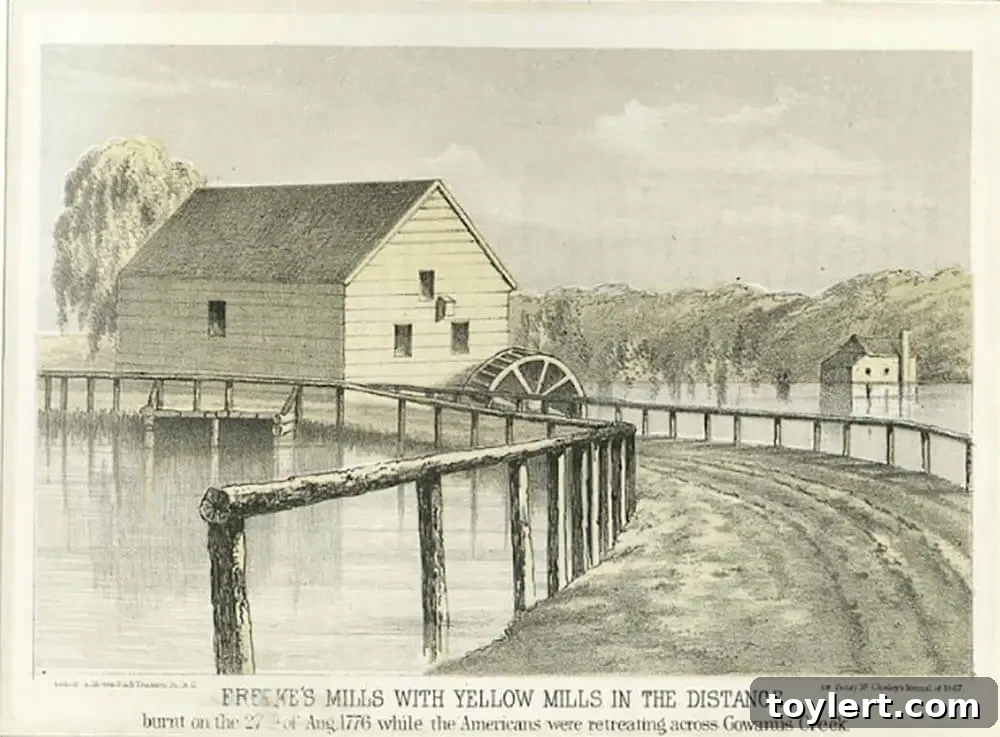
The urban landscape surrounding the Gowanus Canal in Brooklyn today presents a fascinating juxtaposition of historical echoes and vibrant modern development. Where a bustling Whole Foods Market now stands, and the architecturally distinctive, formerly abandoned transit power station known as the Batcave captures the imagination, there once existed a serene, utilitarian feature: Denton’s Mill Pond. This tranquil body of water, pictured in historical records, represents a stark contrast to the canal’s current reputation as a Superfund site and a hub of ongoing urban revitalization. It’s a testament to the profound transformations that have shaped one of Brooklyn’s most enigmatic neighborhoods, illustrating a journey from a verdant, working landscape to a dense industrial corridor, and now, to a burgeoning creative and commercial district.
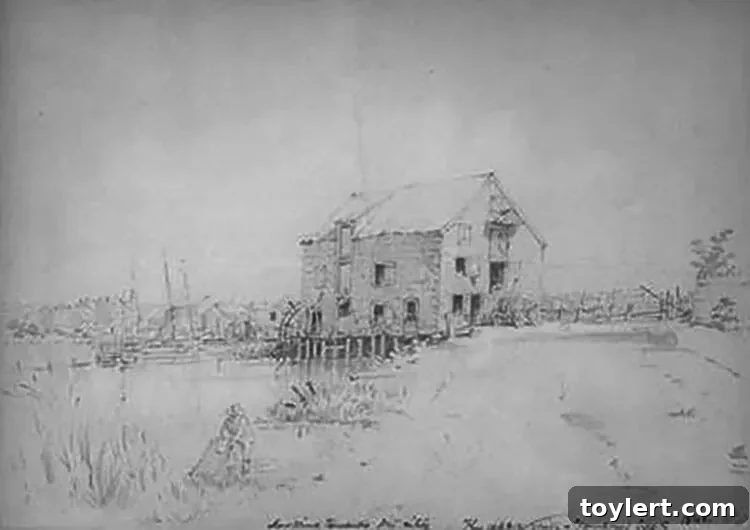
Known variously as Denton’s Mill and Yellow Mill, this significant Colonial-era engineering feat was not merely a picturesque pond but a vital economic engine. Established in 1709, the mill pond was integral to the area’s early industrial activity, serving as the power source for a water mill. The creation of this mill pond involved the ingenious damming of a branch of what was then locally referred to as the “Gowanus Kil.” This “kil” – a Dutch term for a small stream or creek – was the natural waterway that would much later be transformed into the navigable, man-made Gowanus Canal we recognize today. The very concept of a mill pond, a controlled pool of water designed to store energy and regulate the flow necessary to turn a mill wheel, highlights the ingenuity and self-sufficiency of early American settlers in harnessing natural resources for production.
A Glimpse into Colonial Brooklyn: The Birth of Denton’s Mill
The establishment of Denton’s Mill Pond in 1709 marked a pivotal moment in the economic development of what would become Brooklyn. In the pre-industrial era, water mills were indispensable for grinding grain, sawing timber, and powering various other nascent industries. The Gowanus area, with its network of tidal creeks and marshlands, provided an ideal natural setting for such endeavors. By carefully constructing a dam across the “Gowanus Kil,” the early settlers created a reservoir that could consistently drive the mill’s machinery. This technological innovation not only sustained local communities by processing agricultural products but also laid the groundwork for future industrial growth in the region. The alternative name, Yellow Mill, possibly refers to the color of the local clay or the timber processed there, further indicating its functional importance.
Beyond the mill pond itself, the property was a more extensive complex, reflecting the integrated nature of colonial enterprises. Historical accounts, such as Henry Whitmore’s 1833 narrative, The Heroes of the American Revolution and Their Descendants, shed light on the broader estate. Whitmore’s research revealed that the mill property also encompassed a dwelling-house, a crucial component for the mill operator and their family. This residence provided convenience and oversight for the mill’s daily operations. Tragically, this dwelling-house met its demise in 1852, succumbing to a fire – a common fate for wooden structures of the era. The inclusion of such details in historical documents underscores the comprehensive picture researchers strive to build, allowing us to reconstruct not just the physical landscape but also the lives lived within it.
More Than Just a Mill: The Property’s Extent and Revolutionary Echoes
The existence of a dwelling-house alongside Denton’s Mill Pond paints a vivid picture of a self-contained, working homestead, rather than just an isolated industrial site. Such properties were often the centers of local community life, serving as places of commerce, social interaction, and residence. The loss of the dwelling-house in 1852 was likely a significant event for the local community, marking the end of an era for that specific structure, even as the Gowanus area continued its relentless march towards greater industrialization.
Henry Whitmore’s account is particularly valuable because it ties the seemingly mundane details of a mill pond and dwelling-house to events of national significance. Published in 1833, his work, The Heroes of the American Revolution and Their Descendants, suggests that the Denton’s Mill property held relevance within the context of the American Revolutionary War, specifically the Battle of Brooklyn. While the exact role of the mill pond during the battle might not be extensively detailed, its strategic location on the Gowanus Kil undoubtedly made it a point of interest, if not directly involved in the skirmishes. The Gowanus area was central to one of the Revolution’s most critical early engagements, and any significant landmarks within it would have been observed and perhaps utilized by both Continental and British forces. Whitmore’s mention serves as a historical breadcrumb, encouraging deeper exploration into how everyday colonial infrastructure intersected with pivotal historical events.
The Gowanus Canal: From Pristine Creek to Industrial Hub
The transformation of the “Gowanus Kil” into the Gowanus Canal represents a quintessential narrative of American industrial development. What began as a natural creek, suitable for supporting a mill pond, was dramatically altered in the mid-19th century to become a navigable waterway. The primary motivation for this monumental undertaking was economic: to facilitate the transport of goods and raw materials for the rapidly industrializing Brooklyn waterfront. The construction of the canal allowed for barges and larger vessels to access the burgeoning factories, warehouses, and shipping operations that sprung up along its banks. This man-made waterway became a lifeline for industries ranging from gas manufacturing and chemical production to cement plants and slaughterhouses, driving Brooklyn’s prosperity but also profoundly changing its environment. The natural beauty of the mill pond era, characterized by fresh water and presumably healthy ecosystems, gave way to a heavily engineered and increasingly polluted industrial artery. The canal, while a marvel of engineering for its time, eventually earned the infamous moniker of a “lavender lake” due to its contaminated waters, a stark reminder of unchecked industrial waste.
Echoes of the Past: The Gowanus and the American Revolution
The history of the Gowanus area is deeply intertwined with the early struggles of the United States. During the American Revolution, specifically in August 1776, the Battle of Brooklyn (also known as the Battle of Long Island) raged across these very lands. The Gowanus Creek and its surrounding marshes played a critical, albeit tragic, role in the Continental Army’s retreat. Many American soldiers, including General William Alexander (Lord Stirling), were either captured or perished while attempting to cross the Gowanus Creek under heavy fire from British forces. The strategic importance of the area, with its natural barriers and limited crossing points, made it a focal point of military maneuvers. Denton’s Mill Pond, situated along the Gowanus Kil, would have been a recognizable landmark, potentially observed or even used by forces moving through the terrain. Whitmore’s 1833 account, though brief in its mention of the mill property, serves to highlight the enduring significance of this locale in the collective memory of the young nation, connecting the utilitarian colonial infrastructure directly to the grand narrative of American independence.
Modern Gowanus: A Tapestry of History, Revitalization, and Controversy
Today, the Gowanus Canal neighborhood is undergoing yet another profound transformation, perhaps its most ambitious to date. The presence of a Whole Foods Market, a symbol of upscale commercial development, vividly illustrates the gentrification and economic shift occurring in the area. This commercial anchor, along with numerous new residential and mixed-use developments, signals a dramatic departure from the canal’s grittier industrial past. Complementing this commercial evolution is the celebrated Batcave, a former Brooklyn Rapid Transit power substation that, after decades of abandonment and subsequent occupation by artists and urban explorers, is now slated for redevelopment. Its iconic, decaying structure once stood as a powerful visual metaphor for the area’s industrial decline and subsequent artistic reclamation, encapsulating the complex layers of Gowanus history from infrastructure to counterculture.
Central to modern Gowanus is the monumental undertaking of the Superfund cleanup. Designated a Superfund site by the EPA in 2010 due to severe contamination from decades of industrial pollution, the canal is currently undergoing an extensive and costly environmental remediation project. This cleanup is not only addressing the toxic legacy of the past but is also paving the way for further urban development and improved public access to the waterfront. The area’s future is envisioned as a blend of eco-friendly spaces, cultural institutions, and thriving businesses, all while attempting to preserve its unique industrial aesthetic and artistic spirit. The ongoing debates about development, affordability, and the balance between new growth and historical preservation are testament to the complex identity of Gowanus in the 21st century, a far cry from the simple, water-powered Denton’s Mill Pond.
Unearthing the Past: The Role of Historical Societies
The ability to connect with the distant past, to visualize Denton’s Mill Pond and the “Gowanus Kil” as they once were, is largely due to the tireless efforts of institutions like the Brooklyn Historical Society, now known as the Brooklyn Public Library’s Center for Brooklyn History. These repositories of local history play an invaluable role in preserving documents, maps, photographs, and artifacts that would otherwise be lost to time. It is through their meticulously curated archives that researchers can recover beautiful pictures and detailed accounts, allowing us to reconstruct the social, economic, and environmental evolution of urban landscapes. The image of Denton’s Mill Pond is not just a photograph; it’s a window into a bygone era, providing tangible evidence of Brooklyn’s origins and its continuous metamorphosis. Such historical resources are crucial for understanding the foundational elements upon which today’s complex urban environments are built, fostering a deeper appreciation for the layers of history beneath our feet.
The Enduring Legacy of Waterpower and Industry in Brooklyn
Denton’s Mill Pond, though long vanished, stands as a symbolic reminder of the foundational role waterpower played in the early economic development of Brooklyn and indeed, much of early America. Before the advent of steam engines and electrical grids, the energy of flowing water was the primary driver of manufacturing and processing. Mills like Denton’s were not isolated entities but were part of a widespread network that powered local economies, turning raw agricultural products into marketable goods and facilitating basic industrial activities. The transition from these decentralized, natural-resource-dependent mills to large-scale, fossil-fuel-driven factories, and eventually to the sophisticated, diverse industries of today, is a crucial chapter in Brooklyn’s economic narrative.
The story of Denton’s Mill Pond and its subsequent disappearance into the urban fabric of the Gowanus Canal is a microcosm of urban evolution. It highlights how natural landscapes are reshaped by human needs, how technological advancements drive economic change, and how layers of history accumulate, sometimes visibly, often hidden beneath modern infrastructure. Understanding this progression – from a simple mill pond powering a community to a polluted industrial canal, and now to a site of environmental cleanup and ambitious redevelopment – offers profound insights into the dynamic interplay between nature, industry, and urban life in one of New York City’s most storied boroughs.
In conclusion, the journey from the functional serenity of Denton’s Mill Pond in 1709 to the bustling, environmentally challenged, yet rapidly revitalizing Gowanus Canal of today is a compelling narrative of continuous transformation. The very ground beneath Whole Foods Market and near the Batcave holds centuries of stories, from colonial industry and Revolutionary War skirmishes to industrial might and environmental awakening. As Brooklyn continues to evolve, the echoes of Denton’s Mill Pond remind us that even the most urbanized landscapes possess deep historical roots, offering invaluable lessons about progress, preservation, and the enduring spirit of adaptability that defines New York City.