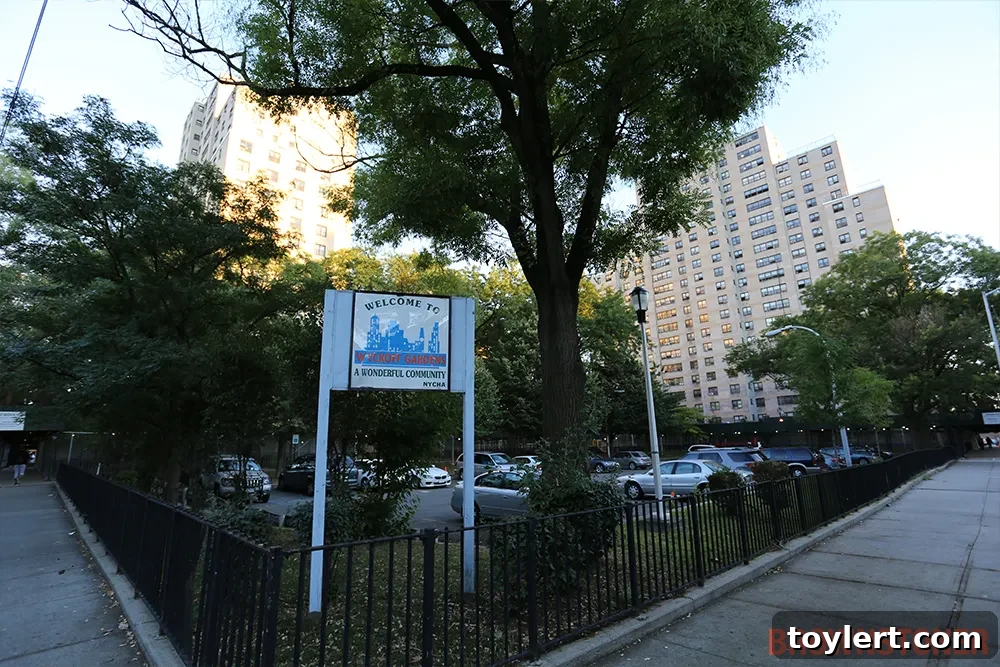
In a move that has sparked significant concern and controversy among residents, the New York City Housing Authority (NYCHA) recently unveiled plans for a new mixed-income residential development within the existing Wyckoff Gardens complex in Boerum Hill, Brooklyn. This initiative, designed to address the city’s persistent affordable housing crisis while generating much-needed revenue for NYCHA, proposes erecting a building on two currently utilized parking lots. The project, as reported by the Daily News, is slated to feature a roughly equal split between market-rate and affordable units, a detail that has immediately raised red flags for the long-term tenants of Wyckoff Gardens.
The announcement itself became a focal point of contention, with residents expressing profound dissatisfaction over the manner in which the information was disseminated. NYCHA Chairwoman Shola Olatoye issued a prerecorded call to tenants on Wednesday evening, preceding the official public disclosure. However, many Wyckoff residents felt that this preliminary communication was gravely deficient in providing critical information. They argued that the call omitted several “salient details” crucial for understanding the full scope and potential impact of the proposed development, leaving them feeling blindsided and unheard.
Crucially, the prerecorded message failed to explicitly inform residents that a substantial new apartment tower would soon be constructed directly on the grounds of their existing public housing complex. Even more significantly, it neglected to specify that this new building would comprise approximately 300 market-rate apartments alongside an equivalent number of affordable housing units. This lack of transparency forced tenants to learn the comprehensive details of the development from various media outlets, rather than directly from the agency responsible for their homes. Such an approach inevitably led residents to draw their own, often negative, conclusions, fostering an atmosphere of distrust and apprehension.
The proposed development at Wyckoff Gardens highlights a complex and often contentious aspect of urban planning in New York City: how to create new affordable housing and generate revenue for cash-strapped public housing authorities without alienating or displacing existing communities. For many residents of Boerum Hill, a neighborhood that has experienced rapid gentrification over the past decades, the introduction of hundreds of market-rate units into their public housing complex stirs deep-seated fears. They worry about the potential for increased property values in the surrounding area, which could, in turn, lead to higher costs of living and a gradual erosion of the community’s established character.
NYCHA, the largest public housing authority in North America, faces immense financial challenges, including a multi-billion dollar repair backlog that impacts the quality of life for hundreds of thousands of New Yorkers. Strategies such as the “NextGen NYCHA” plan have often included initiatives to leverage underutilized land within existing public housing developments for new construction, frequently involving mixed-income projects. The rationale is often that the revenue generated from the market-rate units, or from the lease of the land to a developer, can be reinvested directly into the maintenance and improvement of the existing public housing stock. From NYCHA’s perspective, this is a pragmatic solution to a dire financial situation, aimed at preserving affordable housing for future generations.
However, for the residents of Wyckoff Gardens, the benefits of such a strategy are often overshadowed by immediate concerns. The loss of parking lots, while seemingly minor to outsiders, represents a tangible reduction in a critical amenity for many families. More fundamentally, the prospect of new construction brings worries about increased density, potential strain on local infrastructure—such as schools, public transportation, and community spaces—and a general disruption to their daily lives during the construction phase. There’s also a powerful psychological element: the feeling that their community, built on the premise of public service and affordable living, is now being used as a site for commercial development.
The communication breakdown surrounding the Wyckoff Gardens announcement serves as a stark reminder of the critical importance of genuine community engagement in urban development projects. A prerecorded call, lacking crucial details, is often perceived not as an act of informing, but as a perfunctory step before a decision has already been made. True engagement involves open dialogue, multiple opportunities for feedback, and a clear, transparent explanation of both the benefits and potential drawbacks of a proposal, allowing residents to feel like active participants rather than passive recipients of change.
This incident in Boerum Hill is not isolated; it echoes similar controversies seen in other NYCHA developments across the city where plans for “infill” housing or mixed-income projects have met with resident resistance. The core conflict often lies between the city’s urgent need for more housing, particularly affordable units, and the established communities’ desire to preserve their way of life, amenities, and the existing social fabric. Balancing these competing interests requires more than just administrative announcements; it demands thoughtful planning, robust community outreach, and a willingness to adapt proposals based on local input.
Looking ahead, the response from Wyckoff Gardens tenants underscores a broader sentiment among public housing residents throughout NYC: a demand for respect, transparency, and a seat at the table when decisions are made that directly impact their homes and neighborhoods. While the need for innovative solutions to fund NYCHA’s critical repairs and expand affordable housing options is undeniable, these solutions must be pursued in a manner that builds trust rather than eroding it. The Wyckoff Gardens case will undoubtedly serve as a critical test case for future mixed-income developments in public housing, highlighting the ongoing tension and the indispensable role of tenant advocacy in shaping the future of affordable housing in New York City.