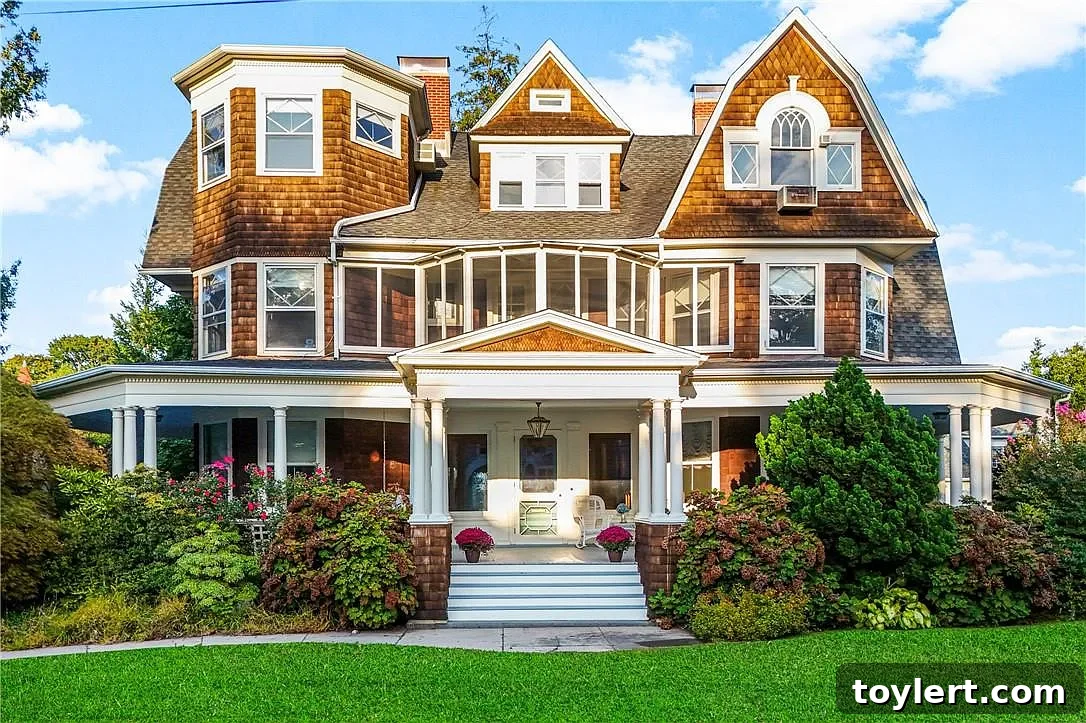
Nestled in the picturesque community of Larchmont, New York, stands a magnificent Shingle Style dwelling, a testament to late 19th-century architectural grandeur and a preserved slice of history. Dating back to the 1890s, this exceptional property was conceived by an architect renowned for his extensive collection of 19th-century pattern books, widely influencing American suburban design. Today, this captivating residence at 71 Beach Avenue in Westchester County proudly retains much of its original character on the exterior, its distinctive shingled facade evoking a sense of timeless charm. Inside, a treasure trove of fine period details awaits, offering a rare glimpse into the elegant lifestyles of a bygone era.
The Shingle Style, a uniquely American architectural movement that flourished between 1880 and 1900, is celebrated for its integration with natural landscapes and its departure from the more ornate Victorian styles. Characterized by its continuous skin of wood shingles, often embracing asymmetrical forms, broad verandas, and complex rooflines, it projected an image of rustic elegance and informal sophistication. This particular home in Larchmont beautifully exemplifies these qualities, blending seamlessly with its coastal surroundings and reflecting the era’s appreciation for craftsmanship and natural materials. It represents a significant architectural style that shaped the aesthetic of America’s burgeoning suburban and resort communities.
The architect behind this captivating design, George Palliser, played a pivotal role in democratizing architectural excellence during his time. Known for his prolific output of pattern books, he brought high-quality, aspirational designs within reach of a broader audience. These books were instrumental in disseminating popular architectural styles across the United States, allowing builders and homeowners to construct well-designed residences without necessarily commissioning an individual architect. Palliser’s designs, often emphasizing comfort, practicality, and aesthetic appeal, resonated deeply with the aspirations of the rising middle and upper classes, who sought homes that were both stylish and functional. This Larchmont home, though a bespoke construction for its original owners, undoubtedly carries the hallmarks of Palliser’s widely admired design philosophy, showcasing the robust and picturesque qualities that defined the Shingle Style.
The land on which this historic house was constructed has its own rich narrative, originating from the expansive holdings of the Larchmont Manor Company. Established in 1872, this visionary company embarked on a transformative project, carving up a former grand estate into hundreds of desirable building lots. Their ambition was to create an exclusive, high-end residential community along the scenic Westchester County waterfront. The strategic subdivision led to the creation of prime waterfront properties, attracting affluent families looking to build substantial homes in a serene, yet accessible, suburban setting. While the initial wave of construction in the 1870s saw the emergence of charming cottages, the subsequent decades witnessed the rise of more imposing and architecturally significant houses, reflecting the popular styles of the time, including the Shingle Style, further solidifying Larchmont Manor’s reputation as a prestigious enclave.
The property’s journey to becoming the esteemed residence it is today is well-documented through historical deeds. Records indicate that this specific lot was sold by the Larchmont Manor Company in January of 1892 to Thomas Henry French. French, a significant landowner in the area, also owned other parcels on the block. However, an 1893 map of the area reveals that only one house had been constructed by that time, suggesting that this particular lot remained vacant for a short period under French’s ownership. Remarkably, French sold this lot later in the same year, indicating a quick turnover. The property changed hands again in 1897, still as an undeveloped parcel, awaiting its future transformation. It was then that the stage was set for its true beginning.
The year 1897 marked a turning point for 71 Beach Avenue. According to the deed, the new owner was Mamie de Cordova. Along with her husband, Aaron de Cordova, a prominent stockbroker, Mamie finally set about constructing the house that stands on the property today. The de Cordovas, likely drawn to Larchmont Manor’s burgeoning prestige and beautiful waterfront, envisioned a home that would reflect their social standing and appreciation for fine architecture. Their decision to build a substantial Shingle Style residence, embodying the elegant designs popular at the turn of the century, contributed significantly to the architectural character of Beach Avenue. It was under their patronage that George Palliser’s vision, or a design inspired by his popular pattern books, was brought to life, transforming an empty parcel into a grand family home. The de Cordovas’ investment marked the genesis of this historic dwelling, imbuing it with a legacy that continues to captivate residents and admirers alike.
Today, the residence at 71 Beach Avenue stands as a vibrant testament to Larchmont’s rich past and the enduring appeal of quality architecture. Its exterior, clad in its characteristic shingles, continues to exude the natural, understated elegance of its original design. The craftsmanship evident in its broad gables, distinctive fenestration, and flowing lines speaks volumes about the attention to detail prevalent in its construction. Inside, the house preserves an array of exquisite period details that transport visitors back to the late 19th century. From intricate woodwork and meticulously crafted fireplaces to original built-in cabinetry and perhaps preserved stained glass, these elements are not merely decorative but tell a story of artistic expression and domestic life from over a century ago. Preserving these features is crucial, as they contribute immensely to the home’s historical integrity and provide an authentic connection to its origins. They allow current and future occupants to appreciate the aesthetic sensibilities and lifestyle of its first inhabitants.
Living in a home like 71 Beach Avenue offers a unique opportunity to connect with history while enjoying modern comforts. It is more than just a house; it is a piece of Larchmont’s architectural heritage, a tangible link to the vision of the Larchmont Manor Company, the design genius of architects like George Palliser, and the aspirations of families like the de Cordovas. The blending of historical significance with the vibrant contemporary community of Larchmont makes this property truly exceptional. It stands as a beacon for architectural preservation, demonstrating how timeless design can adapt and thrive through generations. This Shingle Style gem continues to captivate, offering a tranquil and sophisticated retreat that embodies the very essence of coastal Westchester living.
In conclusion, the Shingle Style dwelling at 71 Beach Avenue in Larchmont, New York, represents a rare confluence of architectural mastery, historical development, and enduring charm. Designed by an architect whose influence permeated the late 19th-century American landscape through widely accessible pattern books, and built on land meticulously developed by the Larchmont Manor Company, this home embodies an era of significant growth and aesthetic refinement. Its journey from an undeveloped lot to a celebrated residence under the patronage of Mamie and Aaron de Cordova is a fascinating chapter in local history. Today, with its meticulously preserved exterior and captivating interior details, it continues to stand as a proud symbol of Larchmont’s architectural legacy, offering a unique opportunity to own and experience a living piece of American design history.