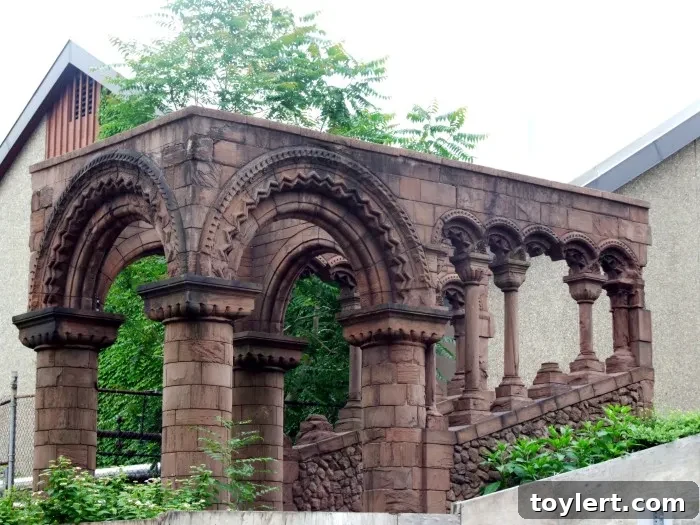
The Enduring Legacy of the Children’s Portico at Pratt Institute, Brooklyn
Brooklyn, one landmark at a time. Dive into the rich architectural tapestry of Brooklyn, where every building tells a story, and some structures stand as testaments to evolving educational philosophies and community spirit. Among these cherished historical gems is the Children’s Portico at Pratt Institute, a site that beautifully encapsulates the institute’s long-standing commitment to innovation, community engagement, and the holistic development of its students and the surrounding neighborhood.
Name: The Children’s Portico at Pratt Institute
Nestled within the vibrant Fort Greene neighborhood of Brooklyn, the Pratt Institute stands as a beacon of artistic and intellectual endeavor. Founded in 1887 by industrialist Charles Pratt, the institute was established with a progressive vision: to offer practical and theoretical education to a diverse student body, preparing them for successful careers and responsible citizenship. This visionary approach extended beyond traditional classroom settings, often manifesting in unique architectural spaces designed to foster specific learning environments or serve the broader community. The Children’s Portico is a prime example of such forward-thinking design, embodying a blend of architectural grace and purposeful utility, making it a significant piece of Brooklyn’s architectural heritage.
A Glimpse into Pratt’s Progressive History and Architectural Vision
From its inception, Pratt Institute has been a pioneer in higher education. Charles Pratt believed strongly in education that blended academic rigor with practical skills, creating a polytechnic institute long before the concept became widespread. The campus itself is a testament to various architectural styles and evolving educational needs. Buildings like the historic Main Building, the innovative Higgins Hall, and the foundational Library are not just structures; they are historical artifacts reflecting the institute’s growth and its profound architectural contributions to Brooklyn. The presence of a “Children’s Portico” within this prestigious campus hints at a deeper narrative concerning community outreach, early childhood education, or perhaps even a specific design experiment that integrated child-centric spaces into an academic environment, showcasing Pratt’s commitment beyond its immediate student body.
The turn of the 20th century saw significant developments in educational psychology and the understanding of child development. Progressive educators advocated for learning environments that were open, stimulating, and child-friendly. It is within this historical context that a structure like the Children’s Portico likely emerged. Whether it served as a dedicated nursery school, a safe and inspiring space for children of faculty and students, or an experimental laboratory for early childhood education students, its very existence underscores Pratt’s holistic approach to education and its commitment to nurturing future generations and fostering community ties. This initiative reflects a broader societal shift towards recognizing the importance of early childhood development, a concept Pratt Institute embraced with architectural conviction.
Architectural Significance and Design Philosophy of the Portico
While specific details about its original architect might require deeper historical archives, the Children’s Portico, by its very name, suggests a classical or neo-classical influence, often characterized by a stately entrance supported by columns. Such architectural features were common in institutional buildings of the late 19th and early 20th centuries, imbuing them with a sense of grandeur, stability, and permanence. A portico also inherently provides a sheltered outdoor space, suggesting a design intended for children to play, learn, or gather, offering protection from the elements while encouraging outdoor activity and connection with nature.
The design would likely have prioritized natural light and ample ventilation, crucial elements for healthy and stimulating learning environments for young children. Materials would have been selected for their durability and robustness, capable of withstanding the rigors of playful children while maintaining an aesthetic appeal consistent with the institute’s overall design standards. Imagine sturdy brickwork or meticulously crafted stone, large, inviting windows to maximize daylight, and perhaps decorative elements that, while classical in form, subtly incorporated motifs appealing to a younger audience or reflected the artistic sensibilities fostered by Pratt’s renowned design programs. The careful integration of such a structure within the main campus speaks volumes about the institute’s philosophy: that children’s spaces are not ancillary but integral to a thriving academic and community ecosystem, a testament to thoughtful urban planning and educational design.
The architectural choice of a portico might also symbolically represent a gateway – a welcoming and distinguished entrance for young minds into a world of learning, creativity, and exploration. It could have been designed to be a less intimidating, more accessible entry point for children into the larger, often imposing academic environment of Pratt Institute, effectively bridging the gap between the comforts of home and the structured environment of formal education. This thoughtful design consideration highlights a humane approach to institutional architecture, focusing on the user experience from the earliest age.
The Portico’s Evolving Role and Profound Community Impact
Over the decades, the function of the Children’s Portico may have evolved considerably, reflecting dynamic changes in educational policy, shifting community needs, or the institute’s own programmatic offerings. Initially, it might have served as a groundbreaking kindergarten or daycare facility, offering a safe, stimulating, and educationally rich environment for the children of faculty, staff, and perhaps even local Brooklyn families. Such a facility would have been an invaluable asset, allowing parents to pursue their academic or professional endeavors at Pratt with peace of mind, knowing their children were in a supportive and expertly managed educational setting. This pioneering role would have cemented Pratt’s reputation as an institution deeply integrated with and responsive to its community.
Beyond its primary function, the Portico could have also served as a living laboratory for Pratt’s diverse student body in fields such as early childhood education, architecture, interior design, or even art education. Students could observe child development, participate in educational activities, and apply theoretical knowledge in a real-world, dynamic setting, making the Portico a vibrant and interactive space for both young learners and future educators and designers. This interdisciplinary approach is very much in line with Pratt’s ethos, fostering practical experience alongside academic study and promoting a holistic view of education that benefits all age groups.
In more recent times, the building might have been thoughtfully repurposed to meet contemporary needs. It could house administrative offices, vibrant student common areas, or specialized academic programs that continue Pratt’s legacy of innovation. Regardless of its current utility, its historical significance as a space originally dedicated to children’s well-being and education remains a poignant reminder of Pratt’s deep roots in community service and progressive educational ideals. Preserving such structures is vital, as they offer tangible links to an institution’s past and its enduring values, providing lessons in adaptive reuse and historical continuity within the bustling urban landscape of Brooklyn.
Pratt Institute: An Architectural Gem in the Heart of Brooklyn
The Pratt Institute campus itself is an architectural marvel, a meticulously curated collection of buildings that collectively narrate the story of Brooklyn’s industrial and cultural growth. From the robust Romanesque Revival of the Main Building to the sleek modernist lines of newer additions, the campus is a living museum of architectural styles, each contributing to its unique aesthetic. The Children’s Portico, while perhaps more modest in scale compared to some of its grander neighbors, contributes significantly to this diverse architectural landscape. It represents a particular moment in time when the needs of the youngest members of the community were carefully considered in institutional design, showcasing a forward-thinking approach to campus planning and social responsibility.
Located in Fort Greene, a neighborhood renowned for its picturesque historic brownstones, lush tree-lined streets, and vibrant cultural scene, Pratt Institute is not just an academic institution but an integral, defining part of Brooklyn’s identity. Its presence has profoundly shaped the cultural, intellectual, and economic life of the borough for over a century. Buildings like the Children’s Portico serve as a historical footprint, detailing how institutions adapt and serve their communities, reflecting broader societal changes in urban development, educational thought, and the evolving role of academic institutions within their urban contexts. They are silent storytellers of progress and community integration.
Preserving History, Inspiring Futures: The Lasting Impact
The preservation of historical buildings like the Children’s Portico is crucial for several compelling reasons. Firstly, they provide a physical and tangible connection to the past, allowing future generations to understand the context and evolution of educational practices, architectural styles, and societal values. Secondly, they contribute immeasurably to the unique character, charm, and authenticity of Brooklyn, distinguishing it from other urban landscapes and enriching its sense of place. Finally, they serve as powerful sources of inspiration, demonstrating how thoughtful and empathetic design can cater to specific human needs, even those of the youngest and most vulnerable members of society, fostering an environment of care and consideration.
The Children’s Portico at Pratt Institute stands as more than just a structure; it is a symbol of innovation, profound community care, and an enduring educational vision. It reminds us that even grand academic institutions often harbor small, dedicated spaces designed with a profound and specific purpose, reflecting a holistic approach to development. As visitors and residents traverse the beautiful and historic campus of Pratt Institute, the Portico offers a silent but powerful narrative of a time when the importance of creating dedicated, well-designed environments for children was recognized as a cornerstone of societal progress. Its legacy continues to enrich the story of Brooklyn and the illustrious history of Pratt Institute, serving as a beacon of thoughtful design and community engagement.
This architectural landmark, though perhaps understated in its appearance compared to some of its more imposing counterparts, holds a powerful narrative within its walls and columns. It speaks eloquently to the comprehensive and empathetic approach Pratt has always taken towards education and community involvement, ensuring that every facet of human development, from early childhood onward, is given due consideration. The Children’s Portico is a timeless testament to the idea that thoughtful design and a nurturing environment can profoundly shape lives, reflecting a timeless commitment to fostering growth, creativity, and well-being across all ages and within the vibrant heart of Brooklyn.