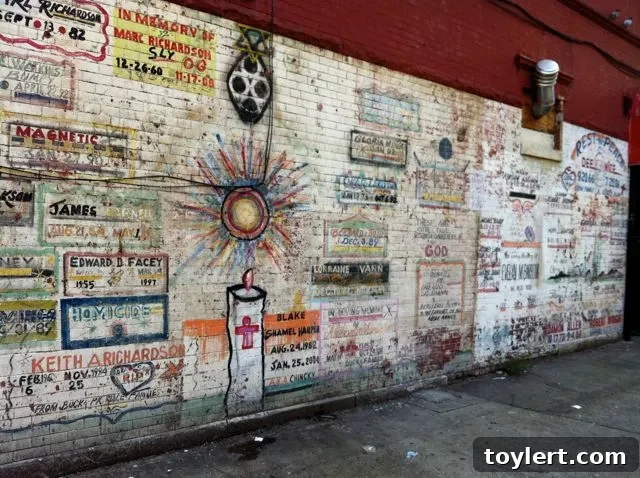
In the vibrant and ever-evolving landscape of Brooklyn, community murals stand as powerful, often poignant, testaments to the ebb and flow of urban life. One such mural, located prominently at the corner of Nostrand Avenue and Park Place in Crown Heights, has become the subject of a compelling and heartfelt discussion. Painted on the side of a local bodega, this mural isn’t merely a splash of color on a brick wall; it’s a profound historical document, commemorating the lives and untimely deaths of approximately fifty individuals from the surrounding neighborhood, whose stories unfolded between the 1990s and roughly 2006.
This particular piece of public art is unique in its scope. While many neighborhood memorials celebrate a single individual or a small group, the Nostrand Avenue mural offers a panoramic, if somber, view of an entire era. Most of those honored were young men, tragically losing their lives before reaching the age of 25. Yet, the mural also acknowledges others who lived longer, some decades older, and, heartbreakingly, some who were mere children. The overarching narrative suggests that these lives were largely claimed by the violence and fierce turf wars that gripped the community during the height of the drug trade. These murals, unofficial monuments to loss and remembrance, are a common sight across Brooklyn’s historically rich neighborhoods like Bed-Stuy, Clinton Hill, and Crown Heights, reflecting a deep-seated need for communities to process grief and honor their departed.
The strategic placement of this particular mural, directly alongside the entrance to an active daycare center, adds another layer of complexity to the ongoing conversation. The presence of young, impressionable children daily passing by a stark reminder of past tragedies naturally sparks questions about its appropriateness and enduring purpose. Currently, there is no official indication that the mural is slated for removal or that the building itself is changing ownership. However, the online discourse, particularly within local forums like Brooklynian, reveals a potent debate about whether such a mural, a vivid chronicle of a vastly different, more violent chapter in Crown Heights’ history, continues to serve a meaningful function in today’s radically transformed neighborhood.
A Window into Crown Heights’ Past: The Context of Remembrance
To fully grasp the significance of the Nostrand Avenue mural and the intense discussions surrounding its future, one must delve into the historical context it represents. The 1990s and early 2000s were challenging decades for many inner-city neighborhoods across America, and Crown Heights was no exception. It was a period marked by systemic issues, economic disparities, and the devastating impact of the crack cocaine epidemic. The drug trade fueled a cycle of violence, leading to turf wars that claimed countless lives, predominantly among the youth. These weren’t just statistics; they were sons, brothers, friends, and neighbors whose potential was tragically cut short. The mural, therefore, is more than just names and dates; it’s a visceral representation of community trauma, resilience, and the desperate human need to remember those swept away by circumstances beyond their control.
Community-led murals emerged as a powerful grassroots response to this era of hardship. Lacking formal recognition or state-sponsored memorials, residents took to the walls of their neighborhoods to create their own acts of remembrance. These murals served multiple purposes: they provided a space for public grieving, offered a visual warning to future generations about the consequences of violence, and ensured that the individuals lost were not forgotten. They became markers of identity, etched into the urban fabric, speaking volumes about the community’s struggles and its enduring spirit.
Crown Heights Today: A Neighborhood Transformed
Fast forward to the present day, and Crown Heights has undergone a dramatic metamorphosis. The neighborhood, like much of central Brooklyn, has experienced significant gentrification and urban renewal. Crime rates have fallen considerably, transforming areas once deemed unsafe into desirable residential zones. New businesses, cafes, and diverse populations have moved in, bringing with them different expectations and perspectives on urban spaces. The era of rampant drug-related violence that the Nostrand Avenue mural so starkly depicts now feels like a distant memory, almost a different world, to many of the neighborhood’s newer residents and even to younger generations who have grown up in a safer environment.
This stark contrast between past and present forms the crux of the debate. As Crown Heights strives to embrace its newfound stability and prosperity, questions inevitably arise about how to reconcile its painful past with its optimistic future. Does a mural commemorating violence detract from the neighborhood’s current image? Does it serve as an unwelcome reminder of a chapter that many wish to leave behind? Or, conversely, is its historical weight precisely what makes it invaluable?
The Heart of the Debate: Preservation vs. Progress
The conversation swirling around the Nostrand Avenue mural touches upon universal themes of memory, healing, and urban development. On one side are those who advocate for its preservation, viewing it as an indispensable part of Crown Heights’ historical narrative. They argue that the mural stands as a crucial warning, a tangible reminder of the devastating human cost of violence and the drug trade. To erase it would be akin to whitewashing history, an arrogant attempt to deny the struggles faced by previous generations and the lives lost in the process. For them, the mural is a sacred space, honoring individuals whose lives mattered, regardless of the circumstances of their deaths. It represents a form of collective memory, a public acknowledgment of pain and resilience that should not be forgotten, but rather learned from. Its proximity to a daycare, for some, offers an opportunity for parents and educators to discuss difficult histories, fostering empathy and understanding among the next generation.
On the other side are those who believe the mural has served its purpose and that its time has come and gone. They contend that in a neighborhood striving for a positive future, constantly confronting images of death and violence can be counterproductive. For new residents, who may not have lived through those turbulent times, the mural might be perceived as a symbol of urban decay rather than a historical lesson. Some argue that for the community to truly move forward and shed the stigma of its past, certain painful reminders might need to be retired. The presence of such a somber memorial next to a children’s daycare, they suggest, could be unsettling, even inappropriate, for very young children. Their perspective often emphasizes progress, healing, and the creation of new narratives that reflect the present vibrancy and future aspirations of Crown Heights.
This isn’t merely a local dispute; it resonates with broader questions about how societies choose to memorialize difficult histories. Who has the authority to decide what parts of a community’s past are preserved and what aspects are allowed to fade? Is it disrespectful to the deceased to desire a different visual landscape, or is it a natural evolution of a community seeking peace and positive identity?
The Enduring Power of Public Art and Collective Memory
Ultimately, the debate over the Nostrand Avenue mural encapsulates the complex interplay between urban development, community identity, and the enduring power of public art. These murals are more than just paint on a wall; they are living artifacts, imbued with the stories, grief, and hopes of a community. They force us to confront uncomfortable truths, to remember lives that might otherwise be overlooked, and to consider the profound impact of socio-economic factors on human lives.
Whether the mural remains as a solemn warning, a marker of profound historical significance, or eventually gives way to a new expression of Crown Heights’ evolving identity, the conversation it sparks is invaluable. It compels residents, old and new, to reflect on their shared history, to grapple with difficult memories, and to articulate their vision for the future of their cherished neighborhood. Do these powerful murals continue to hold a vital place and serve a meaningful purpose in neighborhoods that have moved more than a decade beyond their most crime-ridden eras? Is it genuinely disrespectful or arrogant to envision a future that perhaps moves beyond such stark reminders of pain, or is it an essential step in collective healing and progress? The answers remain as complex and layered as the history etched onto the walls of Crown Heights itself.
Should the Shrine at Nostrand and Park Place R.I.P.? [Brooklynian]