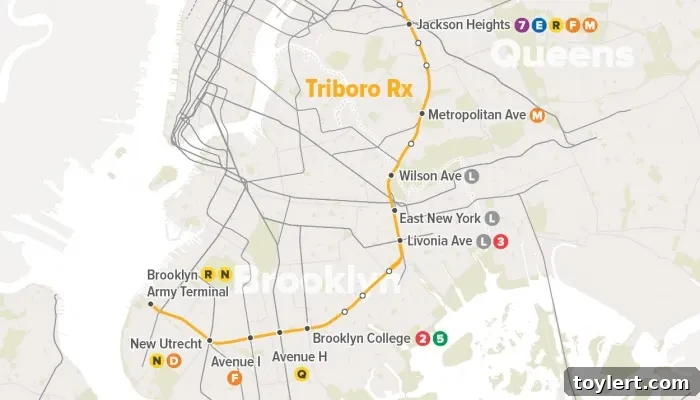
Revolutionizing Outer Borough Transit: The Vision of the Triboro Rx (X Line)
For too long, residents of New York City’s vibrant outer boroughs have contended with a transportation paradox: living in one of the world’s most extensive subway systems, yet often finding inter-borough travel an arduous and time-consuming endeavor. While increased tolls continue to spark debate, a far more impactful solution looms on the horizon – the proposed Triboro Rx line, affectionately known as the X. This ambitious transit project promises to fundamentally transform how Brooklynites, Queens residents, and Bronx inhabitants navigate their city, knitting together currently hard-to-reach spots and fostering unprecedented connectivity.
The Triboro Rx isn’t just another subway line; it’s a game-changer designed to bridge geographical divides that have long frustrated commuters and hindered economic growth outside Manhattan. Imagine a future where traversing the vast landscapes of these dynamic boroughs is as seamless as a quick ride, rather than a multi-transfer odyssey. This vision offers a powerful answer to the perennial question of how to move beyond a Manhattan-centric transit model and truly unlock the potential of New York City’s diverse neighborhoods.
Addressing Decades of Commute Woes in the Outer Boroughs
Anyone who lives in the outer boroughs understands that certain routes are practically unfeasible by public transport, making a car or bike the only practical options. Consider the journey from the charming brownstones of Park Slope in Brooklyn to the bustling streets of eastern Bed-Stuy. What should be a relatively short distance often devolves into a labyrinthine trip involving multiple subway lines, extensive waiting times, and often an indirect route through Manhattan or a long bus ride. The current transit infrastructure, largely built with a focus on channeling commuters into and out of Manhattan, simply fails to adequately serve the needs of direct inter-borough travel.
Even more striking is the stark contrast in travel times for journeys like Bushwick, Brooklyn, to Jackson Heights, Queens. This route, a mere 15 minutes by car under ideal conditions, can stretch to a staggering hour and a half via the subway, demanding two or even three transfers across different lines. Such inefficiencies don’t just consume precious time; they create invisible barriers, limiting access to jobs, education, cultural institutions, and recreational opportunities that lie just a borough away. These inefficiencies are not merely an inconvenience; they represent a significant drag on quality of life and economic mobility for millions of New Yorkers.
The Vision: What is the Triboro Rx (X Line)?
The Triboro Rx line proposes to utilize existing freight rail lines, largely unused for passenger service, to create a sprawling arc of a subway line that would bypass Manhattan entirely. This innovative approach would repurpose infrastructure that already exists, significantly reducing some of the typical construction challenges associated with new subway tunnels. The X line would essentially run along an eastern arc, connecting southern Brooklyn, through central Queens, and into the southern Bronx, creating a vital orbital link.
This ambitious proposal envisions a continuous service that would “knit together” communities that are currently disconnected by inconvenient and circuitous public transit options. From Bay Ridge and Sunset Park in Brooklyn, through key hubs in Queens like Astoria, Long Island City, Woodside, and ultimately into the Bronx neighborhoods such as Hunts Point and Co-op City, the X line would forge unprecedented direct connections. It represents a paradigm shift from the current “hub and spoke” system, offering a true “ring” of connectivity that promises to redefine urban mobility for millions.
Unlocking Unprecedented Benefits: The Impact of the X Line
The implementation of the Triboro Rx line would usher in a new era of connectivity and efficiency for New York City, delivering a multitude of benefits across various sectors:
Significantly Reduced Commute Times and Enhanced Convenience
The most immediate and tangible benefit for commuters would be a dramatic reduction in travel times. Imagine the Bushwick-to-Jackson Heights journey cut from 90 minutes to perhaps 20-30 minutes, or a trip from Bay Ridge to Astoria taking minutes instead of an hour-plus. By eliminating the need for circuitous routes through Manhattan and multiple transfers, the X line would free up countless hours for residents, allowing them to spend more time with family, pursue hobbies, or simply relax. This enhanced convenience would make inter-borough travel a practical and attractive option for daily commutes and casual trips alike.
Fostering Economic Growth and Job Accessibility
Improved transit directly translates to economic opportunity. The X line would unlock new labor markets, allowing residents of one borough to access job opportunities in another without enduring prohibitive commutes. This expanded access to employment would stimulate local economies, support small businesses, and potentially reduce unemployment rates in underserved areas. Furthermore, by making previously remote areas more accessible, the Triboro Rx could catalyze real estate development and urban renewal along its route, fostering vibrant new commercial and residential hubs. Businesses would benefit from a wider pool of talent, and consumers would have easier access to diverse markets.
Promoting Environmental Sustainability and Reducing Traffic Congestion
A more efficient public transportation system is a greener transportation system. By offering a viable alternative to car travel for inter-borough trips, the Triboro Rx would significantly reduce the number of vehicles on the road. This would lead to a tangible decrease in traffic congestion, particularly on arterial roads and bridges connecting the boroughs. Consequently, New York City would see a reduction in carbon emissions and other pollutants, contributing to cleaner air and a healthier environment. It aligns perfectly with global efforts to promote sustainable urban living and combat climate change.
Enhancing Social Equity and Community Development
For many New Yorkers, lack of adequate transit is a barrier to upward mobility and full participation in city life. The X line would enhance social equity by providing better access to essential services, educational institutions, healthcare facilities, and cultural attractions for residents across the outer boroughs. Communities that have felt isolated due to poor transit connections would suddenly become more integrated into the broader fabric of the city. This improved access can lead to better educational outcomes, improved health, and a stronger sense of community pride and belonging.
Relieving Pressure on Existing Manhattan-Bound Lines
While not its primary goal, the Triboro Rx could indirectly alleviate some of the pressure on existing, often overcrowded, subway lines that funnel into Manhattan. By providing a compelling alternative for lateral travel, it might slightly reduce the number of passengers making unnecessary trips through Manhattan simply to get from one outer borough to another. This could contribute to a more balanced distribution of ridership across the entire MTA network.
Challenges and the Path Forward for the Triboro Rx
While the vision for the Triboro Rx line is compelling, its realization is not without significant challenges. Foremost among these is securing adequate funding, as large-scale infrastructure projects in New York City often run into billions of dollars. Political will and broad public support will also be crucial in navigating the complex planning, environmental reviews, and regulatory hurdles. Integration with the existing MTA fare system and operational protocols will require careful consideration, as will mitigating potential disruptions during the construction phase.
However, the long-term benefits far outweigh these short-term obstacles. The Triboro Rx represents a forward-thinking investment in the future of New York City, demonstrating a commitment to building a more connected, equitable, and sustainable metropolis. It’s a testament to urban planning that looks beyond immediate needs to create lasting infrastructure that serves generations.
The Future of NYC Transit: A Call for Innovative Solutions
As New York City continues to grow and evolve, its transportation infrastructure must adapt to meet the demands of its diverse population. The Triboro Rx line is more than just a proposed subway route; it’s a symbol of what’s possible when urban planners and policymakers dare to dream big and challenge existing paradigms. By focusing on inter-borough connectivity, the X line offers a powerful model for how major cities can decentralize their transit systems and create more efficient, resilient, and inclusive urban environments.
The time is ripe to move beyond the limitations of increased tolls and incremental adjustments. The comprehensive and transformative potential of the Triboro Rx demands serious consideration and robust support. For the millions of New Yorkers living in Brooklyn, Queens, and the Bronx, the X line promises not just a faster commute, but a more connected city, opening up new horizons for work, leisure, and community engagement. It is an investment not just in tracks and trains, but in the future prosperity and livability of the entire metropolitan area, ensuring that New York remains a world leader in innovative urban development.