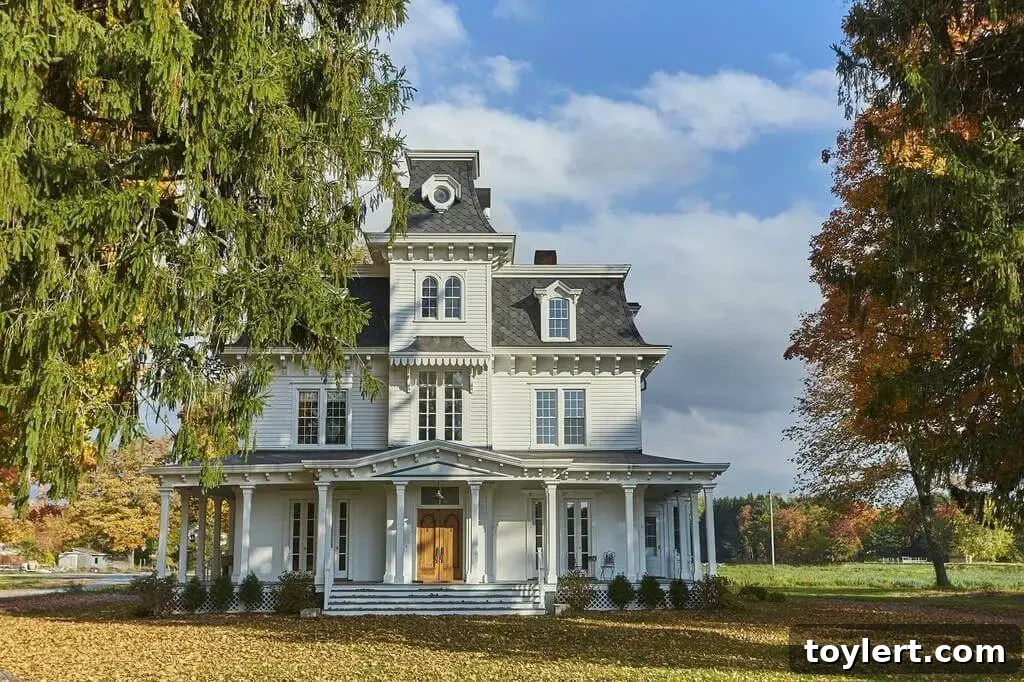
Nestled on a sweeping expanse of emerald lawn, bordered by the serene beauty of surrounding farmland, stands a magnificent Second Empire-style manse that effortlessly transports one back to a more elegant era. Imagine, if you will, the gentle sway of a covered porch, the distant rumble of a horse-drawn carriage ascending a long, tree-shaded drive, and the quiet contemplation of a New Yorker seeking refuge from the summer heat of the 19th century. This captivating historic home in Red Hook, New York, is not merely a structure; it is a living testament to a bygone age, boasting a wealth of original details that whisper stories of the past, including some atmospherically preserved interiors that bear the beautiful patina of time.
The architectural grandeur of 14 Linden Farms Lane is undeniable. Currently on the market, this residence is a near-perfect embodiment of the Second Empire style, a period of design celebrated for its opulence and distinctive features. Its most defining characteristic, the elegant mansard roof, immediately commands attention, providing both visual appeal and practical benefits such as expanded attic space. Complementing this are the meticulously crafted bracketed cornices, adding a layer of sophisticated detailing beneath the eaves. A prominent rectangular central tower pierces the roofline, lending an imposing silhouette, while grand, inviting porches wrap around the exterior, promising delightful al fresco moments. While the house splendidly retains its period authenticity, a discerning eye might note the subtle absence of cresting along the tower and roofline – a common decorative flourish that would have added yet another touch of Victorian exuberance to its already impressive facade.
Stylistically, the house strongly suggests a construction period spanning the late 1860s to the 1870s, a decade when the Second Empire style, with its origins in Napoleonic France, reached the zenith of its popularity across the United States. This architectural movement, often associated with prosperity and status, saw a surge in grand public buildings and private residences adopting its distinctive features. However, intriguing historical records offer a slight discrepancy: while the current listing boldly claims a construction date of 1856, cartographic evidence tells a slightly different tale. An 1858 map of the Red Hook area, a valuable window into the past, does not appear to indicate a structure at this specific location. Yet, a subsequent 1867 map decisively shows a house positioned gracefully off the semi-circular drive that we now recognize as Linden Farm Lane. This historical mapping suggests a construction closer to the mid-1860s, aligning more closely with the peak of the Second Empire’s influence in American architecture.
The earliest documented association with the property on the 1867 map points to Abraham Staats. However, historical research suggests that this grand residence likely formed a vital part of the much larger “Homestead Farm” belonging to his father, Henry Staats. Henry, a formidable figure of his time, resided in his own substantial home situated just to the north of this property. Contemporary accounts painted Henry Staats as a man of considerable energy, influence, and wealth, a true titan of his community. Yet, even great men have their weaknesses. One rather blunt assessment from the period, while acknowledging his achievements, lamented his overly generous nature towards his sons. These sons, it was noted, regrettably “had not inherited his faculty for making and saving money.” This candid observation provides a fascinating, human glimpse into the family dynamics behind what must have been a significant and prosperous estate, hinting at the challenges of maintaining inherited wealth across generations in the burgeoning American economy.
The allure of the Second Empire style lies in its inherent sense of grandeur and formality, a direct influence from the reign of Napoleon III in France. Architects of this era drew inspiration from the Louvre Museum’s additions, popularizing a rich vocabulary of architectural elements that projected an image of sophistication and prosperity. The mansard roof, named after French architect François Mansart, was a cornerstone of this style, offering aesthetic beauty while maximizing usable interior space by allowing for extra floors beneath its distinctive slopes. The elaborate cornices, often adorned with modillions or brackets, added a layer of decorative richness, echoing classical motifs. A central tower, a common feature, not only provided an architectural focal point but also often served as a belvedere, offering panoramic views of the surrounding Dutchess County landscape—a luxury for any 19th-century homeowner.
Red Hook itself, in the 19th century, was rapidly transforming from a purely agricultural hub into a desirable retreat for wealthy New Yorkers. The picturesque landscapes, fertile farmlands, and the tranquility of the Hudson River Valley provided a stark contrast to the bustling, often grimy, urban centers. Families like the Staats, who had already established deep roots in the region, played a pivotal role in shaping its character. Their sprawling homesteads were not just homes but working farms, symbols of their status and contributions to the local economy. Owning a grand Second Empire home here was a statement – a declaration of success and a commitment to a life of refined country living, away from the summer heat and disease of the city, yet close enough for convenient travel.
Stepping inside a home like 14 Linden Farms Lane today offers a unique journey through time. The “atmospherically peeling interiors,” far from being a flaw, are a testament to the home’s deep history and character. They present an opportunity for a new owner to embrace the authentic patina of age, to carefully restore, or to thoughtfully blend historic elements with modern design sensibilities. Such details might include original wide-plank flooring, intricate plasterwork, period fireplaces, or elaborate millwork that speaks volumes about the craftsmanship of its time. The challenge and joy of owning a historic Victorian-era mansion like this lie in balancing the preservation of its irreplaceable heritage with the integration of contemporary comforts and technologies, ensuring its continued relevance and functionality for centuries to come.
The significant size and scale of the Staats’ Homestead Farm, of which this house was a part, speaks volumes about the family’s prominence. Henry Staats’s reputation as a “man of energy, influence and wealth” would have manifested not only in the quality of his own dwelling but also in the substantial structures associated with his family and operations. The observations regarding his sons’ less acute financial acumen, while perhaps harsh, highlight a common societal concern of the era: the preservation and growth of dynastic wealth. Many grand estates faced decline in subsequent generations if stewardship faltered. This house, having survived over a century and a half, is a testament to the enduring quality of its original construction and perhaps, to the eventual resilience of its lineage or new owners who appreciated its inherent value.
Today, Red Hook continues to enchant. It remains a coveted destination in Upstate New York, renowned for its pastoral beauty, vibrant local culture, and proximity to the Hudson River and the Catskill Mountains. Historic homes like the Second Empire mansion on Linden Farms Lane contribute significantly to the area’s charm, attracting buyers who cherish architectural heritage and a connection to the past. These discerning individuals are not merely purchasing a house; they are acquiring a piece of history, an opportunity to become custodians of a legacy. The blend of tranquil rural life with convenient access to quaint village shops, farm-to-table restaurants, and cultural attractions makes Red Hook an ideal location for those seeking a unique lifestyle that bridges the old and the new.
The decision to acquire and preserve a historic property of this magnitude is a commitment, but one rich with rewards. It offers an unparalleled connection to the past, a chance to immerse oneself in the craftsmanship and aesthetic values of a bygone era. For those with a passion for architectural conservation and a vision for transformation, 14 Linden Farms Lane represents a canvas. It is an opportunity to breathe new life into an already magnificent structure, to respectfully update it while celebrating its distinctive Second Empire character, from the iconic mansard roof to the grand porches. This Red Hook gem is more than just a house; it is a profound link to Dutchess County’s rich history, waiting for its next chapter to be written by an owner who understands and appreciates its timeless beauty and enduring story.