Brooklyn’s Real Estate Renaissance: A Banner Year for Commercial Investments in 2012
The year 2012 marked an extraordinary period for Brooklyn’s commercial real estate market, signaling a robust recovery and an emerging investment hotspot. A comprehensive year-end report from Ariel Property Advisors unveiled staggering figures, painting a picture of unprecedented growth and investor confidence. The borough witnessed a monumental surge in commercial sales, effectively doubling the total transaction volume seen in 2011 and cementing Brooklyn’s status as a premier destination for property investment.
This remarkable performance wasn’t merely a fleeting trend but a testament to Brooklyn’s sustained development and increasing appeal. Investors, both large-scale institutions and private entities, began to recognize the profound value and potential within its diverse neighborhoods. The report meticulously detailed a year where optimism translated into tangible assets, setting new benchmarks for the borough’s property landscape.
Unpacking the Soaring Numbers: A Deep Dive into Ariel Property Advisors’ Report
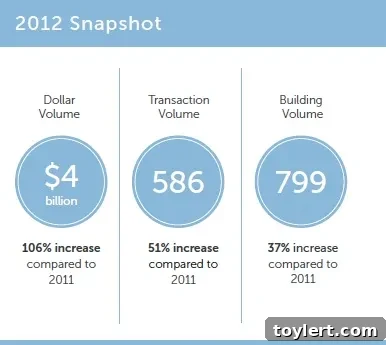
According to Ariel Property Advisors, the total commercial sales in Brooklyn for 2012 reached an impressive $4 billion. This figure alone represents a significant milestone, more than doubling the $1.9 billion recorded in the previous year. Such an increase is not just statistical; it reflects a powerful market rebound and a renewed appetite for Brooklyn assets following the economic uncertainties of earlier years. The sheer volume underscores a profound shift in market dynamics, positioning Brooklyn as a key driver in the broader New York City real estate scene.
Beyond the monetary value, the report also highlighted a substantial increase in the number of individual deals, which climbed by over 50 percent. This surge indicates a broadening of market activity, with more properties changing hands and a wider range of investors participating. It points to a healthy, liquid market where opportunities are abundant and transactions are closing at a brisk pace. This increased deal flow fostered a competitive environment, driving up demand and, consequently, property values across various submarkets within Brooklyn.
Multi-Family Properties Lead the Charge in Investment
A significant portion of these transactions, specifically more than half, were attributed to multi-family buildings. This preference for residential income-generating properties is hardly surprising, given Brooklyn’s burgeoning population and consistently high demand for housing. The borough’s unique blend of vibrant communities, excellent transportation links, and cultural attractions continued to draw new residents, fueling the need for rental units. Investors flocked to multi-family assets, recognizing their stable income streams and long-term appreciation potential. These properties, ranging from classic brownstones to modern apartment complexes, became the backbone of Brooklyn’s investment sales market in 2012, reflecting strong confidence in the borough’s demographic trends and economic future.
The allure of multi-family properties was also driven by relatively low vacancy rates and steady rent growth, making them an attractive proposition for those seeking reliable returns. Developers and investors alike capitalized on this trend, looking to either acquire existing portfolios for immediate income or invest in projects that promised future rental revenue, further solidifying the sector’s dominance in the market.
Neighborhood Hotspots: Where Prices Reached New Heights
The report also shed light on specific neighborhoods that experienced exceptional price appreciation, reaching levels previously unimaginable. Park Slope and Williamsburg, two of Brooklyn’s most sought-after enclaves, saw commercial property prices approaching $1,000 a square foot. These figures are not just impressive; they are indicative of these areas’ premium status and intense desirability.
Park Slope: A Blend of Historic Charm and Modern Appeal
Park Slope, renowned for its tree-lined streets, brownstone architecture, and proximity to Prospect Park, has long been a desirable residential neighborhood. In 2012, its commercial real estate mirrored this popularity. The area’s robust retail corridors, diverse dining scene, and family-friendly atmosphere made it a magnet for both residents and businesses. Investors eyeing Park Slope understood that acquiring property here meant tapping into a stable, affluent demographic with high disposable income, ensuring strong commercial tenancy and consistent demand for rental units. The limited supply of available properties, combined with ever-increasing demand, naturally pushed prices upwards, establishing it as a top-tier market.
Williamsburg: The Epicenter of Brooklyn’s Cultural and Economic Boom
Meanwhile, Williamsburg continued its transformation from an industrial hub to a global trendsetter. Its evolution into a vibrant center for arts, fashion, technology, and culinary innovation attracted a young, affluent, and creative demographic. The influx of new residents and businesses created an insatiable demand for both commercial spaces and multi-family housing. Proximity to Manhattan, coupled with a distinct cultural identity, made Williamsburg properties a hot commodity. Developers raced to meet demand, and investors paid top dollar, recognizing the long-term growth potential in this dynamic neighborhood. The approaching $1,000 per square foot milestone in Williamsburg underscored its rapid gentrification and its emergence as one of the most expensive and desirable markets in not just Brooklyn, but all of New York City.
The Kings Plaza Mega-Deal: A Landmark Transaction
The crowning jewel of Brooklyn’s 2012 commercial real estate achievements was undoubtedly the acquisition of Kings Plaza Shopping Mall in Sheepshead Bay. This monumental transaction, valued at $751 million, stood as the single largest commercial sale in the borough for the year. The sale was more than just a large number; it was a powerful statement about the confidence in Brooklyn’s retail sector and its capacity to attract major institutional investment.
Kings Plaza, a sprawling retail complex, serves a vast demographic in Southern Brooklyn. Its acquisition at such a high valuation signaled that even established retail assets within the borough held immense value and potential for future growth. Such a significant deal often acts as a bellwether, encouraging other large investors to consider Brooklyn for similar scale investments. It underscored the diversification of Brooklyn’s commercial market, proving that not only residential and boutique commercial properties were thriving, but major retail centers also commanded premium valuations.
Underlying Factors Fueling Brooklyn’s Real Estate Surge
Several macroeconomic and local factors converged to create the perfect storm for Brooklyn’s commercial real estate boom in 2012. Understanding these drivers is crucial to appreciating the full scope of the year’s success.
Post-Recession Recovery and Investor Confidence
Following the 2008 financial crisis, the real estate market, like many sectors, experienced a downturn. However, by 2012, investor confidence had largely returned. Brooklyn, with its resilient economy and steady population growth, emerged as a safe and lucrative haven for capital. Investors, eager to deploy funds in stable markets, looked past traditional Manhattan strongholds and discovered the compelling value proposition Brooklyn offered. The perception of risk decreased, while the potential for significant returns increased, drawing both domestic and international capital into the borough.
Low Interest Rates and Favorable Financing
The sustained period of historically low interest rates played a critical role in fueling investment activity. Access to affordable capital made borrowing more attractive for developers and investors, reducing the cost of acquisition and project financing. This environment encouraged new development, stimulated property upgrades, and made it easier for buyers to secure financing for their purchases, thus driving transaction volumes and contributing to price appreciation across all commercial property types.
Demographic Shifts and Population Growth
Brooklyn continued to experience a substantial influx of new residents, drawn by its cultural vibrancy, diverse job market, and more accessible housing options compared to Manhattan. This demographic shift created sustained demand for both residential and commercial spaces. A growing population requires more housing, more retail outlets, more office spaces, and more services, directly stimulating the commercial real estate market. The borough’s increasing density and evolving demographics were fundamental to its growth story.
Economic Development and Infrastructure Improvements
Ongoing economic development initiatives and infrastructure improvements also contributed to Brooklyn’s appeal. Investments in public transportation, new business incubators, and urban revitalization projects enhanced the borough’s connectivity and economic vitality. These improvements made Brooklyn an even more attractive location for businesses and residents, further solidifying its long-term growth prospects and enticing commercial real estate investment.
The Outlook Beyond 2012: Sustaining the Momentum
The performance of Brooklyn’s commercial real estate market in 2012 set a high bar, raising questions about the sustainability of such rapid growth. However, the underlying fundamentals that fueled this boom appeared robust. Experts and analysts generally predicted that while the extraordinary doubling of sales might be a rare event, Brooklyn was poised for continued strong performance. The borough had firmly established itself as a dynamic, resilient, and highly desirable investment market.
The year’s success indicated a paradigm shift, where Brooklyn was no longer merely an alternative to Manhattan but a primary destination in its own right. The trends observed in 2012 – strong multi-family demand, rapid price appreciation in key neighborhoods, and significant institutional investment – were expected to continue shaping the market for years to come. The challenge would be to manage this growth sustainably, ensuring that Brooklyn’s unique character and affordability were preserved amidst its economic boom.
Conclusion: Brooklyn’s Commercial Market, A Beacon of Growth
The year-end report by Ariel Property Advisors unequivocally positioned 2012 as a banner year for Brooklyn commercial real estate. With total sales reaching an astounding $4 billion, more than double the previous year, and a 50 percent increase in the number of deals, the borough demonstrated exceptional market vitality. The dominance of multi-family transactions, coupled with soaring prices in areas like Park Slope and Williamsburg, underscored the robust demand and investor confidence. The landmark $751 million sale of Kings Plaza Shopping Mall further highlighted the borough’s capacity for large-scale investment.
Brooklyn’s commercial property market became a beacon of growth, driven by a confluence of economic recovery, low interest rates, demographic shifts, and strategic urban development. The borough’s trajectory suggested a sustained period of investment appeal, making it one of the most compelling real estate stories of its time. The strong performance of 2012 laid a solid foundation for future growth, cementing Brooklyn’s reputation as an indispensable component of the New York City real estate landscape and a prime location for savvy investors.
Brooklyn Investment Sales Jump 50% Over 2011 [TRD]