Unveiling the Future: The Ambitious Plans for the Wyckoff House Visitors Center
A landmark moment for one of New York City’s most treasured historical sites is on the horizon. After two years of meticulous planning and anticipation, the New York City Parks Department has officially filed an application for a groundbreaking new building: the Wyckoff House Visitors Center. This significant development marks a new chapter for the Pieter Claesen Wyckoff House, the oldest surviving structure in New York City, which currently operates as a vibrant museum dedicated to preserving Dutch colonial heritage.
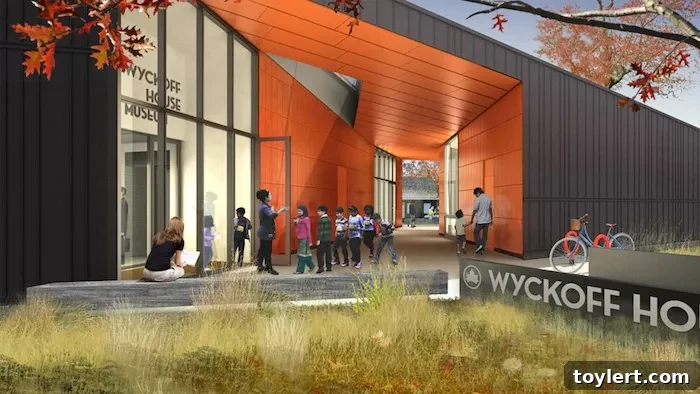
A Glimpse into History: The Pieter Claesen Wyckoff House
Nestled at 5914 Clarendon Road in Brooklyn, the Pieter Claesen Wyckoff House stands as a remarkable testament to the city’s rich past. Constructed in 1652, this extraordinary farmhouse holds the distinguished title of being New York City’s oldest structure and is a designated National Historic Landmark. Its humble beginnings trace back to Pieter Claesen Wyckoff, a Dutch immigrant who arrived in New Netherland (now New York) in 1637. The house, built in the traditional Dutch colonial style, offers an unparalleled window into the lives of early European settlers and their interactions with the indigenous Lenape people.
Today, the Wyckoff House Museum serves as an invaluable educational resource and cultural hub. It not only preserves the physical structure but also perpetuates the stories, traditions, and historical significance of the Wyckoff family and the wider colonial era. Visitors can explore the preserved interiors, delve into interactive exhibits, and participate in a myriad of educational programs designed for both schoolchildren and the general public. However, like many historic sites, the museum has faced challenges related to accommodating its growing audience and expanding its programming within the confines of a fragile 17th-century building.
The Necessity of Expansion: Why a Visitors Center?
The vision for a dedicated visitors center stems from a clear need to enhance the museum’s capacity, improve visitor experience, and safeguard the historic house itself. Operating a modern museum within a nearly 400-year-old structure presents inherent limitations. The historic house, while beautiful and authentic, was not designed for the heavy foot traffic, administrative needs, or extensive exhibition spaces required by a contemporary museum.
A new visitors center will address these critical issues by providing essential facilities that are currently lacking or inadequate. This includes dedicated space for welcoming guests, offering orientation, housing administrative offices, providing modern restrooms, and creating flexible areas for educational workshops, public lectures, and community events. Furthermore, by directing initial visitor flow and certain activities to the new center, the historic Wyckoff House can be better protected from the wear and tear associated with direct and continuous public access, ensuring its preservation for future generations.
The expansion is not merely about adding space; it’s about elevating the entire museum experience. It allows for a more comprehensive presentation of the house’s history, the broader context of Dutch colonial life, and the enduring legacy of the Wyckoff family. With improved facilities, the museum can expand its educational outreach, host larger groups, and become an even more vibrant cultural anchor for the East Flatbush and Canarsie communities in Brooklyn.
Architectural Innovation: nArchitects’ Vision for the New Center
The design of the new two-story visitors center and caretaker apartment, located at 5914 Clarendon Road immediately adjacent to the historic property, is entrusted to the acclaimed firm nArchitects. Known for their innovative approach and ability to integrate contemporary design within sensitive historical contexts, nArchitects has conceptualized a 4,780-square-foot building that promises to be both strikingly modern and deeply respectful of its venerable neighbor.
As reported in March, the new structure is strategically placed. This thoughtful positioning serves a dual purpose: it creates a welcoming entry point for visitors while simultaneously shielding the 17th-century house from the direct impact of street noise and urban activity. This architectural dialogue between old and new is a hallmark of nArchitects’ work, aiming to create a harmonious ensemble where each structure enhances the other’s presence without overshadowing it. The modern design, likely featuring clean lines, expansive glazing, and contemporary materials, will provide a compelling visual contrast to the rustic charm of the original farmhouse, inviting curiosity and signaling a forward-thinking institution.
The interior layout of the new center is designed for versatility and functionality. It will house essential museum activities and interactive displays that contextualize the historic house, allowing visitors to engage with its history before entering the original structure. Furthermore, dedicated event spaces will provide flexible venues for public programs, community gatherings, and private functions, significantly expanding the museum’s revenue-generating potential and outreach capabilities. Crucially, administrative offices will relocate to the new building, freeing up valuable space within the historic house and providing a modern, efficient workspace for staff. The inclusion of a caretaker apartment underscores a commitment to on-site stewardship and security for this irreplaceable landmark.
The architectural plans, now officially filed with the NYC Department of Buildings under application number 320868897, represent a concrete step forward in a long-held ambition. This meticulous planning ensures that the new facility will not only meet the operational demands of a modern museum but also contribute positively to the architectural landscape of the neighborhood while respecting the integrity of the National Historic Landmark.
A New Era for Community and Preservation
The construction of the Wyckoff House Visitors Center heralds a new era for both the museum and the surrounding Brooklyn community. For the Wyckoff House Museum, it means an enhanced ability to fulfill its mission of education and preservation. The new facilities will enable a richer, more accessible, and more engaging visitor experience, drawing in a wider audience from across New York City and beyond.
From a preservation standpoint, the visitors center is a critical investment. By diverting the functional demands of a public institution away from the fragile 17th-century structure, it significantly reduces the stress on the historic house, thereby contributing to its long-term stability and integrity. This careful balance between access and protection is paramount for the custodians of such invaluable heritage sites.
For the community, the new center reinforces the Wyckoff House’s role as a vibrant local landmark and cultural anchor. Enhanced programming, improved accessibility, and dedicated community spaces will foster greater engagement and pride among residents. It offers a tangible link to the past, reminding us of the foundational stories that shaped New York City, and provides a modern platform for celebrating diversity, education, and shared heritage.
This project stands as a testament to the enduring importance of historical preservation and the dynamic evolution of cultural institutions. By embracing innovative architectural solutions, the Wyckoff House Museum is poised to welcome future generations into its story, ensuring that the legacy of Pieter Claesen Wyckoff and early New York continues to inspire and educate for centuries to come.