Brooklyn’s Evolving Educational Landscape: The P.S. 8 Middle School Expansion and Community Tensions
In New York City, particularly within its vibrant and ever-changing boroughs like Brooklyn, the concept of real estate permeates every aspect of urban life—and education is no exception. The allocation and utilization of school facilities frequently become focal points for intense community debate, especially when successful public or charter schools, backed by highly engaged parent bodies, seek to expand. These expansion efforts often target underutilized spaces within existing schools grappling with declining student enrollments. Such scenarios invariably ignite passionate discussions about equity, resources, and the very identity of educational institutions. We’ve witnessed these tensions boil over before, notably during the heated conflict in Fort Greene just last year, involving the well-resourced Arts & Letters charter school and the more vulnerable P.S. 20. Now, a strikingly similar drama is unfolding in the heart of Downtown Brooklyn, where a prominent elementary school, P.S. 8 from Brooklyn Heights, is proposing a significant expansion that has stirred a powerful wave of community resistance.
P.S. 8’s Ascendant Trajectory and the Quest for Middle School Space
P.S. 8, strategically located in the affluent and historically charming neighborhood of Brooklyn Heights, has enjoyed an extraordinary surge in popularity over the past decade. Its reputation for academic excellence and strong community involvement has made it a highly sought-after institution for local families. This growing demand has led to increased enrollment pressures, prompting the school to undertake its own physical expansion in recent years to accommodate its thriving student body. As these students progress, their parents naturally seek to maintain a continuity of quality education within their local community, ideally extending through middle school. This drive to provide a seamless educational pathway is the primary impetus behind P.S. 8’s current ambition: to launch a new middle school program.
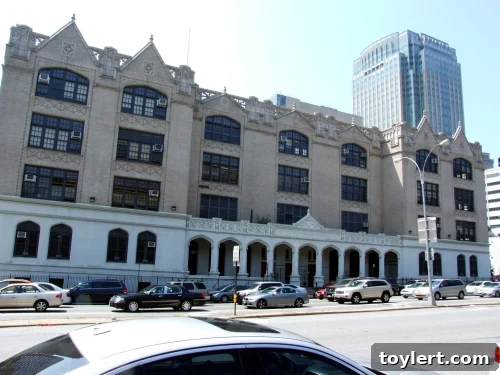
The proposed location for this new middle school is none other than the campus shared by Westinghouse and Polytechnic High School on Tillary Street, a mere stone’s throw from P.S. 8. This particular building is eyed by P.S. 8 proponents because it is currently operating at less than 80 percent capacity, presenting what appears to be a viable solution for expansion into underutilized educational infrastructure. The building itself is a significant structure within Downtown Brooklyn’s architectural fabric, having been featured as a “Building of the Day” for its notable design and historical presence. For many P.S. 8 parents, this co-location represents a logical and efficient use of city resources, directly addressing their children’s educational needs within their immediate geographic vicinity.
Political Endorsement and Parental Enthusiasm
The proposal for the P.S. 8 middle school at the Westinghouse site has garnered considerable support from local political figures and a robust contingent of P.S. 8 parents. A recent community meeting saw more than 30 parents turn out to passionately advocate for the plan, articulating their vision for a continuous, high-quality public education option for their children. Their arguments often emphasize the potential benefits of providing a local middle school, reducing commutes, and fostering community cohesion. Council Member Steve Levin, a key political voice in the district, publicly endorsed the initiative, stating unequivocally, “The expansion into a middle school will mean that students from P.S. 8 will be able to continue their education at a local, quality public school.” His support is echoed by other influential elected officials, including State Senator Daniel Squadron and Assemblymember Joan Millman, underscoring the political momentum behind the proposal.
These supporters consistently frame the expansion as a cooperative venture, aimed at enhancing educational opportunities for all. They often use reassuring language, emphasizing their commitment to being “good neighbors” and assuring the existing high school community that this is not a hostile “take-over.” They present the plan as a mutually beneficial arrangement, leveraging underused space to serve a growing student population and strengthen the overall educational offerings in Downtown Brooklyn.
A Clash of Visions: Resistance from Westinghouse and the Wider Community
Despite the assurances and political backing, the P.S. 8 expansion plan has met with significant and organized resistance, particularly from parents and stakeholders associated with Westinghouse and Polytechnic High School, as well as broader community education leaders. These groups view the proposal with deep skepticism and a sense of alarm, perceiving it not as a collaborative effort but as an encroachment on their established institution.
Khem Irby, the first vice president of the District 13 Community Education Council, has emerged as a prominent voice for the opposition. Her powerful metaphor encapsulates the sentiment of many resistors: “I hear everyone talking about being a good neighbor. A neighbor doesn’t live in your house.” This statement perfectly illustrates the perception that the P.S. 8 expansion represents an unwelcome intrusion, rather than a partnership. For the Westinghouse community, their school is not merely an underutilized building; it is a long-standing vocational institution with its own unique culture, mission, and student body.
Beyond the fundamental issue of shared space, grave concerns have been raised regarding the practicalities and potential negative consequences of co-locating middle school students with high school students. Irby starkly warned of potential trouble, articulating fears that mixing adolescents of vastly different age groups in the same building could lead to behavioral issues and an unsafe environment, referencing possibilities like “High school students might be having sex in the hallways.” These concerns highlight the significant developmental differences between a middle schooler and a high schooler and the challenges of managing two distinct student populations within a shared physical and social space.
Unearthing Deeper Undercurrents: Class, Race, and Conspiracy
Beneath the surface of logistical and operational concerns, the debate over the P.S. 8 expansion plan taps into profound socioeconomic and demographic tensions that are increasingly prevalent in rapidly gentrifying Brooklyn. The original article subtly hints at “obvious class and race tensions just barely below the surface,” and indeed, such conflicts often expose disparities in power, privilege, and access to resources within the city’s educational system.
P.S. 8, serving Brooklyn Heights, tends to draw students from more affluent and predominantly white families. Westinghouse, as a vocational high school, historically serves a more diverse, often working-class student population, many of whom rely on public transport from various parts of Brooklyn and beyond. The perception that a well-resourced, predominantly white elementary school is attempting to expand into the space of a historically diverse vocational high school can easily be interpreted as a form of displacement or a struggle for scarce public resources. It raises questions about whose educational needs are prioritized and whose community identity is preserved in the face of rapid urban transformation.
Adding another layer of complexity and mistrust is the circulating “conspiracy theory” that suggests the city’s Department of Education has been deliberately shrinking Westinghouse’s enrollment over time, specifically to create the very “unused turf” now being eyed by P.S. 8. This theory, whether substantiated or not, reflects a deep-seated suspicion among some community members that these expansion plans are not organic but are part of a larger, calculated strategy to reallocate educational space and resources to more politically influential or demographically desirable schools, potentially at the expense of institutions serving less privileged communities. Such theories underscore a pervasive sense of disempowerment and a belief that decisions about their children’s education are being made without genuine community consultation or consideration for long-term impacts on established institutions.
The Broader Implications for Brooklyn’s Educational Future
The conflict surrounding the P.S. 8 middle school expansion at Westinghouse is more than just a localized dispute over a building; it is a microcosm of the larger challenges facing public education in burgeoning urban centers. It forces a critical examination of how school space is valued, allocated, and managed in a city where demand for quality education constantly outstrips available resources. The outcome of this debate will have significant implications for co-location policies, community engagement in educational planning, and the equitable distribution of educational opportunities across diverse neighborhoods.
It also highlights the ongoing tension between different models of public education: the traditional neighborhood school serving a specific geographic community versus vocational or specialized high schools that often draw students from a wider catchment area based on interest and aptitude. As Brooklyn continues its rapid development, these conversations about identity, belonging, and the future of its educational institutions are likely to intensify, making the P.S. 8 and Westinghouse situation a crucial test case for navigating the complexities of an evolving urban landscape.
Ultimately, the challenge lies in finding solutions that respect the needs and identities of all communities involved, ensuring that the pursuit of expansion for one school does not inadvertently undermine the vitality and mission of another. The path forward demands genuine dialogue, transparency, and a commitment to equitable outcomes for all students in Brooklyn.
For more detailed information on this developing story, please refer to the original coverage:
P.S. 8 Middle School Plan Meets Westinghouse Resistance [Brooklyn Eagle]