By Debbie Nathan and Alyssa Katz
This article was originally published on May 19 at 5:01 a.m. EDT by THE CITY.
The Enigmatic Sherita Billboard: Unraveling Atlantic Avenue’s Hidden Real Estate Mystery
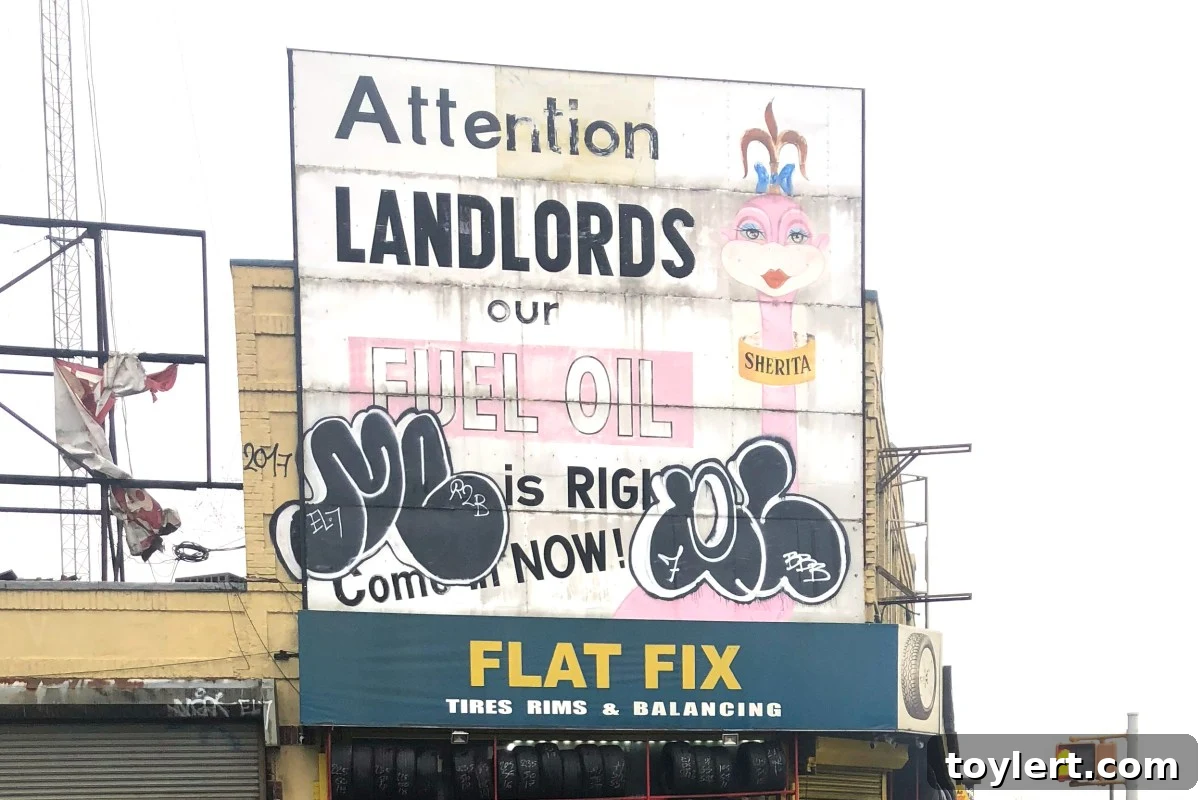
For over two decades, a peculiar hand-painted billboard has captivated the imaginations of those traversing a formerly drab industrial stretch of Atlantic Avenue in Brooklyn. Appearing around 25 years ago, this remarkable piece of urban art seemed both deeply rooted in its surroundings and strikingly otherworldly. Featuring the mysterious name “Sherita” alongside an enigmatic dinosaur, the billboard quickly transcended its humble origins to become an unexpected landmark, a silent witness to Brooklyn’s relentless evolution, and, as we would later discover, a pivotal clue in a complex saga of real estate intrigue and alleged deed theft.
A Unique Icon Emerges: The Sherita Dinosaur Billboard
The first sightings of the Sherita billboard marked it as an anomaly. In a borough constantly reinventing itself, this hand-painted mural stood out. It wasn’t slick commercial advertising; rather, it possessed an raw, artistic charm that hinted at a deeper, more personal narrative. The juxtaposition of the name “Sherita” – a seemingly ordinary human name – with the prehistoric grandeur of a dinosaur ignited countless conversations among passersby. Was Sherita the artist? The owner? A beloved figure? And what could possibly be the connection to such a magnificent, long-extinct creature?
The billboard’s vibrant, if somewhat faded, imagery offered a stark contrast to the utilitarian brickwork and industrial facades that characterized this part of Atlantic Avenue. It wasn’t merely paint on a wall; it was a conversation starter, a piece of urban folklore. Its unusual blend of personal dedication and fantastical elements ensured its place in the collective memory of the neighborhood, gradually transforming from a curious sight into an integral part of the Brooklyn streetscape. It became a point of reference, a beloved eccentricity, and for many, a nostalgic emblem of a changing Brooklyn.
Decoding the Art: Sherita, the Dinosaur, and Local Lore
Attempts to decipher the billboard’s meaning often led to more questions than answers. The dinosaur, typically depicted with a benevolent yet watchful gaze, often suggested a guardian, a protector of something valuable, or perhaps a symbol of resilience in the face of rapid change. For some, it represented the ancient past clashing with Brooklyn’s dynamic present. For others, it was a whimsical touch, a personal declaration that defied conventional explanation. Local historians and art enthusiasts speculated about the artist’s intent, the billboard’s longevity a testament to its compelling, almost spiritual, presence.
The name “Sherita” remained the most elusive piece of the puzzle. Without any accompanying contact information or a clear commercial purpose, it hinted at a story deeply personal. Was it a tribute to a loved one, a child, or perhaps a long-lost friend? Or did Sherita represent something more abstract – an ideal, a memory, or even a community spirit? This profound ambiguity only deepened the billboard’s allure, cementing its status as one of Brooklyn’s most intriguing, unspoken narratives.
Beyond the Art: A Gateway to Real Estate Deception
What began as an artistic enigma eventually unveiled a far more sinister reality. The Sherita billboard was not just an aesthetic marvel; it stood on a property whose ownership history was tangled in a web of alleged deceit. The original URL hinting at “real estate deed theft” pointed towards a dark underbelly beneath Brooklyn’s booming property market – a market where valuable assets could be illicitly seized from unsuspecting owners, often through fraudulent means. The billboard, therefore, transformed from a simple piece of art into an unintentional beacon, signaling a property with a deeply troubled past.
Investigations into the property where the billboard proudly stood began to expose irregularities in its chain of title. It wasn’t long before suspicions mounted that the land beneath the iconic dinosaur had been targeted by unscrupulous individuals looking to exploit the vulnerable. Deed theft, a pernicious form of property fraud, involves the illegal transfer of property ownership, often by forging documents or manipulating elderly or incapacitated owners. In a city like New York, where real estate values skyrocket, such crimes are alarmingly prevalent, leaving victims devastated and properties caught in legal limbo.
The Shadow of Deed Theft on Atlantic Avenue
The story of the Sherita billboard’s property became a stark illustration of how easily families could lose their generational assets. As reporters delved deeper, they uncovered a pattern of suspicious transactions, hurried filings, and missing documentation that painted a grim picture of systematic fraud. Elderly homeowners, often those who had resided in their homes for decades, became prime targets. Their properties, unencumbered by mortgages and ripe for redevelopment, were illicitly transferred, leaving rightful owners bewildered and dispossessed.
The building housing the billboard, like many others in rapidly gentrifying areas of Brooklyn, represented significant latent value. Its industrial facade belied the prime location and the potential for lucrative development. This made it an attractive target for those who operate on the fringes of the law, exploiting complex property laws and gaps in oversight to enrich themselves at the expense of legitimate owners. The billboard, in its silent grandeur, overlooked these clandestine dealings, its whimsical imagery a poignant contrast to the grim reality unfolding beneath it.
The Billboard as a Silent Witness and Community Sentinel
In this context, the Sherita billboard took on a new, profound significance. It became a silent witness to a broader narrative of urban transformation, gentrification, and the often-unseen struggles of long-term residents. As Brooklyn’s neighborhoods rapidly changed, old industrial zones gave way to residential complexes and trendy establishments. Properties that were once considered undesirable suddenly commanded exorbitant prices, creating an environment ripe for exploitation.
The billboard, with its dinosaur standing guard, became an unwitting sentinel. It watched as the true owners fought to reclaim what was rightfully theirs, and as legal battles unfolded behind the scenes. Its very presence on a contested property underscored the human cost of a relentless real estate market and the devastating impact of property fraud on individuals and communities. It served as a constant, if understated, reminder that beneath the vibrant surface of urban development, profound injustices were often at play.
Advocacy and the Fight for Justice
The discovery of alleged deed theft connected to the billboard’s property spurred significant advocacy efforts. Community groups, legal aid organizations, and investigative journalists, including the authors, banded together to shed light on these pervasive schemes. The Sherita billboard, once just a local curiosity, now became emblematic of a larger fight against property fraud, prompting calls for greater protection for homeowners, especially those in vulnerable populations. It highlighted the need for more robust regulatory measures and increased public awareness campaigns to prevent such crimes.
The story became a cautionary tale, illustrating how even seemingly isolated incidents of fraud contributed to the erosion of community stability and generational wealth. For many, the billboard symbolized the resilience of Brooklyn residents against external pressures and the enduring spirit of those who fought to preserve their homes and their heritage.
The Legacy of the Sherita Billboard
Today, the Sherita billboard stands as more than just a piece of street art. It is a powerful symbol of Brooklyn’s complex identity – a blend of quirky creativity, deep-rooted history, and the stark realities of urban development and its challenges. Its enduring presence on Atlantic Avenue serves as a poignant reminder of the property disputes it witnessed and the vulnerability of homeowners in a hyper-competitive real estate market.
Whether Sherita was a real person or a symbolic muse, and regardless of the dinosaur’s original intent, the billboard has evolved beyond its initial purpose. It has become a landmark of resistance, memory, and a testament to the fact that even in the busiest of cities, untold stories lie just beneath the surface, waiting to be discovered. The Sherita dinosaur billboard continues to tell a story – not just of art, but of justice, community, and the ever-changing landscape of one of New York’s most iconic boroughs.
Its legacy encourages us to look closer at our surroundings, to question the unspoken narratives of our urban environments, and to recognize that behind every unique landmark, there might be a significant story waiting to be unraveled – a story that speaks volumes about the very fabric of our communities.