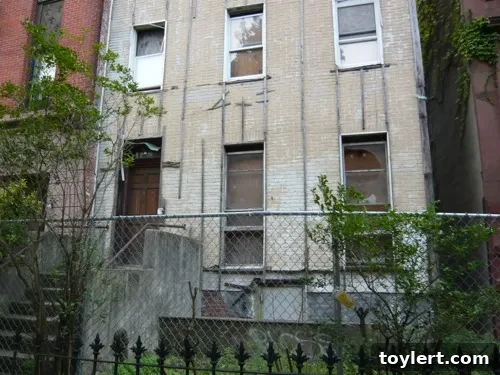
476 Washington Avenue: A Landmark Dilemma in Clinton Hill, Brooklyn’s Historic Heart
A striking, albeit crumbling, piece of Clinton Hill’s rich architectural tapestry, the property at 476 Washington Avenue presents a unique and challenging proposition to potential buyers. Nestled within a coveted historic district, this once-grand residence now stands in a severe state of disrepair, raising questions about preservation, development, and the future of a significant neighborhood landmark.
The property, currently listed for an ambitious $1.4 million, is being marketed not for its existing structure but rather as prime land ripe for a new 5,000-square-foot townhouse development. This vision, however, immediately clashes with the building’s protected status as a designated landmark. The listing candidly describes the current structure as a “three-story vacant building in need of total gut renovation or tear-down,” a phrase that underscores the profound conflict at the heart of this real estate opportunity.
The Unyielding Hand of History: Landmarking and Development
The most significant hurdle for any developer eyeing 476 Washington Avenue is its landmarked status. As a story in Fort Greene-Clinton Hill Patch highlighted, this designation is not merely a formality; it carries stringent requirements for preservation and restoration. Unless the building were to suffer a catastrophic and natural collapse, any proposed development would be legally obligated to restore the original facade and secure explicit approval from the Landmarks Preservation Commission (LPC).
This legal framework fundamentally contradicts the marketing approach of selling the property as a site for a “tear-down” or new construction. The very essence of landmarking is to protect and preserve structures that contribute to the historical, cultural, and architectural character of a neighborhood or city. In Clinton Hill, a district celebrated for its majestic brownstones and tree-lined streets, such preservation is paramount to maintaining its unique identity.
For a developer, this means navigating a complex and often costly path. Rather than the simpler route of demolition and new build, the path for 476 Washington Avenue involves meticulous historical research, expert architectural consultation, and a deep understanding of preservation techniques. The facade, even in its current damaged state, is considered an invaluable part of the city’s heritage and must be painstakingly brought back to its former glory, a process that can significantly inflate project budgets and timelines.
Beyond Bricks and Mortar: The SRO Complication
Adding another layer of complexity to this already intricate situation is the property’s designation as an SRO, or Single Room Occupancy unit. SROs are residential buildings that contain multiple rental units, typically without private kitchens or bathrooms, rented to individuals. Once a common form of affordable housing, SROs in New York City are now heavily regulated to protect existing tenants and prevent displacement.
The listing explicitly promises to deliver a “certificate of non-harassment at closing.” This certificate is a critical document required by the city for any SRO property owner who wishes to demolish, alter, or convert the building. It certifies that the owner has not harassed tenants within a specified period, a measure designed to prevent owners from intentionally making conditions unlivable to force tenants out, thereby clearing the way for more profitable redevelopment. While the current listing states the building is vacant, the SRO designation still imposes legal obligations and bureaucratic hurdles that must be cleared, even if no tenants are currently residing there. This adds a substantial legal and administrative burden to the already considerable challenges posed by its landmark status.
A Swift Turnaround and Whispers of Controversy
Public records, specifically from PropertyShark, reveal an intriguing detail about the property’s recent transactional history. The current owner acquired 476 Washington Avenue in January for $691,000, less than half the current asking price. This rapid appreciation and quick flip strategy are common in a hot real estate market like Brooklyn, but in this context, it raises eyebrows given the building’s condition and protected status.
Furthermore, local rumors paint a more troubling picture. A tipster relayed concerns that the previous owner had allegedly been observed intentionally tearing holes in the roof. This purported act of deliberate damage suggests a potential, albeit illicit, attempt to bypass Landmarks requirements. The logic behind such a desperate measure would be that if a landmarked building were to become structurally unsound due to neglect or damage – particularly water damage from an open roof – it might be deemed unsalvageable, thus opening a loophole for demolition. Such actions, if proven, would not only be illegal but also deeply unethical, undermining the very principles of historic preservation and community trust.
Photos accompanying news stories about the property vividly illustrate its neglected state, showing a broken front window and a significant portion of the rear of the building, where an extension once stood, now entirely open to the elements. These images underscore the urgency of intervention, whether for preservation or a lawful, sensitive redevelopment, before the building deteriorates beyond repair.
Clinton Hill: A Coveted Neighborhood’s Character at Stake
Clinton Hill, with its grand 19th-century mansions, historic brownstones, and vibrant community, is one of Brooklyn’s most desirable neighborhoods. Its charm lies not only in its architectural beauty but also in the tangible sense of history that permeates its streets. Properties like 476 Washington Avenue are not just individual structures; they are integral threads in the neighborhood’s fabric.
The concerns voiced by neighbors, as reported by Patch, are understandable. Neglected properties, especially landmarked ones, can become eyesores, safety hazards, and diminish the collective value and aesthetic appeal of the entire block. The community has a vested interest in seeing such properties either meticulously restored or redeveloped in a manner that respects the historical context and architectural integrity of the area. This situation at 476 Washington Avenue therefore transcends a mere real estate transaction; it becomes a test case for how historic districts balance the pressures of modern development with the imperative of preserving their unique heritage.
The Path Forward: Investment, Innovation, and Integrity
For a developer, 476 Washington Avenue represents a significant challenge but also a potentially rewarding opportunity. The successful revitalization of such a property would require not only substantial financial investment but also a commitment to innovative architectural solutions that harmonize contemporary living with historic aesthetics. It calls for a developer with vision, patience, and a deep respect for the city’s past.
The ideal outcome would be a painstaking restoration that revives the building’s original grandeur while adapting its interior for modern use, perhaps as a luxurious single-family home or a series of high-end condominiums, all while adhering strictly to Landmarks Preservation Commission guidelines. Such a project would not only transform a blighted property into a jewel but also contribute positively to the neighborhood’s ongoing legacy of preservation.
Conversely, a failure to find such a developer, or a decision to pursue contentious demolition attempts, could lead to prolonged legal battles, community opposition, and potentially the irreversible loss of a significant historic asset. The fate of 476 Washington Avenue remains uncertain, a poignant reminder of the delicate balance between urban growth, economic forces, and the enduring value of history and heritage in New York City.
Photo Credit:
Above photo by Caitlin Nolan for Fort Greene-Clinton Hill Patch