Samuel Yellin: The Enduring Legacy of America’s Master of Architectural Ironwork
Throughout history, human ingenuity has given rise to individuals whose mastery of a particular skill or craft transcends mere competence, achieving legendary status. From the exquisite glassblowers of Murano in Renaissance Italy, whose secrets were fiercely guarded, to the delicate lace makers of France whose nimble fingers wove intricate beauty, and the formidable tile masters of Spain and Portugal whose vibrant works adorned countless structures, the world has always celebrated true artisans. These craftsmen and artists were not just skilled laborers; they were innovators, visionaries, and often, tastemakers.
By the turn of the 20th century in America, as the Gilded Age gave way to an era of unprecedented architectural ambition and prosperity, the decorative arts experienced a profound renaissance. Architects designing grand estates, majestic public buildings, and opulent commercial structures increasingly relied on specialized artisans to realize their comprehensive visions. Clients, with burgeoning budgets and refined tastes, came to expect a certain level of sophisticated ornament and bespoke décor that spoke to the building’s purpose and prestige. This period marked a crucial shift where artists and craftsmen began to gain individual recognition, their names becoming synonymous with unparalleled quality and distinct style. Just as Tiffany Studios became the benchmark for breathtaking stained-glass artistry, establishing a brand identity that clients sought to emulate, one name rose to similar prominence in the realm of metalwork: Samuel Yellin.
Samuel Yellin: The Undisputed Genius of Wrought Iron
For discerning architects and affluent patrons seeking the pinnacle of ironwork, Samuel Yellin was the unequivocal choice. His forge was not merely a workshop; it was a crucible where molten metal was transformed into masterpieces of strength, elegance, and intricate beauty. Yellin’s ironwork was so far superior to that of his contemporaries that it was only a matter of time before his name achieved the same widespread acclaim as many of the celebrated architects whose designs he magnificently complemented. For anyone with a serious interest in architecture, art history, or the decorative arts, the name Samuel Yellin resonates with the legacy of a true master. Indeed, countless residents and visitors to cities like New York have, perhaps unknowingly, passed by or through the gates of his greatest works, experiencing the enduring power of his craftsmanship.
A Life Forged in Fire: Yellin’s Journey to Mastery
Samuel Yellin’s journey to becoming America’s preeminent iron artist began far from the bustling streets of New York. Born in Poland (then part of Austria-Hungary) in 1884, he was apprenticed as a blacksmith at a remarkably young age, immersing himself in the ancient craft of metalworking. This early training instilled in him not only the technical skills but also a profound respect for the material and the traditional methods of working it. Unlike many who embraced the industrialization sweeping across the early 20th century, Yellin remained steadfast in his commitment to hand-forging. He believed that the human touch, the deliberate hammer strokes, and the nuanced understanding of metal’s properties were essential to creating truly expressive and lasting works.
In 1906, Yellin immigrated to the United States, bringing with him a prodigious talent and an unwavering dedication to his craft. After a brief period in Philadelphia working for other metal shops, he established his own workshop, “Samuel Yellin Metalworkers,” in 1909. This move marked the beginning of an era that would redefine architectural ironwork in America. From humble beginnings, Yellin built a formidable reputation based on meticulous detail, artistic integrity, and an uncompromising standard of quality that attracted the most prestigious commissions.
The Samuel Yellin Metalworkers: A Crucible of Craftsmanship
Yellin’s Philadelphia workshop was more than just a place of production; it was a vibrant hub of artistic creation and skilled labor. He assembled a team of highly talented artisans, many of whom were immigrants themselves, bringing diverse traditions and skills to the forge. Under Yellin’s strict yet inspiring guidance, this collective of master craftsmen executed designs that ranged from monumental gates and grilles to delicate balustrades, lighting fixtures, and decorative elements. The workshop was a testament to the power of collaborative artistry, where Yellin’s vision was brought to life through the collective expertise of his team.
What set Yellin apart was his profound understanding of iron’s capabilities and limitations. He knew how to coax organic forms from the rigid material, infusing his creations with a sense of fluid movement, often incorporating motifs inspired by nature – vines, leaves, flowers, and animals – alongside more abstract geometric patterns. His designs were rarely repetitive, each commission reflecting a unique artistic interpretation tailored to the specific architectural context. This commitment to individuality and artistic expression ensured that every piece emerging from his forge was a unique work of art, a signature of excellence.
The Art of Wrought Iron in an Industrial Age
At a time when mass production and machine manufacturing were rapidly becoming the norm, Yellin staunchly upheld the traditions of wrought iron. He championed the painstaking process of heating, hammering, twisting, and bending metal by hand, believing it imparted a character and soul that no machine could replicate. Wrought iron, by definition, is iron that has been worked by hand, distinguishing it from cast iron (poured into molds) or steel (a stronger alloy). Yellin’s mastery of wrought iron meant that his pieces possessed an inherent strength and resilience, while also exhibiting a delicate, almost lyrical quality.
His techniques were rooted in centuries-old European traditions, but his aesthetic was distinctly American, adapting classical and Gothic influences to modern architectural styles. He paid meticulous attention to the smallest details, ensuring that every rivet, every curve, and every joint contributed to the overall harmony and integrity of the design. This dedication to craft not only made his works aesthetically superior but also structurally robust, designed to last for generations. His approach was a powerful counter-narrative to the prevailing industrial trends, proving that human craftsmanship still held unparalleled value.
Iconic Works and Enduring Presence in New York City
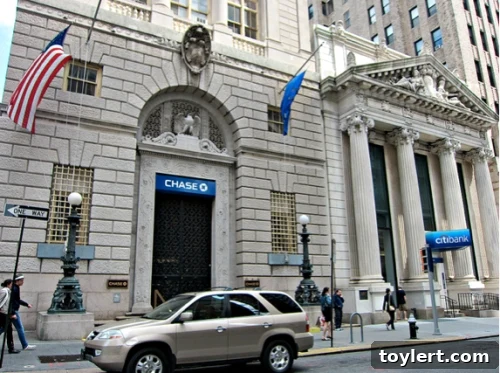
Samuel Yellin’s extraordinary talent led him to collaborate with many of the era’s most renowned architects, including Cass Gilbert, Bertram Goodhue, and John Russell Pope. His ironwork became an indispensable feature of some of America’s most iconic buildings, imbuing them with a sense of permanence and refined grandeur. While his works can be found across the United States, from university campuses to cathedrals, his presence in New York City is particularly profound. The very image accompanying this article showcases his craftsmanship at the Brooklyn Trust Company building, a testament to his intricate detailing.
Some of his most celebrated New York City commissions include the massive and imposing gates of the Federal Reserve Bank of New York on Maiden Lane, whose intricate patterns and formidable presence perfectly convey institutional strength. His artistry also graces the majestic interiors of the Astor Court at the Metropolitan Museum of Art, where delicate grilles and railings demonstrate his versatility. Other notable examples include the beautiful ironwork found in numerous private residences, university buildings like the Harkness Memorial Tower at Yale University (though technically in New Haven, it’s a prime example of his work for institutions often associated with NYC architects), and various other commercial structures. Each piece tells a story, marrying functionality with unparalleled artistic expression.
A Legacy Forged in Time
Samuel Yellin passed away in 1940, but his legacy continues to inspire and awe. He left behind a monumental body of work that stands as a testament to the enduring power of handcraftsmanship in an increasingly mechanized world. His impact extended beyond the individual pieces he created; he elevated the status of the architectural artisan, proving that decorative elements were not mere embellishments but integral components of architectural design. He demonstrated that true beauty and longevity arise from a deep understanding of materials, a mastery of tools, and an unwavering commitment to artistic vision.
Today, Yellin’s works are meticulously preserved and celebrated for their historical and artistic significance. They offer a tangible connection to a past era when craftsmanship was paramount and bespoke artistry defined luxury. For those who take the time to observe the intricate details of a Yellin gate or railing, there is an immediate appreciation for the skill, patience, and artistry involved. His works are not just structural elements; they are sculptures in iron, imbued with the spirit of a master who understood how to make metal sing. Samuel Yellin remains an enduring symbol of American craftsmanship, a true luminary whose legacy is quite literally forged in the very fabric of our architectural heritage.