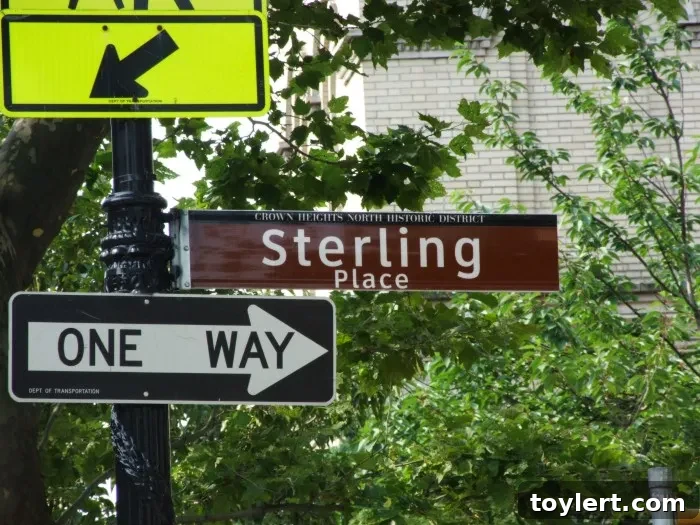
Welcome back to a journey through Brooklyn’s rich tapestry of history! While Montrose is enjoying a well-deserved break, we invite you to delve into one of our city’s most intriguing street name origins. Prepare to discover the fascinating story behind Sterling Place, a thoroughfare that stitches together the vibrant neighborhoods of Park Slope and Crown Heights, stretching from the bustling energy of 5th Avenue all the way to East New York Avenue.
Unveiling Sterling Place: The Enduring Legacy of Lord Stirling in Brooklyn’s Streets
Brooklyn, a borough celebrated for its distinct character and deep historical roots, boasts a street grid that often serves as a living museum. Most of its named thoroughfares pay homage to figures of historical significance – presidents, influential pastors, pioneering politicians, city founders, prominent local families, and revered military personnel. Each name carries a story, a fragment of the past etched into the urban landscape. Among these narratives, the tale of Sterling Place stands out, not just for the eminent figure it commemorates, but for its direct connection to pivotal moments in American history that unfolded right here in Brooklyn.
For those familiar with the street, it’s a vibrant artery connecting diverse communities. But few might realize that Sterling Place wasn’t always known by this distinguished name. Its journey to its current designation is a fascinating glimpse into Brooklyn’s evolving identity. Originally, much of what we now recognize as Sterling Place bore the name Butler Street. This former designation still persists in certain pockets, particularly west of 5th Avenue, extending towards Court Street, reminding us of the layers of history beneath our feet. The transition to Sterling Place unfolded in two significant phases, mirroring the rapid growth and reorganization of Brooklyn in the late 19th century.
The first transformation occurred in 1873, a pivotal year when the stretch of Butler Street located between 5th Avenue and Flatbush Avenue was officially rechristened Sterling Place. This initial renaming marked a conscious effort to align parts of the city with figures deemed worthy of honor. The second, and more expansive, change took place in 1897. During this period, the name Sterling Place was extended eastward, ultimately reaching East New York Avenue, solidifying its identity across a substantial portion of Brooklyn. This expansion reflected a burgeoning civic pride and a desire to connect the city’s thoroughfares with a shared historical narrative.
But this raises a compelling question that often sparks curiosity: Who was “Sterling,” and what extraordinary contributions warranted such a prominent and lasting tribute in the very fabric of Brooklyn? The answer leads us back to one of the most intriguing and valiant figures of the American Revolutionary War: Major General William Alexander, famously known as Lord Stirling. His life was a remarkable blend of ambition, claims to nobility, military valor, and unwavering dedication to the cause of American independence. To truly understand Sterling Place, we must first understand the man behind the name.
The Aristocratic Rebel: Who Was William Alexander, Lord Stirling?
William Alexander, born in New York City in 1726, was a man of considerable means and even greater aspirations. The son of James Alexander, a prominent Scottish lawyer who had emigrated to America, William inherited a keen intellect and a drive for success. His early career saw him establish himself as a successful merchant, surveyor, and land speculator, demonstrating a sharp business acumen that would serve him well. However, it was his claim to a Scottish peerage that truly set him apart and earned him the moniker “Lord Stirling.”
Alexander believed he was the rightful heir to the dormant earldom of Stirling, a title that had been granted in the 17th century. He pursued this claim with tenacity, traveling to Great Britain and engaging in extensive legal battles in the Scottish courts. Although his claim was ultimately rejected by the House of Lords in 1762, he continued to use the title “Lord Stirling” throughout his life, and it was widely accepted and used by his contemporaries, especially in America. This blend of colonial birth and an asserted noble heritage made him a unique figure in the burgeoning American colonies, positioning him among the elite yet with a distinct American identity.
Beyond his aristocratic claims, Lord Stirling was a man deeply engaged in the intellectual and political currents of his time. He was a close friend and associate of many influential figures, including George Washington, and actively participated in pre-Revolutionary activities. As tensions escalated between the American colonies and Great Britain, Stirling, despite his European aristocratic connections, firmly sided with the cause of American independence. His commitment wasn’t merely rhetorical; he was prepared to dedicate his wealth, influence, and ultimately, his life, to the revolutionary cause.
Lord Stirling’s Indispensable Role in the American Revolution
When the American Revolutionary War ignited, William Alexander, Lord Stirling, quickly distinguished himself as a military leader. He was commissioned as a brigadier general in the Continental Army in 1776, rising rapidly through the ranks due to his leadership skills and strategic insight. His military career was marked by bravery, tactical acumen, and an unyielding resolve, qualities that would be severely tested on the battlefields of New York.
The Battle of Long Island: A Defining Moment in Brooklyn
Lord Stirling’s name is inextricably linked to one of the most significant and harrowing battles of the entire war: the Battle of Long Island, fought in August 1776. This battle, largely unfolding on the very ground that now comprises much of Brooklyn, was a devastating defeat for the Continental Army, yet it also showcased moments of extraordinary heroism that allowed the American cause to survive.
During the battle, Stirling commanded a brigade of American troops, notably the valiant Marylanders. His division was tasked with defending the crucial Gowanus Road and the vital pass at the Vechte-Cortelyou House, now famously known as the Old Stone House in Park Slope. This position was critical to preventing the British from outflanking the main American force and cutting off their retreat to Brooklyn Heights, where General Washington was attempting to organize an evacuation.
As the battle raged, Stirling’s troops found themselves in a desperate situation. The British, under General William Howe, had executed a brilliant flanking maneuver, surprising the American forces and threatening to encircle them entirely. Recognizing the dire predicament of Washington’s army, Lord Stirling made a courageous and selfless decision. He, along with approximately 400 of his brave Marylanders, launched a series of daring, almost suicidal, counterattacks against overwhelming British and Hessian forces at the Old Stone House. Their objective was not victory, but time – time for Washington’s main army to escape.
These repeated assaults, fought with incredible ferocity and at immense personal cost, served as a crucial diversion. For several hours, Stirling’s men held the line, engaging thousands of British and Hessian soldiers, drawing their attention and firepower away from the main American retreat. This desperate stand allowed General George Washington and the bulk of the Continental Army to successfully withdraw across the perilous Gowanus Creek and evacuate to Manhattan under the cover of darkness and a providential fog. Though Stirling and many of his men were eventually captured, their heroic sacrifice prevented the total annihilation of the American army, a defeat from which the young nation might never have recovered. It was a strategic loss, but a tactical victory for the spirit of the Revolution.
Lord Stirling’s capture was a significant setback for the American cause, but his actions on that fateful day cemented his legacy as a true hero. He was eventually exchanged and returned to active service, continuing to serve with distinction throughout the war, participating in battles such as Trenton, Princeton, Brandywine, and Germantown. He was promoted to major general in 1777, a testament to his continued valor, strategic contributions, and unwavering commitment.
The Lasting Impact: Why Sterling Place?
Given Lord Stirling’s profound connection to the Battle of Long Island – a battle that, for all its tragedy, highlighted the resilience and bravery of the fledgling American forces right here in Brooklyn – it becomes clear why a street in this borough would bear his name. The renaming of Butler Street to Sterling Place was more than just a change on a map; it was an act of historical recognition, a way to permanently embed the memory of a local hero and a pivotal moment into the very urban fabric. It was a conscious decision to honor a man whose courage directly impacted the survival of the Continental Army and, by extension, the birth of the United States.
By naming Sterling Place after William Alexander, the city fathers of the late 19th century were not only honoring a specific individual but also commemorating the spirit of sacrifice and defiance that defined the American Revolution. It served as a reminder that Brooklyn was not just a collection of neighborhoods but a place where national history was forged in fire, where lives were laid down for liberty. This act of civic remembrance ensured that Lord Stirling’s heroism, particularly his stand during the darkest hours of the Battle of Long Island, would not be forgotten by future generations inhabiting these historic streets.
Sterling Place Today: A Living Legacy
Today, Sterling Place traverses some of Brooklyn’s most vibrant and historically rich neighborhoods. Starting in Park Slope, known for its elegant brownstones, independent boutiques, and tree-lined streets, it meanders through the culturally diverse expanse of Prospect Heights, home to cultural institutions like the Brooklyn Museum and Prospect Park, and finally into the bustling, community-driven area of Crown Heights. Along its length, you’ll find a captivating blend of historic architecture, local businesses, community spaces, and residential areas that reflect the ongoing evolution of Brooklyn while retaining its distinct historical charm.
As residents and visitors walk or drive along Sterling Place, they are, perhaps unknowingly, retracing a path steeped in history. From the quiet grandeur of its brownstone blocks to the lively commercial stretches, the street serves as a tangible link to the dramatic events of the past. It encourages us to look beyond the immediate present and appreciate the layers of stories that contribute to Brooklyn’s unique identity, a reminder that the echoes of foundational moments continue to resonate in our modern urban environment.
Conclusion: More Than Just a Name
The story of Sterling Place is a compelling illustration of how street names can serve as powerful conduits to the past. What might seem like an arbitrary label is, in fact, a carefully chosen tribute, imbued with historical significance. From its humble beginnings as Butler Street to its grand renaming in honor of the “Aristocratic Rebel,” Lord Stirling, this Brooklyn thoroughfare embodies a narrative of sacrifice, courage, and the enduring spirit of American independence. It’s a testament to the idea that the physical landscape of a city can be a profound storyteller, preserving the memory of heroes and pivotal events for centuries.
Next time you find yourself on Sterling Place, take a moment to reflect on Major General William Alexander. Remember his unwavering stand during the perilous Battle of Long Island, his dedication to a nascent nation, and the indelible mark he left on the borough of Brooklyn. It’s a powerful reminder that history is not just found in textbooks, but lives all around us, etched into the very streets we traverse, waiting to be rediscovered and appreciated.