Capturing a Bygone Era: Brooklyn in the Summer of 1974 Through Danny Lyon’s Lens
In the vast tapestry of New York City’s history, few periods are as evocative or as thoroughly documented by certain artists as the 1970s. A decade often characterized by grit, economic hardship, and profound social change, it was also a time when the city’s unique spirit shone brightly through the challenges. It is within this fascinating context that the remarkable work of photographer Danny Lyon takes on particular resonance. During the summer of 1974, Lyon embarked on a photographic journey through Brooklyn, capturing slices of daily life that, in retrospect, offer an invaluable window into a bygone era. His images, stark and honest, reveal a borough on the cusp of significant, unimaginable transformation. Among these compelling visual narratives, one particular photograph stands out: an apartment house situated directly across from the iconic Fort Greene Park. This image, a seemingly mundane snapshot of urban architecture, now serves as a powerful testament to the dramatic shifts that have reshaped Brooklyn’s landscape and economy over nearly half a century. The contrast between its 1974 appearance and its potential valuation today—easily millions of dollars—underscores the incredible narrative of urban evolution that defines modern Brooklyn.
Danny Lyon: A Maverick Lens on America’s Social Fabric
Danny Lyon is not merely a photographer; he is a profound visual historian and a chronicler of marginalized communities, countercultures, and the raw realities of American life. Born in 1942, Lyon developed a distinctive style of immersive photojournalism, often living among his subjects to gain a deeper, more authentic understanding of their experiences. His early career saw him documenting the Civil Rights Movement with the Student Nonviolent Coordinating Committee (SNCC), providing some of the most enduring and intimate images of that pivotal era. Later, he explored the world of outlaw motorcycle gangs in his seminal work “The Bikeriders” and delved into the grim realities of prison life in “Conversations with the Dead.” Lyon’s approach is characterized by a profound empathy and an unwavering commitment to showing the world as it truly is, without embellishment or sensationalism. His work from Brooklyn in 1974, originally commissioned by the Environmental Protection Agency and subsequently becoming a cherished part of the National Archives and Records Administration, follows this same powerful ethos. These photographs capture the unvarnished truth of a borough struggling yet vibrant, offering an invaluable historical record that continues to resonate with viewers today. They remind us that history is not solely shaped by grand events, but by the everyday lives of people in places undergoing subtle yet profound change, making Lyon’s contribution to documentary photography indispensable.
Brooklyn in 1974: A Borough Defined by Flux and Enduring Resilience
The Brooklyn that Danny Lyon documented in the summer of 1974 was vastly different from the globally recognized cultural powerhouse it has become today. The 1970s were an exceptionally challenging decade for New York City as a whole, grappling with a severe fiscal crisis, escalating crime rates, and significant population shifts. The phenomenon of “white flight” to the suburbs was rampant, leaving many urban neighborhoods in palpable decline, characterized by abandoned buildings, increasing poverty, and a pervasive sense of urban decay in certain areas. Brooklyn, once a thriving industrial hub and home to distinct ethnic enclaves, was deeply affected by these macroeconomic and social trends. Manufacturing jobs dwindled, public infrastructure aged, and vital public services faced severe budget cuts. However, even amidst these profound struggles, Brooklyn remained a place of immense character, community spirit, and enduring resilience. Its diverse communities, ranging from working-class neighborhoods to burgeoning pockets of artistic and intellectual life, continued to foster a unique and intricate cultural tapestry. The borough was a vibrant melting pot of stories, daily struggles, and everyday triumphs, a far cry from the polished, often gentrified image predominantly associated with it in the 21st century. Lyon’s unflinching camera masterfully captured this inherent duality—the visible signs of urban decline alongside the indomitable spirit and vibrant life of its residents, providing a truthful snapshot of a complex era.
The Enduring Image: Fort Greene Park and Its Historic Surroundings
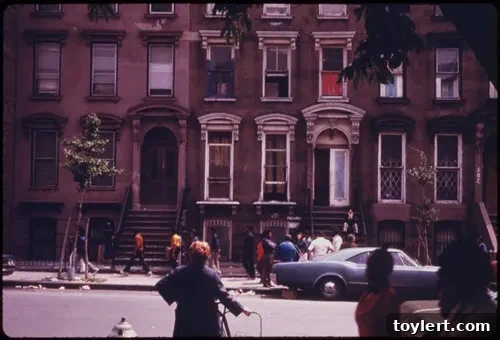
Among the striking and evocative collection of photographs by Danny Lyon from his 1974 Brooklyn series, one particular image serves as a compelling focal point for understanding the borough’s remarkable transformation. It depicts an apartment house situated directly across from the verdant, historic expanse of Fort Greene Park. This park itself holds significant historical importance, not least because it was originally designed by the legendary landscape architects Frederick Law Olmsted and Calvert Vaux, the masterminds behind Manhattan’s iconic Central Park. Serving as a vital green lung and communal gathering space for the surrounding neighborhoods, the park has witnessed countless moments in Brooklyn’s history. In Lyon’s photograph, the apartment building, with its distinctive architectural features indicative of an earlier era, stands as a quiet yet powerful sentinel, silently witnessing the ebb and flow of urban life. The street scene immediately around it, though perhaps considered unremarkable at the time, now offers subtle yet invaluable clues about the era: the types of cars parked along the curb, the condition of the pavement, the general atmosphere of a seemingly ordinary summer day in the bustling city. The image is notably devoid of the bustling crowds or overt signs of affluence that now characterize many parts of contemporary Brooklyn. Instead, it presents a quieter, perhaps grittier reality, a powerful testament to the unvarnished urban landscape of the mid-1970s, making it a priceless historical document that connects us directly to the past.
Business Insider published a great set of photos taken by photographer Danny Lyon in Brooklyn during the summer of 1974. The one above shows an apartment house across from Fort Greene Park. Hard to believe that house would now sell for a couple of million bucks!
From Gritty Past to Gilded Present: Fort Greene’s Astounding Transformation
The most striking and often incredulous observation accompanying Lyon’s photograph, and indeed many historical images of Brooklyn from that challenging era, is the dramatic and almost unimaginable shift in real estate values. The original commentary accompanying the image points out, almost with a sense of wonder, that the very apartment house depicted “would now sell for a couple of million bucks!” This statement encapsulates one of the most significant and profound urban phenomena of the last few decades: the widespread gentrification and subsequent revitalization of historically underserved or previously overlooked neighborhoods in major American cities, particularly evident across Brooklyn. Fort Greene, with its beautiful brownstone architecture, charming tree-lined streets, and enviable proximity to Manhattan, always possessed an inherent attractiveness. However, in the 1970s, many of these architectural gems were severely undervalued, often poorly maintained, or available at comparatively affordable prices. Decades of sustained economic recovery, strategic urban planning initiatives, and a significant cultural shift towards the appeal of urban living collectively fueled an unprecedented real estate boom. Artists and young professionals, initially drawn by lower rents and the authentic, unpretentious charm of the neighborhood, inadvertently laid the groundwork for a broader influx of residents and investment. Over time, property values in desirable areas like Fort Greene skyrocketed, transforming once-modest homes and apartments into multi-million dollar assets. This sweeping transformation, while undeniably bringing economic prosperity, enhanced amenities, and improved infrastructure to many, has also raised complex and often contentious questions about affordability, displacement of long-term residents, and the rapidly changing demographics of the borough. The “couple of million bucks” figure is not merely an astonishing price tag; it is a potent symbol of a profound social, economic, and cultural redefinition that continues to shape Brooklyn today.
Danny Lyon’s Lasting Legacy: A Lens for Understanding Urban Evolution
Danny Lyon’s photographs from Brooklyn in 1974 are far more than just nostalgic glimpses into a distant past; they are vital, irreplaceable historical documents that profoundly help us understand the dynamic and often tumultuous processes of urban evolution. By meticulously capturing the city at a specific, pivotal moment in time, Lyon provides an essential baseline against which to measure the dramatic and multifaceted changes that have unfolded since. His extensive body of work actively encourages us to look beyond the superficial present and to deeply appreciate the intricate layers of history, struggle, and enduring resilience that define our complex urban environments. These powerful images serve as a potent and timeless reminder that cities are not static entities but rather living, breathing organisms constantly being reshaped by powerful economic forces, significant social movements, and the countless individual decisions of millions of inhabitants. For researchers, historians, urban planners, sociologists, and engaged residents alike, Lyon’s Brooklyn series offers invaluable insights into the historical trajectory of one of America’s most iconic and ever-changing boroughs. They invite profound reflection on how far Brooklyn has come, what significant aspects have been gained in its journey, and perhaps what irreplaceable elements have been lost in its relentless march toward a new, often glittering, identity. The continued fascination with these compelling photographs, vividly exemplified by prominent publications like Business Insider bringing them to new and diverse audiences, underscores their timeless relevance and their enduring power to provoke thoughtful discussion and meaningful conversation about urban identity, change, and the very soul of a city.
The journey through Danny Lyon’s 1974 Brooklyn photographs is a profoundly enriching one, offering a unique and critical perspective on a city perpetually in transition. From the quiet, tree-lined streets of Fort Greene to the broader, often challenging landscape of a borough grappling with its identity, Lyon’s discerning lens captured the very essence of an era. The astounding transformation of a humble apartment building into a multi-million dollar property encapsulates the dramatic narrative of urban gentrification and revitalization, a complex and ongoing story that continues to unfold in cities worldwide. These images are not merely historical artifacts; they are vibrant windows into the soul of a city, encouraging us to reflect deeply on its past, comprehensively understand its present, and thoughtfully contemplate its unfolding future. They stand as a powerful testament to the enduring power of documentary photography to capture, preserve, and illuminate the intricate human story woven into the fabric of urban life.
Here Is What Brooklyn Was Like In The Summer Of 1974 [Business Insider]
Photo by Danny Lyon/National Archives and Records Administration