Brooklyn Utopias: Artists Reimagine New York City’s Transit Future
The daily rhythm of New York City is inextricably linked to its colossal transportation network. For millions, subways, buses, and commuter trains are not just modes of travel but arteries of opportunity and connection. Yet, this vital system, like any urban infrastructure, grapples with a myriad of challenges. Recognizing this profound impact, the compelling art exhibition Brooklyn Utopias: In TRANSITion brought together a collective of 19 forward-thinking artists and designers. Their mission was to explore, dissect, and ultimately reimagine the city’s transportation landscape, delving into critical issues ranging from systemic weaknesses and escalating costs to the pressing problem of “transportation deserts” in the outer boroughs.
Creative Solutions for Urban Mobility
Far from simply highlighting existing flaws, the exhibition served as a vibrant canvas for visionary ideas. Artists were encouraged to transcend conventional problem-solving, imagining ideal urban transit systems and proposing innovative alternate solutions to the city’s frequently problematic subways and commuter trains. This unique convergence of art and urban planning underscored the power of creative thinking in addressing some of the most complex challenges facing modern metropolises. Each piece invited viewers to consider what a truly utopian transit system in New York City might look like, challenging perceptions and inspiring dialogue.
Unpacking New York City’s Transit Weaknesses and Economic Burdens
A central theme of Brooklyn Utopias: In TRANSITion was a candid exploration of the inherent weaknesses within New York City’s transportation system. Decades of intensive use, coupled with evolving urban demands and maintenance backlogs, have led to an infrastructure that often struggles to meet the needs of its vast ridership. Artists tackled common commuter frustrations, such as frequent delays, overcrowding during peak hours, and the visible signs of aging infrastructure, transforming these everyday experiences into evocative art. Through various mediums, they brought to life the tangible and intangible impacts of a system often perceived as strained and overburdened.
The economic dimension of public transit was another significant focal point. The rising cost of fares and the general expense of commuting in New York City can place a substantial burden on residents, disproportionately affecting low-income communities. Artists delved into how these rising costs impact accessibility, limit opportunities, and contribute to economic disparities across the city. Their works offered poignant commentaries on the affordability crisis, urging viewers to consider innovative models that could ensure equitable access to public transportation for all New Yorkers, thereby safeguarding mobility as a fundamental right rather than a privilege.
Addressing Transportation Deserts: A Quest for Equitable Access
One of the most profound and socially critical issues addressed by the exhibition was the existence of “transportation deserts.” These are areas, predominantly found in the geographically expansive outer boroughs—including significant portions of Brooklyn, Queens, and the Bronx—where public transit options are either scarce, inefficient, or entirely absent. Residents in these zones face arduous commutes, often requiring multiple transfers or reliance on private vehicles, which further strains household budgets and contributes to environmental concerns. The artists’ works vividly illustrated the isolation and disadvantage experienced by communities living in these underserved areas.
Through detailed maps, compelling visual narratives, and conceptual designs, the exhibition highlighted how the lack of adequate transit infrastructure perpetuates social and economic inequities. It showed how limited access to transportation directly impacts opportunities for employment, education, healthcare, and cultural engagement. By shining a spotlight on these overlooked regions, Brooklyn Utopias: In TRANSITion aimed to stimulate public discourse and push for more inclusive urban planning strategies that prioritize connectivity and accessibility for every neighborhood, ensuring a more unified and equitable urban experience for all its citizens.
Martin McCormack’s Bold Vision: A Rail Link Proposal
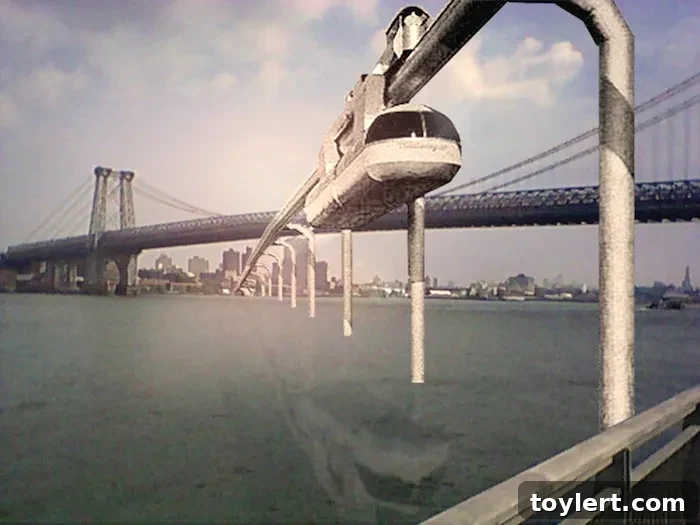
Among the many inspiring pieces, Martin McCormack’s digital collage, “A Proposal for a Rail Link Connecting Midtown Manhattan, 2 Pulaski St, Brooklyn and Coney Island,” stood out as a powerful example of the exhibition’s forward-thinking spirit. McCormack’s work transcended mere artistic commentary, offering a meticulously imagined, yet audacious, tangible solution to some of New York’s enduring transit challenges. The collage, rich in detail and conceptual depth, proposed a vital new rail connection designed to bridge existing gaps within the metropolitan transit grid.
McCormack’s proposed rail link is a strategic intervention, envisioning enhanced connectivity between the bustling economic hub of Midtown Manhattan and two distinct, yet crucial, Brooklyn locations: Pulaski Street in Williamsburg, an area that has long sought more direct rapid transit access, and the iconic recreational destination of Coney Island. This ambitious link promises to alleviate congestion on existing, overburdened lines, open up new avenues for economic development in underserved neighborhoods, and dramatically improve the ease of travel for hundreds of thousands of commuters, local residents, and tourists. His digital collage is more than just a work of art; it’s a compelling visual argument for bold infrastructure projects that challenge conventional urban planning and dare to conceive a more interconnected, efficient, and equitable city, where accessibility is paramount for all.
The Transformative Role of Art in Urban Discourse
The artists participating in Brooklyn Utopias: In TRANSITion utilized a diverse palette of artistic expressions to convey their powerful messages. While Martin McCormack’s digital collage offered a concrete proposal, other artists might have explored immersive installations that transport viewers into speculative future transit environments, or sculptures that abstractly represent the complex flow of people and vehicles. Photographic series could have documented the raw, unvarnished reality of current commutes, while conceptual designs might have presented revolutionary new transit modes.
Regardless of their chosen medium, each piece contributed to a broader, resonant narrative: that the multifaceted challenges of urban transit are not merely engineering or logistical puzzles, but deeply human issues. They are intertwined with social justice, economic opportunity, environmental sustainability, and the very fabric of community cohesion. The exhibition powerfully demonstrated how art can serve as an invaluable catalyst for public engagement, translating intricate urban planning data and policy debates into accessible, emotionally resonant forms. It actively encouraged citizens to look beyond the immediate frustrations of their daily commutes and to envision, discuss, and advocate for a radically improved future. By presenting a spectrum of radical ideas and innovative designs, the artists cultivated a vibrant space for critical thinking and collaborative problem-solving, inviting every visitor to ponder their own “utopias” for urban mobility.
The Historic Setting: The Old Stone House
The exhibition found its home at the historic Old Stone House, located at 336 3rd Street in the vibrant Park Slope neighborhood of Brooklyn. This choice of venue was particularly symbolic, creating a powerful juxtaposition between a site steeped in local history and contemporary artistic discourse on the future of urban development. The Old Stone House, itself a landmark of community gathering and historical significance, provided an intimate yet impactful backdrop for such a thought-provoking display. Its location within Park Slope, a diverse and dynamic Brooklyn enclave with its own unique transportation dynamics, further grounded the exhibition in local experiences while resonating with universal urban themes.
The opening reception for Brooklyn Utopias: In TRANSITion, which took place from 6:30 to 9 PM, served as a bustling nexus of intellectual and artistic exchange. Attendees, including art enthusiasts, urban planners, policy makers, and concerned community members, converged to engage with the artists’ visions and to collectively discuss the pressing future of transit in New York City. Events of this nature are indispensable for fostering robust community dialogue, mobilizing collective action, and generating momentum toward tangible improvements in urban infrastructure, creating a shared vision for a more connected future.
For those interested in visualizing the exact geographical context of the Old Stone House and its vibrant surroundings within the intricate urban fabric of Brooklyn, a detailed map view can be conveniently accessed here.
Conclusion: Charting a Course for Sustainable Urban Mobility
Brooklyn Utopias: In TRANSITion was undeniably more than just an art exhibition; it was a profound critical examination and an inspired reimagining of urban mobility. By uniquely bringing together the creative insights of 19 artists and designers to address pressing transit challenges, the exhibition not only brilliantly illuminated existing problems but also showcased the boundless potential for truly innovative and human-centric solutions. From tackling pervasive congestion and mitigating rising costs to bridging debilitating transportation deserts and fostering equitable access for all, the visionary concepts presented offered a hopeful and compelling glimpse into a future where New York City’s transit system genuinely serves all its inhabitants with unparalleled efficiency, sustainability, and profound equity.
The exhibition unequivocally demonstrated the inherent power of art to inspire meaningful change and drive crucial discussion on fundamental civic issues. Such platforms are vital for dynamic urban centers, providing invaluable spaces where imagination can seamlessly intersect with necessity, ultimately paving the way for the development of more thoughtful, inclusive, and effective urban planning strategies. The groundbreaking ideas sparked by these 19 visionary artists and designers continue to resonate deeply, urging us all to consider our own roles in actively shaping the future, not just of our urban landscapes, but of the very quality of life within them.