Eastern Parkway: Tracing a Century of Brooklyn’s Urban Transformation
A profound look at the dramatic evolution of Brooklyn’s iconic Eastern Parkway, from its visionary beginnings to its vibrant present.
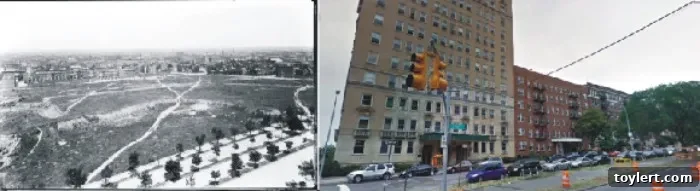
The Unveiling of Change: Eastern Parkway Then and Now
Few vistas in the sprawling borough of Brooklyn encapsulate the relentless march of time and urban development quite as vividly as Eastern Parkway. A comparative glance at its appearance in 1900 versus its bustling contemporary form reveals a transformation so profound it borders on the miraculous. What was once an expanse of open fields, crisscrossed by rudimentary dirt tracks, has blossomed into a formidable urban artery, a densely populated corridor lined with imposing apartment buildings and a rich tapestry of street life.
The visual evidence from over a century ago offers precious few hints of the monumental changes that lay ahead. It’s almost impossible to imagine that the vast, undeveloped terrain captured in early photographs would, within a mere twenty-five years, largely give way to the architectural might of residential and commercial structures. This dramatic evolution of Eastern Parkway stands as a testament to Brooklyn’s dynamic growth, its unwavering appeal, and the ambitious vision of its early planners.
The Visionaries: Crafting Brooklyn’s First Parkway
To truly appreciate Eastern Parkway’s journey, one must delve into its origins. Conceived in the mid-19th century by the illustrious landscape architects Frederick Law Olmsted and Calvert Vaux – the very minds behind New York City’s Central Park and Brooklyn’s Prospect Park – Eastern Parkway was a pioneering urban planning endeavor. It was not merely a road but Brooklyn’s first official “parkway,” a revolutionary concept designed to connect green spaces and provide a scenic, tree-lined thoroughfare for leisurely carriage rides, far removed from the grime and congestion of industrial city streets.
Their grand vision for Eastern Parkway was laid out in the 1860s and 1870s, long before much of the surrounding land was settled. The idea was to create an elegant, wide boulevard, featuring a central mall for pedestrians, flanked by roadways and rows of stately trees. This deliberate design aimed to blend the aesthetic beauty of a park with the functionality of an urban street, fostering a sense of civic grandeur and offering residents an escape into nature within the urban fabric. At its inception, the areas adjacent to the parkway, particularly the northern stretches, were largely undeveloped, awaiting the inevitable wave of population growth and construction.
Brooklyn’s Boom: The Era of Rapid Urbanization
The late 19th and early 20th centuries heralded an unprecedented era of growth for Brooklyn. Factors such as booming immigration, industrial expansion, and the subsequent extension of elevated trains and subways dramatically reshaped the borough’s landscape. These infrastructural advancements made previously remote areas accessible and desirable for development, fueling a massive construction boom. It was within this context that the seemingly prescient prediction – that the open fields of Eastern Parkway would soon be built upon – began to materialize with astonishing speed.
By the 1920s, the bucolic scenes of 1900 had become a distant memory. Land values soared, and developers moved swiftly to meet the escalating demand for housing. The stately apartment buildings that now define the northern side of Eastern Parkway began to rise, transforming the once-vacant plots into a dense, vertical landscape. Architects embraced various styles of the era, from Beaux-Arts to Art Deco, contributing to a diverse and imposing streetscape. This period of rapid urbanization cemented Eastern Parkway’s status not just as a scenic route, but as a vital residential corridor, accommodating a burgeoning population drawn to Brooklyn’s promise.
Eastern Parkway Today: A Vibrant Urban Tapestry
Today, Eastern Parkway is far more than just a roadway; it is a pulsating artery of Brooklyn life, a testament to enduring urban planning, and a hub of cultural activity. The “vastly built up collection of streets and buildings” that characterizes the present-day scene speaks volumes about a century of relentless development. Large apartment complexes, many dating back to the early 20th-century boom, stand shoulder to shoulder, housing a diverse community that reflects Brooklyn’s global appeal.
The parkway seamlessly connects some of Brooklyn’s most cherished institutions and green spaces. It serves as the gateway to the world-renowned Brooklyn Museum, the serene Brooklyn Botanic Garden, and the magnificent Prospect Park. Its central pedestrian mall, originally envisioned for leisurely strolls, continues to provide a crucial green respite for residents, a place for dog walkers, joggers, and families to gather amidst the urban bustle. This blend of historic architecture, vibrant community life, and access to cultural landmarks makes Eastern Parkway a uniquely compelling destination within New York City.
Architectural Evolution and Enduring Significance
The architectural narrative of Eastern Parkway is a fascinating study in adaptation and preservation. While the initial parkway concept emphasized natural beauty and open space, the pressures of urban growth necessitated a denser form of development. Yet, the parkway’s inherent design, with its generous width and central green spine, allowed for the construction of significant residential buildings without completely sacrificing the initial aesthetic. Many of these structures, with their intricate facades and grand lobbies, are now considered architectural gems, contributing to the area’s rich historical character.
Designated as a historic district in its own right, Eastern Parkway stands as a living museum of urban planning and residential architecture. It demonstrates how a visionary landscape design can not only endure but also evolve to meet the demands of a growing metropolis. The thoroughfare plays a crucial role in Brooklyn’s identity, hosting major annual events such as the vibrant West Indian Day Parade, which transforms the parkway into a spectacular display of culture, music, and community spirit, drawing hundreds of thousands of spectators.
Beyond the Concrete: Eastern Parkway’s Legacy
Eastern Parkway’s journey from a series of dirt roads in an open field to a dynamic urban boulevard is a microcosm of New York City’s broader narrative of transformation and resilience. It epitomizes the ongoing dance between nature and urbanity, between initial planning ideals and the powerful forces of development. The clues that were “few” in 1900 have today materialized into an undeniable reality, showcasing a landscape entirely reimagined yet still deeply rooted in its founding principles.
The profound changes observed along Eastern Parkway remind us that cities are living entities, constantly evolving and adapting. What remains constant is the enduring spirit of Brooklyn – a spirit of innovation, community, and an unyielding capacity for growth. Eastern Parkway serves not just as a transportation route, but as a historical corridor, a cultural stage, and a vibrant home, continuing to shape the lives of countless New Yorkers a century after its dramatic transformation began.