Echoes of the Past: Unearthing Flatlands Brooklyn’s Dutch Farming Legacy
In the bustling heart of modern Brooklyn lies a rich tapestry of history, much of it woven from the agricultural roots that once defined its landscape. One such story, vivid yet often overlooked, centers around an old Dutch farm in Flatlands, a vibrant community with deep historical connections. Though the physical farm may be gone, its legacy endures, brought to life through personal narratives and cherished family photographs. These never-before-published glimpses into the early 20th century offer a rare window into a time when Flatlands, now a dense urban neighborhood, was primarily a verdant expanse of working farmland.
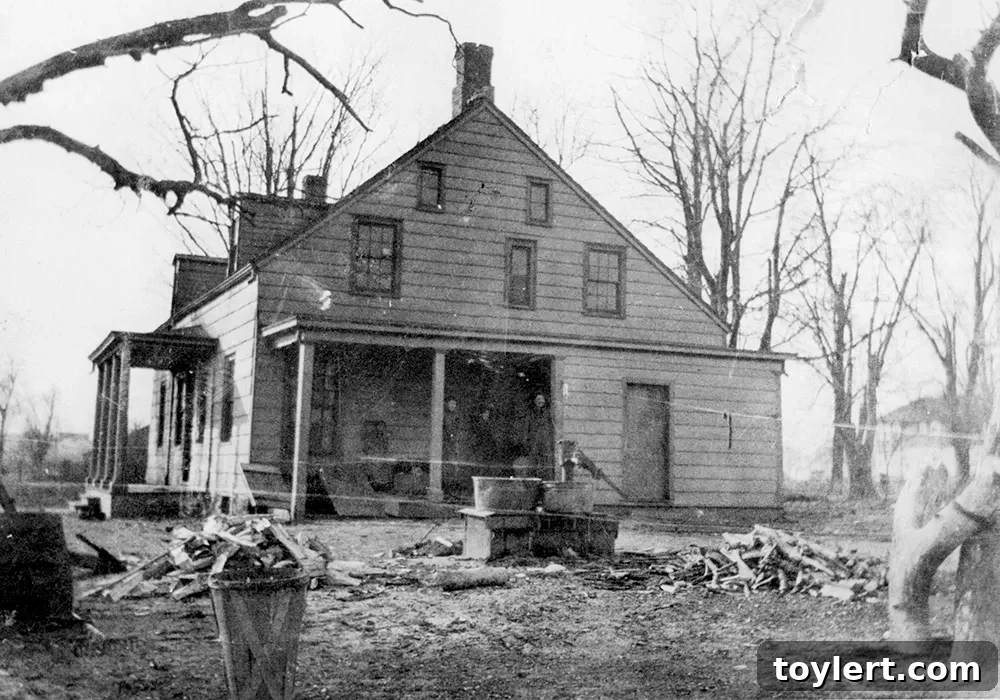
The image above captures the very essence of this lost era: The Kouwenhoven Farmhouse, a structure that stood as a testament to the region’s enduring Dutch heritage. For a quarter of a century, from approximately 1900 to 1925, this stately home served as the dwelling for a family deeply entrenched in the daily rhythms of farm life. The figures visible on the porch are not merely decorative elements; they represent the dedicated farm hands whose labor cultivated the land and fed a burgeoning city. Their presence reminds us of the communal effort required to sustain such an operation, a stark contrast to the independent, solitary image often associated with farming.
The Life of a Tenant Farmer: Robert Buckley and the Kouwenhoven Estate
The story deepens with the account of Robert Buckley, a tenant farmer whose life and livelihood were intricately tied to the Kouwenhoven estate in Flatlands. As shared by a descendant currently residing in Park Slope, Buckley was a “market man” for the Kouwenhovens from the late 1800s through the early 1920s. This designation as a “market man” was crucial, highlighting his role not just in cultivating the land but also in bringing its bounty directly to the consumers. His days were long, beginning before dawn, as he loaded his horse-drawn wagon with fresh produce, making the arduous journey from the farm along Kings Highway to the bustling Wallabout Market.
Tenant farming in this period was a common arrangement, especially in areas like Brooklyn that were gradually transitioning from rural to urban landscapes. Farmers like Robert Buckley would lease land from wealthier landowners, often families like the Kouwenhovens who had deep roots in the area, sometimes tracing back to the original Dutch settlers. In exchange for their labor and a share of the harvest or a fixed rent, tenant farmers gained access to land they might not otherwise afford. This system allowed for continued agricultural productivity while landowners could gradually prepare for the eventual sale and development of their properties. Buckley’s dedication underscores the resilience and entrepreneurial spirit required to thrive in such a demanding profession.
From Field to Market: The Produce and Livestock of a Flatlands Farm
The fertile lands of Flatlands, nurtured by generations of Dutch farming practices, yielded an impressive variety of crops essential to feeding the rapidly expanding population of New York City. Robert Buckley’s wagon, a vital link between the farm and the urban populace, would be laden with staples such as potatoes, a versatile and caloric cornerstone of the diet; hearty cabbage, a resilient crop well-suited to the local climate; earthy beets, valued for their roots and greens; and crisp celery, increasingly popular for its flavor and perceived health benefits. These weren’t luxury items but fundamental ingredients that sustained countless families across Brooklyn and beyond, highlighting the critical role these local farms played in the region’s food supply chain.
Beyond the bountiful vegetable plots, the Kouwenhoven farm was a microcosm of sustainable agriculture, housing a variety of livestock. Among these, Bossy, a beloved dairy cow, stands out, illustrating the personal connection farmers had with their animals. Dairy cows were indispensable, providing fresh milk, cream, and butter, products that were in high demand and offered a steady source of income. The presence of livestock not only diversified the farm’s output but also contributed to the ecological balance, with animal waste serving as natural fertilizer for the fields. This integrated approach to farming was typical of the era, maximizing efficiency and minimizing waste long before such concepts became modern buzzwords.
Kings Highway and Wallabout Market: Lifelines of Early 20th Century Brooklyn
The journey Robert Buckley undertook from the Flatlands farm to Wallabout Market was more than just a commute; it was a daily pilgrimage along two of Brooklyn’s most significant arteries. Kings Highway, a road with ancient origins, tracing its path back to Native American trails and later formalized by the Dutch as a crucial thoroughfare, served as the primary route for transporting goods and people across Brooklyn. In the early 20th century, it was still a relatively pastoral road in many sections, but its future as a major urban boulevard was already taking shape. The eventual expansion of Kings Highway, a sign of Brooklyn’s relentless urbanization, directly contributed to the demise of farms like the Kouwenhoven estate, paving the way for residential and commercial development.
At the other end of Buckley’s route lay the Wallabout Market, an iconic institution in Brooklyn history. Established in the mid-19th century near the Brooklyn Navy Yard, Wallabout Market grew into one of the largest and most vital wholesale produce markets in the nation. It was a sensory explosion: the clamor of vendors, the aroma of fresh produce, the bustling activity of merchants, and the incessant movement of wagons and early delivery trucks. Farmers from all over Long Island and Brooklyn converged here, selling their wares directly to grocers, restaurant owners, and even individual consumers seeking the freshest goods. For a “market man” like Robert Buckley, Wallabout Market was not just a destination; it was the culmination of weeks and months of hard work, the point where his labor translated into sustenance for the city and income for his family and the Kouwenhovens. Its role in shaping Brooklyn’s economy and feeding its burgeoning population cannot be overstated.
The End of an Era: Development and the Disappearance of Flatlands Farms
The period between 1900 and 1925 marked a significant turning point for Brooklyn. The relentless march of urbanization, fueled by population growth and improved transportation infrastructure, began to consume the agricultural lands that had defined much of the borough for centuries. For the Kouwenhoven farm, this inevitable transition arrived in 1925 when the land was sold to developers. This sale was not an isolated incident but part of a larger pattern across Flatlands and other historically rural parts of Brooklyn, as farm after farm gave way to new housing developments, streets, and urban amenities.
The expansion of Kings Highway, mentioned in the family caption, was both a symptom and a driver of this development. Wider roads were needed to accommodate more traffic, connect new neighborhoods, and facilitate commerce, but their construction often necessitated the acquisition and demolition of existing properties, including farms. While this development brought progress and housing for new residents, it also meant the irreversible loss of Brooklyn’s agricultural heritage. The transformation was swift and profound, reshaping the landscape and the livelihoods of families like the Kouwenhovens and Buckleys. The fields where potatoes, cabbage, and beets once grew were soon covered with houses, sidewalks, and the trappings of modern urban life.
Preserving Memories: The Enduring Importance of Family Stories
In a city as dynamic and ever-changing as Brooklyn, the preservation of personal histories and family anecdotes becomes incredibly precious. The “never-before-published family photos and stories” shared by the Brownstoner reader are more than just nostalgic mementos; they are invaluable historical documents. They provide intimate insights into daily life, economic realities, and the social fabric of a bygone era that official records often miss. These personal narratives humanize history, allowing us to connect with the individuals who lived and worked in these spaces, understanding their challenges, their triumphs, and their contributions.
The Kouwenhoven Farmhouse and the story of Robert Buckley remind us that Flatlands, now a bustling residential area, once played a crucial role in feeding New York City. It encourages us to look beyond the contemporary streetscapes and imagine the fields, the farmhouses, and the horse-drawn wagons that traversed these very same paths. By sharing these stories, we ensure that the memory of Brooklyn’s agricultural past, its Dutch roots, and the hard-working families who shaped its early development are not forgotten. They are vital threads in the rich tapestry of Brooklyn’s identity, connecting us to a heritage that continues to subtly influence the character of its neighborhoods.
This remarkable glimpse into a Flatlands Dutch farm, through the eyes of one family, offers a powerful reminder of how profoundly Brooklyn has evolved. It underscores the importance of preserving these individual stories, for they are the true custodians of our collective past, ensuring that the echoes of agrarian Brooklyn continue to resonate amidst the vibrant clamor of the modern borough.