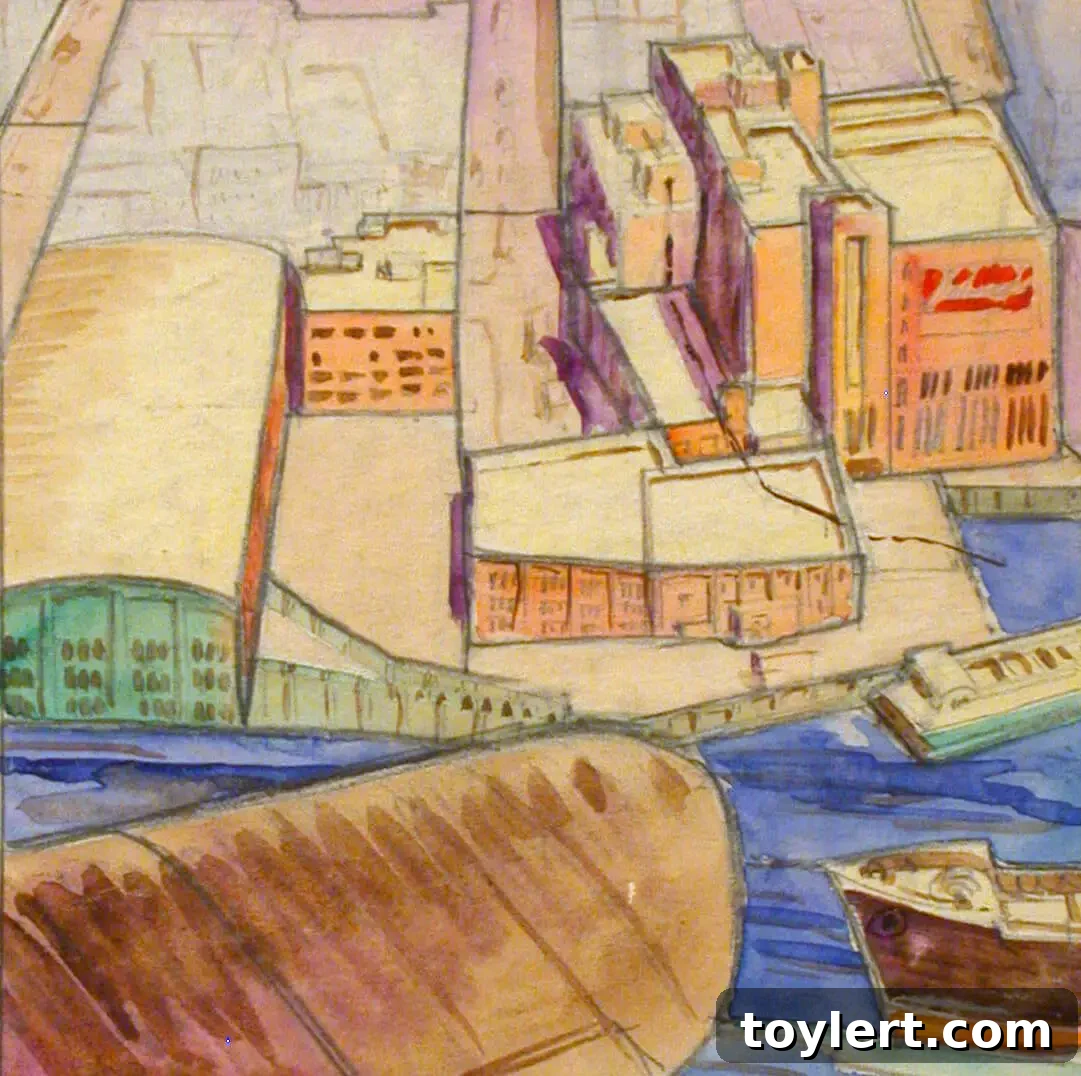
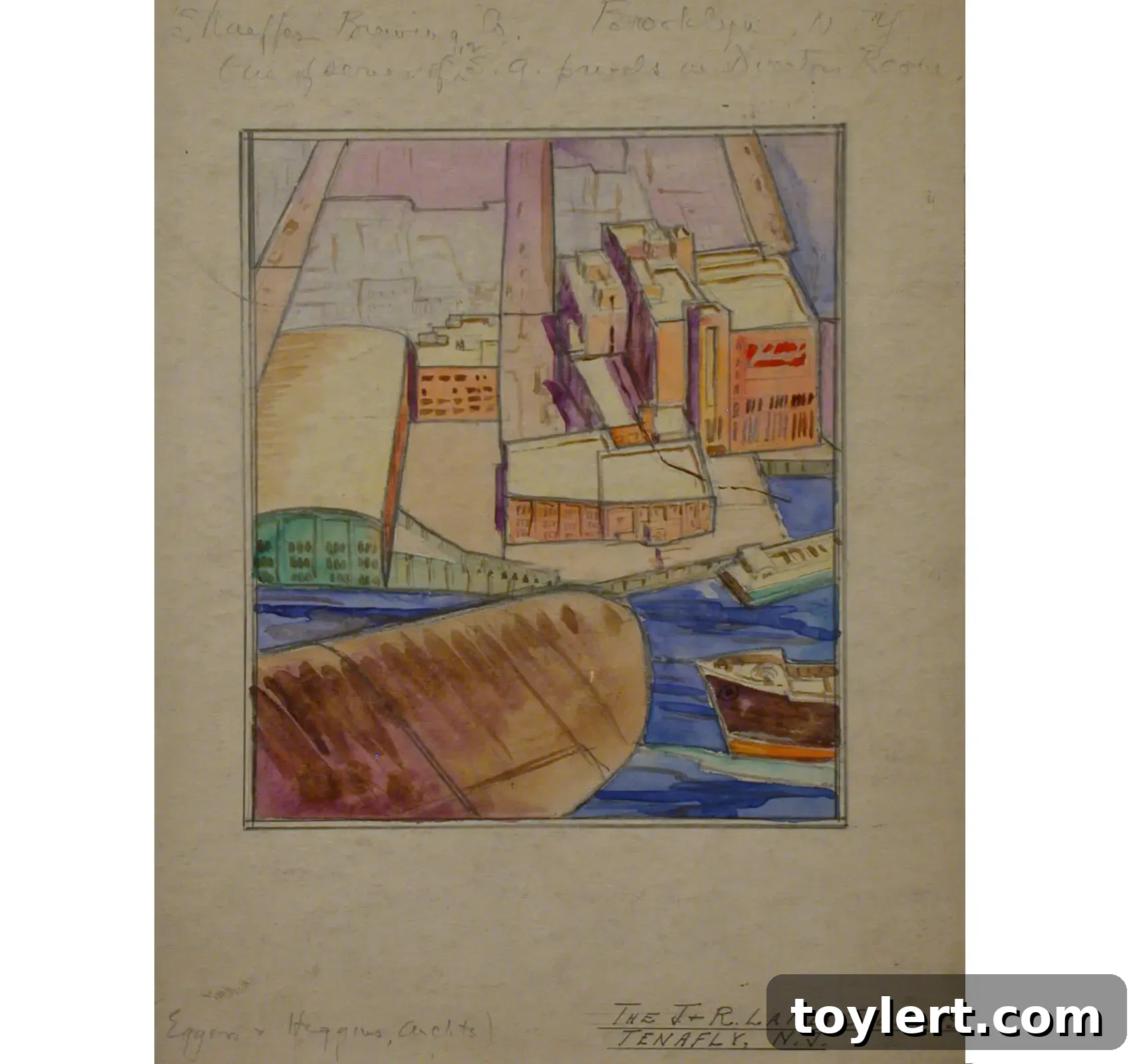
In the vibrant tapestry of New York City’s industrial past, a small, unassuming sketch can often serve as a powerful portal, unlocking forgotten narratives and revealing the intricate details of a bygone era. Such is the case with a recent discovery: a delicate drawing that offers a rare glimpse into the lost grandeur of the Schaefer Brewery on Kent Avenue in Williamsburg. This evocative piece of ephemera captures a decorative embellishment, a stained-glass design, that once might have adorned the opulent interiors of one of Brooklyn’s most iconic brewing establishments, reminding us of the artistry and aspiration woven into the fabric of daily commerce.
The Lost Grandeur of Schaefer Brewery: A Glimpse Through a Stained Glass Sketch
The sketch, meticulously preserved within the vast collections of the Library of Congress, is more than just a drawing; it’s a blueprint for a piece of history. It vividly illustrates a proposed stained-glass panel designed to depict the sprawling Schaefer Brewery complex itself, situated majestically on Kent Avenue, spanning the blocks between South 8th and South 9th streets in Williamsburg. A faded pencil notation scrawled across the top of the sketch offers crucial context, indicating that this particular design was intended for one of twelve distinct stained-glass panels. These panels were slated to grace the walls of a highly significant space within the brewery: the “Director’s Room.” This detail alone speaks volumes, suggesting a level of corporate sophistication and a commitment to aesthetic excellence that went beyond mere industrial utility.
Unearthing a Fragment of History: The Stained Glass Design
The very idea of adorning a corporate “Director’s Room” with elaborate stained-glass panels depicting the industrial complex itself is a testament to the pride and ambition of the Schaefer brewing company. Stained glass, an art form historically associated with religious edifices and grand residential estates, brought a sense of timeless elegance and bespoke craftsmanship to the heart of an industrial operation. Such a choice would have communicated not only the company’s prosperity but also its deep roots and enduring legacy within the community. Each panel would have served as a visual narrative, celebrating the architectural prowess and the scale of operations that defined Schaefer’s presence in Williamsburg. The depiction of the Kent Avenue complex would have been a powerful symbol of the company’s physical footprint and its contribution to the urban landscape, transforming a functional workspace into a gallery of corporate identity and heritage.
The Architectural Vision: Eggers & Higgins and Schaefer’s Corporate Identity
The Schaefer Brewery, while founded in Manhattan in 1842, truly found its stride and expanded its iconic presence after relocating to Brooklyn in 1916. This strategic move placed it firmly within Williamsburg, a burgeoning hub of industrial activity and a rich brewing tradition. The decades that followed, particularly the 1930s and 1940s, marked a significant period of growth and architectural transformation for the brewery. During this expansion, Schaefer engaged the services of a renowned architectural firm, Eggers & Higgins, Architects. Their name, too, is faintly penciled onto the historical sketch, reinforcing their central role in shaping the physical identity of the brewing giant.
Eggers & Higgins were not merely architects of functional buildings; they were visionaries who understood the power of corporate branding through design. Their partnership with Schaefer extended far beyond the Williamsburg complex. The firm was responsible for designing a number of high-profile projects for the beer company, most notably their innovative pavilions for the 1939 New York World’s Fair and the 1964 New York World’s Fair. These World’s Fair pavilions were grand statements of industrial progress and marketing savvy, designed to captivate millions of visitors and solidify Schaefer’s image as a modern, forward-thinking brand. The undated sketch, broadly assigned a date range of 1920 to 1950, aligns perfectly with the peak period of Eggers & Higgins’ extensive and impactful work for Schaefer, suggesting a consistent and integrated design philosophy that encompassed everything from the industrial plant to public exhibition spaces.
Schaefer’s Journey: From Manhattan Roots to Brooklyn’s Brewing Powerhouse
The story of F. & M. Schaefer Brewing Company began with humble origins in Manhattan, establishing itself as one of America’s oldest breweries. However, the move to Brooklyn in 1916 was a pivotal moment, strategically positioning the company in an area ripe with industrial advantages. Brooklyn, particularly the Williamsburg waterfront, offered superior access to transportation networks, including waterways for shipping and rail lines for distribution, along with a robust infrastructure and a skilled labor force. This relocation wasn’t just a change of address; it was an expansion of ambition, allowing Schaefer to significantly increase its production capacity and reach a wider market. During the Prohibition era (1920-1933), like many breweries, Schaefer adapted by producing non-alcoholic beverages, but with the repeal, it quickly reasserted its dominance in the beer market, capitalizing on its established reputation and expanded Brooklyn facilities.
The Golden Age of Brewing in Williamsburg
Williamsburg was, for decades, synonymous with brewing. Beyond Schaefer, legendary names like Rheingold and Liebmann (Rheingold Beer) also called this vibrant neighborhood home. This concentration of breweries created a unique industrial ecosystem, contributing significantly to Brooklyn’s economy and cultural identity. The Schaefer complex itself became a landmark, its towering structures and bustling operations a testament to American manufacturing prowess. The architectural designs by Eggers & Higgins during the post-Prohibition boom reflect an era of optimism and industrial confidence, with buildings that blended functional efficiency with a robust, often Art Deco-influenced aesthetic. The stained-glass design, depicting this very complex, would have been a proud internal display of this industrial monument, a constant reminder of the company’s physical and economic strength.
Beyond the Beer: Schaefer’s Cultural Impact and World’s Fair Presence
Schaefer was more than just a brewery; it was a cultural touchstone. Its advertising slogans, like “The one beer to have when you’re having more than one,” became ingrained in American pop culture. The decision to invest in grand pavilions at the New York World’s Fairs of 1939 and 1964 demonstrates Schaefer’s commitment to public engagement and cutting-edge marketing. These pavilions were not just places to sample beer; they were immersive experiences designed to showcase the brewing process, highlight the brand’s heritage, and project an image of innovation and American enterprise. The 1939 Fair, with its “World of Tomorrow” theme, allowed Schaefer to present itself as a forward-looking company, while the 1964 Fair continued this tradition, connecting the brand with contemporary ideals and a new generation of consumers. The architectural vision for these public spectacles would have been carefully harmonized with the brand’s overall identity, much like the internal stained-glass panels of the Director’s Room.
The Transformation of the Waterfront: Remembering Lost Industrial Giants
Tragically, the industrial landscape of Williamsburg underwent a dramatic transformation in the latter half of the 20th century. Facing increasing competition, changing consumer tastes, and mounting economic pressures, many of Brooklyn’s iconic breweries, including Schaefer, eventually ceased operations or relocated. The original Schaefer Brewery on Kent Avenue, once a symbol of Brooklyn’s industrial might, met the fate of many similar industrial sites: demolition and redevelopment. Today, the Williamsburg waterfront is dominated by residential towers, trendy businesses, and recreational spaces, a stark contrast to the gritty, bustling industrial hub it once was. The absence of these monumental structures leaves a void, but fragments like this stained-glass sketch help bridge the gap, allowing us to visualize what once stood proudly on the waterfront.
Preserving the Past: The Enduring Value of Historical Ephemera
The discovery and preservation of this simple sketch underscore the immense value of historical ephemera. These seemingly minor artifacts—a drawing, a letter, a faded photograph—are often the most direct and intimate links we have to the past. They offer granular detail that grand histories sometimes overlook, providing insights into the aesthetic sensibilities, corporate culture, and daily operations of institutions like the Schaefer Brewery. Without such items, our understanding of Brooklyn’s rich industrial heritage and the intricate stories of its lost landmarks would be significantly diminished. This sketch, therefore, is not merely a design; it is a precious historical document, illuminating the ambition, artistry, and architectural legacy of a company that brewed its way into the heart of New York City.
Conclusion: A Legacy Etched in Time
The stained-glass design for the Schaefer Brewery’s Director’s Room is a profound artifact, a testament to an era when even industrial spaces were imbued with a sense of architectural pride and artistic detail. It opens a unique window into the world of one of America’s great brewing enterprises, revealing the collaborative vision between the Schaefer company and the esteemed architects Eggers & Higgins. While the physical brewery on Kent Avenue may be long gone, replaced by the ever-evolving landscape of Williamsburg, this sketch ensures that its legacy endures. It reminds us that history is often found in the most unexpected places, preserved in the delicate lines of a forgotten drawing, waiting to tell the story of a lost landmark and the indelible mark it left on Brooklyn and beyond.