This is the second installment in the compelling story of Reverend William Gibb’s journey and the spiritual awakening he brought to Brooklyn. If you haven’t already, we invite you to read Part 1 to fully appreciate the unfolding narrative.
From Theatrical Stages to Sacred Stages: Reverend William Gibb’s Divine Call to Brooklyn
The late 19th century was an era of profound spiritual ferment across North America, a time when fervent religious revivals swept through communities, stirring souls and transforming lives. It was within this dynamic spiritual landscape that William Gibb, an actor from the picturesque maritime city of Halifax, Nova Scotia, experienced a personal revelation as dramatic and transformative as any theatrical performance he had ever graced. Much like the Biblical Saul, who encountered a blinding light on the road to Damascus and was forever changed, Gibb underwent a profound spiritual conversion that rerouted the entire course of his life.
In 1888, a year brimming with personal significance, Gibb made an unequivocal decision to abandon his career on the stage. Though the stage had offered him a livelihood, it hadn’t necessarily brought him great success, and perhaps, more importantly, it had left a void that no applause could fill. Instead, he chose to dedicate himself wholly to the pulpit, filled with a newfound, unshakeable zeal for the Lord. This was no mere career change; it was a divine calling, a complete reorientation of his purpose, setting him on a path that would ultimately lead him far beyond the familiar shores of Canada.
An Emerging Voice in Nova Scotia’s Spiritual Landscape
William Gibb’s initial foray into ministry began humbly but with great passion in his home province of Nova Scotia. He embarked on a journey of itinerant preaching, moving from one church to another, sharing his powerful testimony and delivering sermons that resonated with the hearts of his listeners. His earnest conviction and engaging speaking style, perhaps honed during his years as an actor, quickly distinguished him. He wasn’t confined by rigid denominational boundaries in his early efforts, reaching out to various congregations seeking spiritual renewal.
His dedication and the evident sincerity of his faith did not go unnoticed. Eventually, his ministry gained official recognition and sanction from a non-denominational Pentecostal church. This was a significant step, marking his transition from an independent preacher to an ordained pastor. The Pentecostal movement, though still in its nascent stages globally during this period, was characterized by its emphasis on personal experience, spiritual gifts, and a fervent evangelistic spirit. Gibb, with his dramatic conversion and passionate delivery, was a natural fit for this burgeoning movement, which sought to bring a fresh, experiential dimension to Christian faith.
As an installed pastor, Reverend Gibb embraced the full scope of his responsibilities with vigor. He became a central figure in the spiritual lives of his congregants, officiating at sacred rites that marked key milestones in their journeys of faith. He baptized children, welcoming them into the Christian community, and administered baptisms to adults who, like himself, had experienced profound personal conversions. He also solemnized marriages, binding couples in holy matrimony and offering guidance as they embarked on their shared lives. Reverend Gibb was himself a married man, and he and his wife formed a dedicated partnership, sharing in the quiet, fulfilling work of ministry within their local Halifax community.
The Unmistakable Call to Brooklyn: A Vision Beyond Borders
For many, such a life—a respected pastor, serving a vibrant community, supported by a loving spouse—would have been the culmination of a life’s ambition. Indeed, Reverend Gibb and his wife might have remained a cherished, albeit small, part of Halifax’s rich religious tapestry, leaving a lasting legacy within their immediate sphere of influence. However, William Gibb harbored a conviction that transcended the comfortable confines of Nova Scotia. He was profoundly certain that God had a grander purpose, a more expansive mission awaiting him, and that this divine assignment lay beyond the borders of Canada.
The spiritual whispers he heard were not of continued service in familiar surroundings but of a new, uncharted territory. God, he believed with unwavering certainty, was calling Reverend Gibb to Brooklyn. This wasn’t a casual preference or a personal ambition; it was a deeply felt spiritual imperative, a powerful sense of destiny that propelled him forward. The Brooklyn of the late 19th and early 20th centuries was a magnet for such visions. It was a bustling, rapidly expanding borough, a crucible of diverse cultures and burgeoning populations, swelling with immigrants from every corner of the globe.
For a passionate evangelist like Reverend Gibb, Brooklyn represented an extraordinary opportunity. Its crowded streets, teeming tenements, and burgeoning industrial zones were ripe for spiritual harvest. It was a place where people, often far from their homelands and traditional support systems, were searching for community, meaning, and spiritual anchors in a new and often overwhelming world. The sheer scale and dynamism of Brooklyn must have presented an irresistible canvas for a man convinced of a divine mandate to spread the Gospel.
Brooklyn: A New Frontier for Revivalism
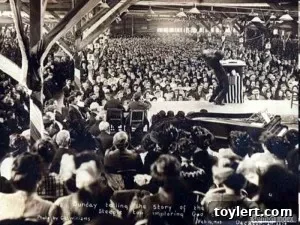
Reverend Gibb’s decision to leave Halifax for Brooklyn aligned perfectly with the broader currents of American religious history. The period was characterized by waves of revivalism, an evangelical movement aimed at stimulating widespread spiritual renewal. These revival meetings, often depicted in period photographs like the one accompanying this article, were not merely church services; they were powerful, emotionally charged gatherings designed to elicit profound personal conversions and communal spiritual awakenings. Preachers, often charismatic and dynamic, would travel from town to town, drawing large crowds with their impassioned sermons, hymns, and calls to repentance.
For Gibb, an actor turned preacher, the ability to command an audience and convey deep emotion would have been an invaluable asset in the highly theatrical world of revivalism. His experiences on the stage, far from being a distraction, would have prepared him to deliver powerful, engaging sermons that captivated and moved his listeners. The non-denominational Pentecostal leanings he acquired in Nova Scotia would also find fertile ground in Brooklyn, where numerous independent ministries and new denominations were sprouting, eager to offer a fresh perspective on faith that often bypassed the more rigid structures of established churches.
The move to Brooklyn, therefore, was not just a geographical relocation but a strategic step into a larger arena where his unique gifts and spiritual convictions could flourish. It promised challenges—establishing a ministry from scratch in a new city, navigating a complex urban landscape, and competing with a myriad of other spiritual and secular attractions. But it also offered an unparalleled opportunity to impact thousands of lives, to build a new spiritual community, and to fulfill what he deeply believed was God’s grand plan for his ministry.
As Reverend William Gibb and his wife prepared to cross the border, leaving behind the familiar comforts of Nova Scotia for the sprawling promise of Brooklyn, they embarked on more than just a physical journey. They were setting out on a mission fueled by unshakeable faith, carrying the torch of revivalism to a city poised on the cusp of the 20th century. Their arrival in Brooklyn would mark the beginning of a new chapter, not only for them but for the countless souls they were destined to touch. What challenges and triumphs awaited this devoted couple as they sought to “stretch forth the saving hand” in the bustling streets of Brooklyn? The answers would unfold in the vibrant tapestry of the borough’s history.