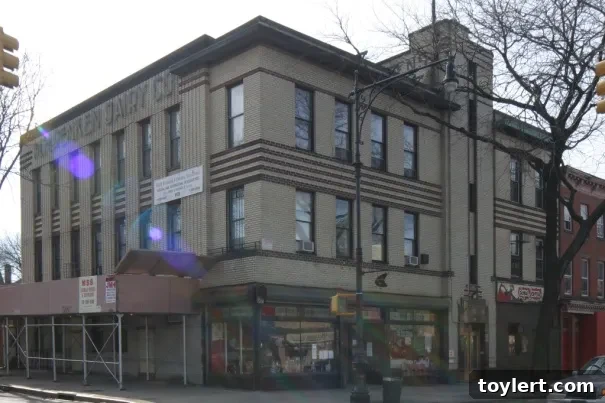
Preserving Brooklyn’s Past: The Enduring Legacy of the M.H. Renken Dairy Building
Brooklyn, a borough renowned for its rich history and distinctive architecture, is a place where every street corner tells a story, and every building holds a piece of the past. Amidst its dynamic urban landscape, certain structures stand as silent sentinels of bygone eras, offering invaluable insights into the daily lives and industries that once thrived here. One such significant edifice is the M.H. Renken Dairy Building, located prominently at 584 Myrtle Avenue, at the bustling intersection with Classon Avenue. This remarkable structure, a testament to early 20th-century commercial design and a vital component of Brooklyn’s historical milk supply chain, has recently garnered the well-deserved attention of the Landmarks Preservation Commission (LPC).
Last week, the LPC officially calendared the M.H. Renken Dairy Building, initiating the formal process for its potential designation as a protected landmark. While the Commission has yet to announce a specific date for the crucial public hearing, this preliminary action underscores the building’s recognized architectural and historical significance. Its impending review offers an opportune moment to delve into the fascinating story behind this edifice, its distinctive Moderne style, and the profound impact the dairy industry had on the health and development of Brooklyn’s burgeoning population. The LPC’s official statement of significance provides a compelling narrative, highlighting why this particular structure, built in the 1930s for milk supply and processing, is worthy of enduring protection and preservation:
The Renken Dairy Company building is an unusual example of the Moderne style of architecture applied to a small commercial structure in Brooklyn. It was constructed as an office in 1932 for the Renken Dairy, established in Brooklyn in the early 20th century. One of several such businesses in the borough, the Renken Dairy’s location in Clinton Hill created a local source for the processing and supply of milk from farms outside the city for distribution to the local population. The Renken Dairy, like others from this period, originally consisted of a group of buildings where the milk was delivered, cleaned and pasteurized, and bottled, all while being kept cool by its own ice plants. This office structure and a nearby utilitarian garage are the only surviving sections of what was once a bustling complex.
Since milk was considered a vital part of children’s diets, sources of clean, healthful milk were crucial to neighborhoods where families lived. Before easy refrigeration, it was necessary to build these processing plants throughout the city. Dairies and their milkmen were a fundamental part of the lives of most children at that time.
This office building was designed by the firm of Koch & Wagner in the Moderne style, popular in the early 1930s. This style was a simplified version of the earlier Art Deco style, featuring light colors and straight lines to provide a sense of dynamism related to machines and their speed, seen as emblematic of the 20th century. The building design is expressed through horizontal bands of red brick against a light brick background and projecting or recessed planes on the building’s facades. The firm of Koch & Wagner designed numerous industrial, commercial and residential properties, primarily in Brooklyn and Queens, from 1910 until 1951. This building serves as a reminder of an earlier, more pastoral time in Brooklyn’s history, when most neighborhoods had a local milk processor for local distribution to insure the product’s freshness and quality.
Unpacking the Moderne Marvel: Design and Context of 584 Myrtle Avenue
As highlighted by the Landmarks Preservation Commission, the M.H. Renken Dairy Company building stands out as a unique application of the Moderne architectural style, especially for a commercial structure of its size in Brooklyn. Erected in 1932, it served as the core administrative office for the Renken Dairy, a company that had firmly established its operations in the borough during the initial decades of the 20th century. The building’s design by the esteemed firm of Koch & Wagner encapsulates the spirit of the early 1930s, reflecting a significant shift in architectural aesthetics.
The Moderne style, a dominant design trend of its era, represented a streamlined evolution from the more decorative Art Deco movement that preceded it. While Art Deco celebrated intricate ornamentation, elaborate geometric patterns, and often bold, contrasting color palettes, Moderne architecture embraced a philosophy of sleek simplicity and functional elegance. It was a style deeply influenced by the machine age, aiming to convey a sense of dynamism, speed, and forward-thinking optimism through its clean lines and unadorned surfaces. Characteristically, Moderne buildings often featured light colors, horizontal emphases, and a focus on essential forms, embodying the technological advancements and modern aspirations of the 20th century.
Koch & Wagner’s execution of the Moderne style at 584 Myrtle Avenue is particularly noteworthy. The building’s facades are visually striking, articulated by distinct horizontal bands of red brick set against a lighter brick background. This thoughtful combination of materials and colors not only creates a compelling visual rhythm but also emphasizes the building’s linear quality—a signature element of Moderne design. Furthermore, the deliberate use of projecting and recessed planes on the facades adds subtle depth and shadow play, contributing to its sophisticated yet understated appearance. These design choices collectively communicated the modernity, efficiency, and reliability that were central to the Renken Dairy’s brand and mission, ensuring the public’s trust in their vital product.
The firm of Koch & Wagner, active from 1910 until 1951, left an indelible mark on the built environment of New York City, with a substantial presence in Brooklyn and Queens. Their prolific output included a wide array of industrial, commercial, and residential properties, showcasing their adaptability and influence. The Renken Dairy Building is a testament to their capacity to integrate contemporary architectural styles into functional structures, making its preservation crucial for appreciating the breadth of their legacy and the architectural narrative of these boroughs.
The Renken Dairy and Brooklyn’s Vital Milk Supply: A Historical Perspective
Beyond its architectural merit, the M.H. Renken Dairy Building holds immense historical significance, deeply intertwined with the critical role of the Renken Dairy Company in the everyday lives of Brooklynites. As the LPC statement emphasizes, the dairy, established in the early 20th century, was one of several such vital businesses in the borough. Its strategic location in Clinton Hill was not arbitrary; it created a localized source for the processing and supply of milk from farms situated outside the city, ensuring efficient distribution to the local population.
In an era before widespread and affordable home refrigeration, the purity and freshness of milk were paramount, particularly for children, whose diets relied heavily on this essential nutrient. This made the existence of numerous local processing plants throughout the city an absolute necessity. These urban dairies served as crucial intermediaries, transforming raw farm milk into a safe, consumable product. The original Renken Dairy, as described by the LPC, was a “bustling complex” far larger than the office and utilitarian garage that survive today. It comprised a sophisticated group of buildings where a multi-stage process unfolded: milk was delivered, meticulously cleaned, pasteurized (a revolutionary health advancement of the time), and then carefully bottled. To maintain its freshness, the entire operation was kept cool by the dairy’s own ice plants, a testament to the advanced infrastructure required for such an enterprise.
The Renken Dairy, like its contemporaries, played a fundamental role in the lives of most children and families. The daily presence of the milkman, a familiar and trusted figure in neighborhoods across Brooklyn, symbolized a direct and reliable connection to this vital food source. This system fostered a sense of community and ensured that even the most densely populated urban areas had access to fresh, healthful milk, which was crucial for combating common childhood diseases and promoting general well-being. The dairy’s operations were not just a commercial venture; they were an essential public health service, contributing significantly to the welfare and development of Brooklyn’s rapidly expanding population.
The Imperative of Preservation: Securing Brooklyn’s Industrial and Architectural Heritage
The Landmarks Preservation Commission’s decision to calendar the M.H. Renken Dairy Building for potential landmark status is a crucial step in recognizing and safeguarding Brooklyn’s layered history. This action of “calendaring” signifies that the LPC has officially deemed the building worthy of consideration for landmark protection, initiating a formal review process that involves comprehensive research, public hearings, and ultimately, a vote by the commissioners. This rigorous process ensures that decisions regarding a building’s future are made with careful consideration of its historical, architectural, and cultural significance to the city.
Preserving structures like the Renken Dairy Building extends far beyond mere aesthetics; it is about protecting tangible links to our collective past and understanding the evolution of urban life. As the LPC’s statement poignantly notes, this building “serves as a reminder of an earlier, more pastoral time in Brooklyn’s history, when most neighborhoods had a local milk processor for local distribution to insure the product’s freshness and quality.” It allows contemporary residents to visualize an era when urban and agricultural spheres were more closely intertwined, and community infrastructure was meticulously designed to serve immediate local needs for essential goods. This connection to a bygone era provides invaluable context for understanding the city’s development and the ingenuity of past generations.
Furthermore, the M.H. Renken Dairy Building’s distinct Moderne architecture offers a vital educational resource. It provides a real-world example of a significant architectural style that defined an era, illustrating how sophisticated design principles were applied to functional industrial and commercial structures. Its preservation helps maintain the architectural diversity that is a hallmark of Brooklyn, preventing the homogenization of its streetscapes and protecting the rich visual storytelling embedded within its built environment. Each preserved landmark contributes to the borough’s unique identity and heritage, enriching the urban fabric for both current and future inhabitants.
In an age of rapid development and constant transformation, safeguarding heritage sites like 584 Myrtle Avenue ensures that future generations can meaningfully connect with the stories of their city. It underscores the importance of local businesses, groundbreaking public health initiatives, and the architectural innovations that characterized the early to mid-20th century. The Renken Dairy Building is not merely a structure; it is a profound historical document, a cultural artifact, and a proud emblem of Brooklyn’s resilient, resourceful, and continually evolving past.
Conclusion: A Future for Brooklyn’s Past
The M.H. Renken Dairy Building at 584 Myrtle Avenue stands as a compelling synthesis of architectural distinction and profound historical significance. Its elegant Moderne design, masterfully crafted by Koch & Wagner, provides a rare and well-preserved glimpse into the aesthetic sensibilities of the 1930s, offering a streamlined counterpoint to the more elaborate styles of its time. Simultaneously, its origins as the nerve center of the Renken Dairy Company illuminate a critical chapter in Brooklyn’s public health and economic development, highlighting the indispensable role of local dairies in nourishing a burgeoning metropolis and ensuring the well-being of its citizens.
The Landmarks Preservation Commission’s proactive step in calendaring this edifice for potential landmark status is a testament to its recognized value, initiating a crucial dialogue about the importance of preserving industrial heritage and representative architectural styles. As Brooklyn continues its dynamic evolution, structures like the M.H. Renken Dairy Building serve as vital anchors, connecting contemporary urban life to the industrious spirit and architectural achievements of previous generations. Its potential landmark designation will ensure that this significant piece of Brooklyn’s past is not merely remembered, but actively celebrated, understood, and protected for generations to come, enriching the borough’s narrative and fostering a deeper appreciation for its enduring legacy.
Photo from the LPC