Navigating Change: An In-Depth Look at Park Slope’s Revised School Rezoning Plan
The landscape of public education in bustling urban centers like Park Slope, Brooklyn, is constantly evolving. With growing populations and the imperative to ensure equitable access to quality schooling, the New York City Department of Education (DOE) frequently undertakes school rezoning efforts. These initiatives, while essential for managing resources and addressing overcrowding, often ignite passionate debate within the affected communities. Recently, the DOE unveiled its revised plan for elementary school rezoning in Park Slope, a move that has left many parents, particularly those connected to P.S. 321, expressing significant frustration, according to reports from DNAinfo.
This article delves into the specifics of the DOE’s updated proposal, examining its key components, the rationale behind the changes, and the reactions from Park Slope residents. We will explore how the plan impacts specific schools, introduces a new educational facility, and grapples with the ever-present concerns surrounding school diversity and community cohesion. Understanding these complex dynamics is crucial for appreciating the challenges and opportunities inherent in shaping the future of public education in one of Brooklyn’s most vibrant neighborhoods.
The Revised Plan: Key Changes and Rationale
The latest iteration of the Park Slope school rezoning plan represents a significant adjustment following initial proposals and extensive community feedback. While some schools, notably P.S. 39, remain unaffected by the revised boundaries, and plans for P.S. 10 and P.S. 107 continue as originally proposed last month, the most substantial changes center around P.S. 321. This beloved and high-achieving elementary school is at the heart of the current community discussion due to the DOE’s decision to carve out a substantial portion of its existing zone.
Impact on P.S. 321 and the Birth of a New School
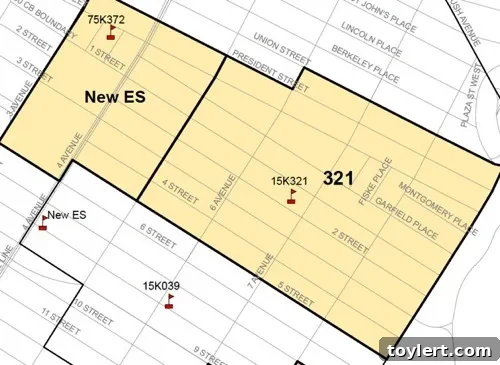
Under the new rezoning plan, 13 blocks situated west of 5th Avenue will be removed from P.S. 321’s traditional attendance area. This geographical shift, clearly illustrated in the zoning map displayed above, means that children residing in this newly designated area will no longer be zoned for P.S. 321. Instead, they will be directed to a brand-new elementary school slated to open its doors next year at 211 8th Street. Carrie Marlin, the Department of Education’s Director of Planning, addressed the community at a public meeting where the revised scenario was unveiled. She articulated that the new plan is perceived as “a better fit based on the feedback we’ve gotten,” suggesting that community input, to some extent, influenced these modifications.
The creation of a new elementary school at 211 8th Street is a pivotal element of this rezoning strategy. It aims to alleviate overcrowding in existing Park Slope schools, particularly P.S. 321, which has experienced significant enrollment pressures due to the neighborhood’s desirability and growth. This new facility is not just a building; it represents an opportunity to establish a new educational hub within the community. In a move designed to ensure smooth leadership and a strong start for the new institution, the DOE has announced that P.S. 321’s current assistant principal, Elizabeth Garraway, is slated to take the helm as the new school’s principal. This decision aims to leverage established educational leadership and potentially ease the transition for families within the rezoned area by offering a familiar and respected figure at the helm of their new school.
Stabilizing Other School Zones: P.S. 39, P.S. 10, and P.S. 107
While P.S. 321 experiences significant shifts, the revised plan brings a degree of stability to other elementary schools in the district. P.S. 39, known for its vibrant community and strong academic programs, remains untouched by the current rezoning proposals. This continuity offers a measure of relief for families within its existing zone. Similarly, the previously proposed rezoning plans for P.S. 10 and P.S. 107 are holding firm. These schools, also integral to the Park Slope educational landscape, will proceed with their earlier outlined boundary adjustments, which were likely designed to manage their respective enrollment capacities and student distributions. The DOE’s approach suggests a targeted strategy, focusing its most dramatic changes on areas with the highest need for intervention, while maintaining stability where previous proposals have been deemed adequate.
Community Reactions and the Diversity Debate
The unveiling of any rezoning plan inevitably stirs strong emotions within affected communities, and the revised Park Slope proposal is no exception. DNAinfo reports that parents who find themselves cut out of P.S. 321 are “fuming,” a sentiment that underscores the deep attachment families have to their local schools and the communities they foster. The frustration often stems from a variety of factors: the disruption of established community ties, the perceived loss of access to a highly sought-after school, and concerns about property values linked to school zones. Many parents choose to live in specific areas precisely for their school districts, and changes to these boundaries can feel like a direct threat to their long-term plans and investments in the neighborhood.
Addressing Concerns about Diversity
A recurring and critical concern in school rezoning discussions, particularly in diverse urban areas like Brooklyn, is the impact on school diversity. Critics often argue that rezoning can inadvertently lead to schools becoming less diverse, creating imbalances that undermine the educational and social benefits of a multicultural student body. In response to charges that the new plan might decrease diversity at P.S. 321, Director Carrie Marlin offered a quantitative assessment. She stated that the impact would be “very very minimal,” projecting a slight shift in the kindergarten class composition from 78 percent white to 81 percent white. This statistic, while presented by the DOE to assuage fears, is often met with scrutiny by community groups and parent advocates who are deeply committed to fostering truly integrated and diverse learning environments. The debate over diversity in schools is multifaceted, encompassing not only racial and ethnic composition but also socioeconomic backgrounds, and it remains a central point of contention in many rezoning efforts across New York City.
Implications and the Road Ahead
The revised Park Slope school rezoning plan marks a significant moment for the community. For families in the 13 blocks west of 5th Avenue, it means adapting to a new educational journey at the 211 8th Street elementary school. For P.S. 321, it signifies a reduction in its enrollment zone, which could alleviate some of its historical overcrowding issues, allowing it to maintain its reputation for excellence with potentially smaller class sizes or more manageable student populations. The appointment of Elizabeth Garraway to lead the new school is a strategic move, providing continuity and experienced leadership as a new institution finds its footing.
As the plan moves towards implementation, the focus will shift to the practical aspects of transition. This includes the successful opening of the new school, the enrollment process for affected families, and ongoing communication between the DOE and the community to address any lingering questions or concerns. Rezoning is rarely a universally celebrated event; it is often a pragmatic response to complex demographic shifts and infrastructure needs. While the current plan seeks to balance the demands of growth with the desires of the community, it underscores the ongoing dialogue required to ensure that all children in Park Slope have access to a high-quality, supportive, and inclusive educational environment for years to come.
Sources:
DOE Releases New Rezoning Plan for Park Slope Schools [DNAinfo]
Plan No. 2 for Park Slope School Rezoning[Brownstoner]
Image from BOE via DNAinfo