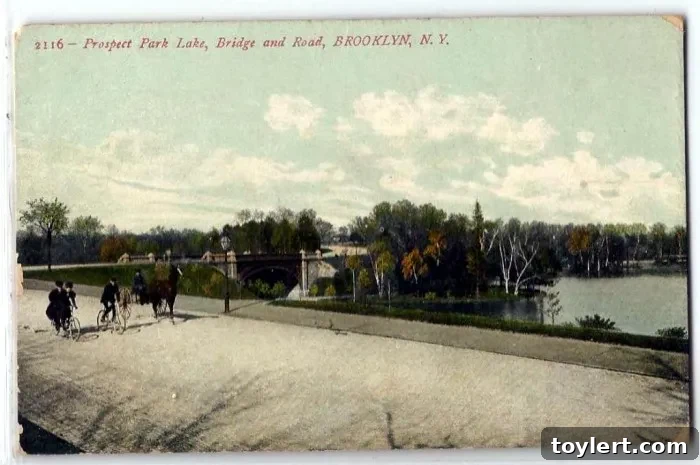
This is Part 4 of our series exploring the visionary work of architect Calvert Vaux and his profound impact on urban landscapes. Read Part 1, Part 2, and Part 3 of this compelling story.
Prospect Park: A Visionary Urban Oasis in the Heart of Brooklyn
Even before its official completion, Prospect Park captured the hearts of Brooklynites. When it first opened its gates to the public in 1867, this ambitious urban green space was still less than halfway finished, yet it immediately garnered immense acclaim. Over the subsequent six years, as construction and refinement continued, the park flourished, growing in both scale and splendor. The collaborative genius of Calvert Vaux and Frederick Law Olmsted, two titans of landscape architecture and urban planning, transformed a wild, uneven terrain into what is widely regarded as one of the world’s most magnificent urban parks. Their enduring masterpiece seamlessly weaves together the grandeur of nature with masterful architectural design, creating an indispensable green lung at the very core of Brooklyn.
The story of Prospect Park is not merely one of aesthetic triumph; it is a testament to the power of thoughtful urban planning and the creation of democratic spaces designed for the health, recreation, and spiritual well-being of city dwellers. In the mid-19th century, as industrialization swept through American cities, the need for accessible natural retreats became increasingly apparent. Vaux and Olmsted, fresh from their groundbreaking success with Manhattan’s Central Park, brought their unparalleled expertise and a shared philosophy to Brooklyn, envisioning a park that would serve as a vital counterpoint to the city’s relentless expansion.
The Genesis of a Masterpiece: Olmsted & Vaux’s Collaborative Genius
The partnership between Frederick Law Olmsted, often hailed as the father of American landscape architecture, and Calvert Vaux, a brilliant British-American architect, was nothing short of legendary. Their collaboration on Central Park in the 1850s had already set a new standard for urban park design, demonstrating an innovative approach that prioritized naturalistic landscapes and recreational opportunities over formal, ornamental gardens. When the opportunity arose to design Prospect Park, they were uniquely positioned to apply their refined principles and learning to a new, equally challenging canvas.
Olmsted’s genius lay in his ability to sculpt vast tracts of land into seemingly natural environments, masterfully manipulating topography, planting, and water features to evoke a sense of tranquility and expansive beauty. He understood the psychological impact of nature on the urban dweller and sought to create spaces that offered respite, contemplation, and active recreation. Vaux, on the other hand, brought a sophisticated architectural sensibility. His designs for bridges, buildings, and ornamental structures within the parks were not mere embellishments; they were integral components that harmonized with Olmsted’s landscape, enhancing the visitor’s experience without overshadowing the natural surroundings. Vaux’s architectural elements often served functional purposes while elevating the park’s aesthetic, guiding pathways, providing shelter, or creating dramatic vistas.
A Vision Realized: The Early Years and Public Reception
The opening of Prospect Park in 1867, though partial, was met with overwhelming enthusiasm. Brooklyn, then a rapidly growing city separate from New York City, eagerly embraced its new green heart. The park immediately became a cherished destination for residents seeking an escape from urban congestion. Families flocked to its nascent lawns and tree-lined paths, enjoying carriage rides, picnics, and leisurely strolls. This early success solidified public support for the project, ensuring the continued funding and labor necessary to bring Olmsted and Vaux’s full vision to fruition.
Over the next six years, from 1867 to 1873, work intensified. The landscape underwent a dramatic transformation, with thousands of trees and shrubs planted, vast meadows graded, and an intricate system of roads, paths, and water bodies meticulously crafted. The design consciously separated different modes of circulation – pedestrians, equestrians, and carriages – to ensure safety and enhance the visitor’s experience. This careful planning meant that a walker could immerse themselves in the quiet beauty of a secluded path, while a rider could enjoy a brisk canter without interruption, and families could take scenic drives through picturesque vistas.
The Enduring Design Philosophy: Blending Nature and Architecture
What sets Prospect Park apart, and indeed makes it a global exemplar, is the profound success of its designers in creating a landscape that feels simultaneously wild and meticulously crafted. Their philosophy was not to merely decorate nature but to enhance and interpret it, offering a heightened natural experience within an urban context. This involved a deep understanding of horticulture, hydrology, and civil engineering, all applied with an artist’s eye.
The park’s topography, originally a mix of swampy lowlands, glacial moraines, and rolling hills, was skillfully adapted. The designers leveraged the existing Kettle Ponds to create the expansive Prospect Park Lake, a defining feature that offers boating and scenic views. The ingenious use of bridges, underpasses, and berms served to conceal urban elements, creating an immersive natural environment where the city often recedes from view. Vaux’s architectural contributions, such as the elaborate boathouse, ornate pavilions, and rustic stone bridges, are not just structures; they are lyrical extensions of the landscape, framing views and inviting interaction.
Key Architectural and Landscape Elements
Prospect Park is a mosaic of distinct experiences, each carefully designed by Vaux and Olmsted:
- Grand Army Plaza: Though often considered separate, this monumental entrance, with its Soldiers’ and Sailors’ Arch, was conceived as the grand gateway to the park, a formal urban statement leading into the naturalistic expanse. Vaux played a significant role in its overall design and architectural elements.
- The Long Meadow: A vast, uninterrupted expanse of green stretching over a mile, providing space for informal recreation and a visual anchor for the park. It embodies the “pastoral” ideal of park design.
- The Ravine: A dramatic, heavily wooded area featuring waterfalls, rustic bridges, and winding paths. This section showcases the “picturesque” style, designed to evoke a sense of wild, untamed nature and offer a more contemplative, secluded experience.
- Prospect Park Lake: The largest body of water in the park, offering boating, ice skating, and a crucial habitat for diverse wildlife. Its creation involved significant engineering to dam and divert water.
- The Lullwater: A serene, winding channel connecting the Ravine to the Lake, bordered by dense vegetation and dotted with charming bridges.
- Concert Grove and The Boathouse: Vaux’s architectural brilliance is evident here. The Boathouse, a Venetian-inspired structure, provides a focal point on the lake, while the Concert Grove offered a gathering place for music and public events, reflecting the park’s role as a cultural hub.
- The Nethermead: Another large, open meadow, offering a slightly more enclosed and intimate pastoral experience than the Long Meadow.
- The Quaker Cemetery: Integrated into the park’s design, this historic cemetery predates the park and was carefully preserved, adding a layer of historical depth and mature woodland.
Vaux’s specific contributions to the architectural fabric are manifold and crucial. He designed numerous bridges, including the exquisite arched bridges over the waterways and the rustic stone bridges that blend seamlessly into the wilder sections. His designs for shelters, gazebos, and the initial concept for the Grand Army Plaza’s arch all speak to his talent for integrating functional and decorative structures within a grand naturalistic scheme. These structures were not merely decorative; they were designed to guide the eye, frame views, and enhance the overall narrative of discovery within the park.
Prospect Park’s Lasting Legacy: More Than Just a Park
By 1873, the core elements of Prospect Park were largely complete, and its reputation as a global model for urban park design was firmly established. Its success demonstrated the profound importance of investing in public green spaces, not as mere luxuries, but as essential components of healthy, vibrant cities. Prospect Park became a blueprint for subsequent park designs across America and beyond, inspiring generations of landscape architects and urban planners.
Today, Prospect Park remains Brooklyn’s foremost natural and recreational haven, serving millions of visitors annually. It continues to be a vibrant center for community life, offering everything from sprawling lawns for picnicking and sports, serene paths for walking and jogging, cultural events and concerts, and a rich ecosystem supporting a diverse array of flora and fauna. The park stands as a living monument to the foresight and artistic genius of Calvert Vaux and Frederick Law Olmsted, whose collaborative vision created an urban oasis that continues to enrich lives and connect people with nature in the very heart of the bustling city.
Their work on Prospect Park solidified their legacy as pioneers, not just in landscape design, but in the broader movement to improve public health and quality of life through accessible natural spaces. The park is a testament to the idea that nature, even within the densest urban environments, is not just a backdrop but an active, vital force capable of transforming city life.