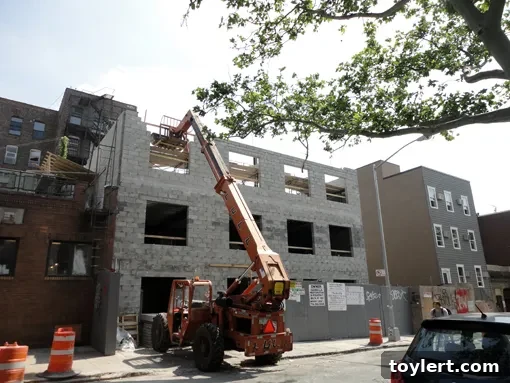
Progress at 36 Conselyea Street: A New Chapter in Williamsburg Development
Williamsburg, Brooklyn, a dynamic nexus of culture, innovation, and urban rebirth, continues its relentless transformation with a multitude of residential projects reshaping its distinctive urban landscape. Amongst these burgeoning developments, the construction at 36 Conselyea Street stands out. Strategically positioned between the vibrant thoroughfares of Lorimer and Union Avenues, this project signifies more than just the addition of another structure to the city’s skyline. It embodies a narrative of perseverance, forward momentum, and the continuous evolution of one of New York City’s most coveted neighborhoods.
This forthcoming nine-unit residential building, methodically ascending towards its intended four-story height, serves as a compelling testament to the meticulous efforts involved in contemporary urban development. Its journey is particularly noteworthy given the historical context surrounding its immediate vicinity, a past that underscores the crucial importance of robust planning and unwavering commitment to safety in construction.
Navigating a Challenging Past: The Shadow of 34 Conselyea Street Collapse
The developmental trajectory of 36 Conselyea Street has been undeniably shaped by an event that brought its precise location into sharp focus. In March 2010, the adjacent property at 34 Conselyea Street experienced a partial structural collapse. This dramatic incident resonated deeply within the local community, serving as a stark and immediate reminder of the paramount importance of stringent construction safety protocols within densely populated urban environments like New York City. The collapse, extensively covered by local media at the time, subjected the entire immediate area to intensified scrutiny, thereby highlighting the inherent risks and profound responsibilities that accompany every urban development venture.
The unfortunate event at 34 Conselyea Street transcended a mere structural failure; it tragically underscored the critical human element intrinsic to the construction industry. Contemporary reports from the period indicated that four workers suffered injuries during the incident, which immediately triggered comprehensive investigations by the New York City Department of Buildings (DOB) and various other regulatory bodies. Such occurrences vividly illustrate the delicate balance between rapid urban expansion and the imperative to rigorously safeguard the well-being of both the construction workforce and the general public. For developers and contractors operating in such close proximity to a previous incident of this magnitude, the lessons absorbed are profound, influencing every aspect from initial site preparation to ongoing structural integrity assessments throughout the construction lifecycle.
While the project at 36 Conselyea Street was distinctly separate in its planning and execution, its progression could not entirely detach itself from the gravity of its neighbor’s unfortunate experience. The necessity for exceptionally meticulous planning, the implementation of robust engineering solutions, and an unyielding adherence to the highest safety standards became unequivocally more pronounced. This pivotal past event undeniably influenced the subsequent construction methodology adopted for 36 Conselyea Street, almost certainly leading to elevated oversight, enhanced precautionary measures, and a heightened collective sense of responsibility from all stakeholders involved in bringing this new residential building to fruition.
The Vision Unfolds: 36 Conselyea Street as a Modern Residential Offering
Despite the initial challenges, and perhaps even galvanized by the imperative to demonstrate best practices, the development at 36 Conselyea Street has steadily continued its upward trajectory. This forthcoming nine-unit building is meticulously designed to achieve a four-story elevation, a common and considered height for new residential constructions in Brooklyn. This particular scale allows the building to harmoniously integrate with the existing architectural fabric of many Williamsburg blocks while judiciously maximizing urban density to meet the ever-growing housing demand.
The phrase “working its way up,” as used to describe the project’s current status, suggests a construction process that is both careful and deliberate, placing a premium on structural stability, long-term durability, and overall quality of execution. Upon its anticipated completion, 36 Conselyea Street is envisioned to deliver contemporary living spaces, thoughtfully designed and expertly tailored to meet the exacting demands of today’s discerning urban dwellers. While the intricate specifics concerning architectural style, interior material selections, and comprehensive amenity packages are typically unveiled as a project nears completion, one can reasonably anticipate features commonly found in premier new Williamsburg developments.
These anticipated features often include open-concept layouts that maximize natural light and foster a sense of spaciousness, soaring ceiling heights that amplify architectural volume, and the incorporation of energy-efficient appliances and systems that align with modern sustainability standards. Furthermore, it is plausible that residents will benefit from desirable private outdoor spaces, such as individual balconies, or a shared, meticulously designed rooftop deck offering expansive panoramic views of the vibrant neighborhood below and potentially the iconic Manhattan skyline. The overarching design philosophy for 36 Conselyea Street is expected to artfully balance sophisticated aesthetic appeal with uncompromising practical functionality, thereby appealing to a diverse demographic that could range from ambitious young professionals to growing families seeking a dynamic and connected community.
Construction Milestones and Paramount Regulatory Compliance
The intricate journey from initial groundbreaking to the final topping out of a structure like 36 Conselyea Street is inherently complex, involving a multitude of phases, each demanding rigorous adherence to local building codes and municipal regulations. For a significant project within the demanding landscape of New York City, the engagement of the Department of Buildings (DOB) is not merely a formality but a continuous and multi-faceted requirement. This engagement spans from the mandatory initial submission of comprehensive architectural plans and the painstaking process of securing all necessary permits, through a series of mandated inspections meticulously conducted at various critical stages of construction. Throughout this entire process, the DOB assumes a crucial oversight role, ensuring paramount safety, undeniable structural integrity, and unwavering compliance with all prevailing zoning ordinances and construction standards.
The critical stages of urban construction typically include, but are not limited to, the following:
- Permit Acquisition: This foundational stage involves securing all requisite approvals and permits, based on detailed architectural and engineering plans, before any physical work can commence.
- Foundation Work: A profoundly critical stage, particularly within a dense urban environment where complex geological conditions, existing subterranean infrastructure, and neighboring structures must be meticulously analyzed and managed.
- Superstructure Erection: This phase marks the visible growth of the building’s skeletal frame, progressively rising from the groundwork to its ultimate designed height of four stories, shaping the future silhouette of the structure.
- Facade Installation: This stage involves bringing the building’s exterior to life. It often necessitates the thoughtful selection and integration of materials that either reflect the inherent architectural character of the surrounding neighborhood or introduce modern, aesthetically pleasing elements.
- Interior Build-Out: A highly detailed and labor-intensive phase, involving the creation of individual residential units, the installation of comprehensive utility systems (electrical, plumbing, HVAC), and the precise finishing of all interior spaces.
- Final Inspections and Certificate of Occupancy: The conclusive and indispensable approval required before any residents can legally occupy the building. This rigorous final assessment verifies that the structure is unequivocally safe, fully compliant with all codes, and entirely habitable.
The previously documented incident at 34 Conselyea Street would have, without doubt, instilled an even greater degree of caution, meticulousness, and rigor within the inspection protocols for its immediate neighbor. Both developers and contractors involved in 36 Conselyea Street would have been acutely aware of the heightened public and regulatory scrutiny surrounding the project. This awareness would have served as a powerful impetus, ensuring that every single phase of construction at 36 Conselyea Street not only meets but demonstrably exceeds all established safety standards. This proactive and highly responsible approach serves a dual purpose: it rigorously safeguards the integrity and longevity of the project itself, and equally importantly, it actively works to rebuild and reinforce crucial community confidence in new urban developments within the district.
Williamsburg’s Evolving Landscape: A Tapestry Woven with More Than Just Buildings
The specific development at 36 Conselyea Street, while significant in its own right, is best understood as a compelling micro-example of a much broader, profound trend that continues to sweep through the entirety of Williamsburg. What was once predominantly characterized as an industrial and working-class neighborhood has, over the past few decades, undergone an astonishing transformation into a globally recognized destination. Today, Williamsburg is celebrated internationally for its vibrant artistic scene, its pioneering culinary prowess, and its exceptionally dynamic and engaged community life. This comprehensive evolution has, in turn, fueled an almost insatiable demand for housing, thereby initiating a continuous and often rapid cycle of demolition, renovation, and extensive new construction.
New residential buildings, such as the promising structure rising on Conselyea Street, play a crucial role in contributing to the robust economic vitality of the entire area. They serve as magnets, attracting a new wave of residents who, through their presence and economic activity, actively support local businesses, bolster cultural institutions, and contribute significantly to the municipal tax base. However, this period of accelerated growth is not without its inherent challenges. These often include pressing concerns about housing affordability, the potential displacement of long-term residents who have deep roots in the community, and the ongoing, delicate struggle to preserve the neighborhood’s unique and cherished character amidst rapid change. Striking an equitable and sustainable balance between the undeniable forces of progress and the vital necessity of preservation remains an enduring and complex dialogue for local officials, proactive community groups, and savvy developers alike.
The wealth of amenities available in Williamsburg undeniably enhances its allure. These include an astonishing diversity of world-class dining options, an eclectic array of independent boutiques and artisanal shops, expansive and meticulously maintained green spaces like the beloved McCarren Park, and exceptionally efficient public transportation links (including the L, G, J, M, and Z subway lines), all of which coalesce to make Williamsburg an extraordinarily attractive and highly desirable place to reside. A new development such as 36 Conselyea Street is strategically positioned to capitalize on these multifaceted advantages, aiming to offer its future residents not merely a physical dwelling, but comprehensive access to a highly desirable and enriched urban lifestyle.
Looking Ahead: The Bright Future of Conselyea Street and Beyond
As the construction at 36 Conselyea Street meticulously approaches its final stages of completion, it is poised to become an integral part of a growing constellation of modern residential buildings that are actively redefining and enhancing the streetscape of North Brooklyn. Its future inhabitants will seamlessly integrate into a vibrant, dynamic community that profoundly values innovation, fosters creativity, and champions urban connectivity. The careful and deliberate progression of this particular project, especially when viewed through the lens of its challenging historical context, stands as an exemplary model for responsible, thoughtful, and community-conscious urban development.
The compelling narrative of 36 Conselyea Street serves as a potent and timely reminder that urban development is, at its core, a continuous, iterative process of adaptation, thoughtful growth, and unwavering commitment. It vividly highlights the intricate and often delicate balance that must be struck between ambitious vision and prudent caution, between groundbreaking innovation and uncompromised safety. As Williamsburg steadfastly continues its journey as a premier, sought-after destination within New York City, projects like 36 Conselyea Street are absolutely vital to its ongoing narrative, shaping not only its evolving physical form but also nurturing and strengthening its indomitable community spirit for generations to come.
For individuals keenly interested in delving deeper into the specifics of this development or seeking a broader understanding of urban planning and real estate trends in Brooklyn, several valuable resources offer crucial insights:
- Historical Context of the Collapse: Conselyea Street Collapse Injures Four Workers [Brownstoner]
- Precise Location Details: GMAP
- Official NYC Department of Buildings Records: DOB