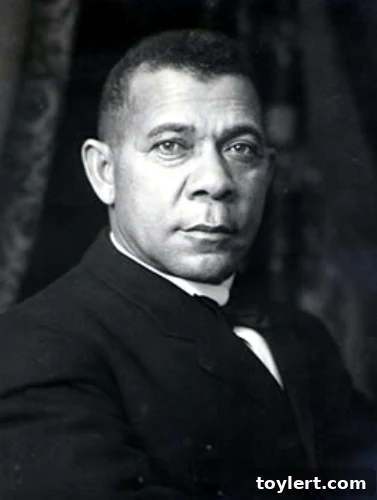
Booker T. Washington: Pioneering African American Progress in a Divided Nation
Booker Taliaferro Washington stands as one of the most towering and complex figures in American history. From 1890 to 1915, he was arguably the most famous and influential Black man in the United States, widely regarded as the principal spokesperson and leader for African Americans during a profoundly challenging era. His life’s work emerged from the ashes of slavery, navigating a nation grappling with the promise of emancipation against the harsh realities of systemic racial oppression, limited opportunities, and pervasive discrimination.
At the turn of the 20th century, African Americans found themselves technically free but largely disenfranchised. They faced tremendous obstacles in achieving social standing, economic stability, and the fundamental promise of the American dream. Washington’s rise to prominence offered a unique philosophy for advancement, one that sparked both widespread support and intense debate, ultimately shaping the trajectory of the burgeoning civil rights movement.
Early Life and the Unwavering Pursuit of Knowledge
Born into slavery in 1856 on a plantation in Franklin County, Virginia, Booker T. Washington’s early life was marked by hardship and toil. His mother, Jane, was an enslaved cook, and his father was a white man whose identity remained unknown to him. Emancipation in 1865 brought a new kind of struggle, as his family moved to Malden, West Virginia, where he worked in salt furnaces and coal mines to help support them.
Despite the arduous labor, Washington harbored an insatiable desire for education. He would wake before dawn to attend school, often walking miles, demonstrating an early and profound commitment to learning. This quest led him, at the age of 16, to the Hampton Normal and Agricultural Institute in Virginia, an institution founded to educate freedmen. His journey to Hampton, often on foot, penniless but determined, epitomized the spirit of self-reliance and perseverance that would later become the cornerstone of his philosophy. At Hampton, under the guidance of General Samuel C. Armstrong, Washington absorbed the principles of industrial education, self-help, and practical skills – lessons that would profoundly shape his vision for African American upliftment.
The Tuskegee Vision: Empowering Through Education and Industry
In 1881, at the young age of 25, Washington was handpicked to lead a new normal school for African Americans in Tuskegee, Alabama. This institution, which he built from the ground up, would become the famous Tuskegee Institute. Washington’s vision for Tuskegee was revolutionary for its time, focusing primarily on vocational and industrial training. He believed that by acquiring practical skills in agriculture, trades, and domestic sciences, African Americans could achieve economic independence and self-sufficiency, which he saw as the most viable path to respect and eventual equality.
Under Washington’s leadership, Tuskegee flourished. Students literally built the school’s buildings, grew their own food, and learned valuable trades like carpentry, masonry, blacksmithing, and printing. This hands-on approach instilled a strong work ethic and provided graduates with tangible skills to enter the Southern economy as productive citizens. Washington argued that economic advancement and the accumulation of wealth would gradually break down racial barriers, fostering a sense of indispensable contribution to the broader American society.
The Atlanta Compromise: A Complex Legacy of Accommodation
Washington’s influence reached its zenith with his powerful address at the Cotton States and International Exposition in Atlanta in 1895. This speech, famously known as the “Atlanta Compromise,” became a defining moment in American race relations. In it, Washington urged African Americans to “cast down your bucket where you are,” meaning they should focus on vocational training, agricultural pursuits, and economic development within their existing communities, rather than demanding immediate social and political equality.
He famously declared, “In all things that are purely social we can be as separate as the fingers, yet one as the hand in all things essential to mutual progress.” This statement was interpreted by many, particularly white Southerners, as an acceptance of racial segregation and a temporary deferral of civil and political rights in exchange for economic opportunity and racial harmony. While it garnered widespread acclaim from white philanthropists, industrialists, and politicians who saw it as a pragmatic solution to the “race problem,” it also ignited fierce criticism from Black intellectuals and activists who believed it conceded too much and undermined the struggle for fundamental human rights.
Influence, Networks, and Behind-the-Scenes Activism
Despite the accommodationist stance of the Atlanta Compromise, Washington was far from passive in the fight for racial justice. His immense influence stemmed not only from his public persona but also from a vast network of connections and a shrewd understanding of power dynamics. He cultivated relationships with powerful white benefactors, including presidents like Theodore Roosevelt and William Howard Taft, and industrial giants like Andrew Carnegie and Julius Rosenwald, securing crucial funding for Black schools and institutions across the South.
Behind the scenes, Washington secretly funded and supported legal challenges against Jim Crow laws, fought against lynching, and quietly worked to dismantle racial discrimination. He used his extensive influence to appoint Black individuals to government positions and to shape public discourse on racial issues. His approach was pragmatic, believing that overt confrontation would only provoke violent white backlash and derail any progress. He saw economic self-sufficiency as the foundation upon which civil and political rights could eventually be built, a strategy born from the harsh realities of the post-Reconstruction South.
Critiques and the Rise of New Voices
Washington’s philosophy, while dominant for a time, faced significant opposition, most notably from W.E.B. Du Bois. Du Bois, a Harvard-educated scholar and activist, championed a more direct and assertive approach to achieving racial equality. He condemned the Atlanta Compromise as a surrender to white supremacy, arguing that Black people should demand immediate political, social, and civil rights, rather than waiting for economic progress to change hearts and minds.
Du Bois and others, forming the Niagara Movement in 1905 and later helping to establish the National Association for the Advancement of Colored People (NAACP) in 1909, advocated for the “Talented Tenth” – the idea that a highly educated Black leadership class should lead the charge for racial equality. This ideological clash between Washington’s gradualist, economic-focused strategy and Du Bois’s demand for immediate rights defined much of the early 20th-century struggle for African American liberation, setting the stage for future civil rights movements.
Booker T. Washington’s Enduring Legacy and Connection to Urban Centers Like Brooklyn
Booker T. Washington passed away in 1915, leaving behind an incredibly complex and enduring legacy. His critics often portray him as an accommodator who inadvertently perpetuated segregation, while his admirers credit him with providing a crucial pathway for economic survival and institution-building during a perilous era. Regardless of the differing perspectives, his impact on African American education, entrepreneurship, and political strategy is undeniable. He mobilized vast resources and inspired generations to pursue education and self-improvement against overwhelming odds.
While his primary work was centered in the rural South, Washington’s ideas and influence resonated deeply in burgeoning urban Black communities across the North, including New York City’s vibrant Brooklyn. Brooklyn, with its rapidly growing African American population in neighborhoods like Bedford-Stuyvesant and Fort Greene, was a crucial hub for Black intellectual thought, entrepreneurship, and cultural expression. Washington’s emphasis on economic independence, vocational skills, and community uplift found both ardent supporters and thoughtful critics within these dynamic urban environments. His speeches and writings were widely read, discussed, and debated in Black churches, social clubs, and newspapers throughout Brooklyn, contributing to the rich tapestry of early 20th-century African American activism and aspiration.
Booker T. Washington remains a pivotal figure in American history, representing a critical transitional period. His life and work offer profound insights into the challenges and strategies for racial advancement in a nation grappling with its foundational ideals. His contributions, though debated, undeniably laid groundwork for future generations to continue the fight for true equality and justice.