Embracing History: Kameelah Janan Rasheed’s Abolitionist Art Installation Transforms Downtown Brooklyn’s Willoughby Square Park
Downtown Brooklyn is poised to witness a profound public art transformation as the city commissions borough artist Kameelah Janan Rasheed to create a compelling, text-based installation at Willoughby Square Park. This significant project is not merely an aesthetic addition but a deeply resonant homage to the area’s rich and often overlooked history in the monumental fight to abolish slavery. As Rasheed shared with Community Board 2’s Parks and Recreation Committee, her work aims to seamlessly weave the narratives of emancipation, liberation, and the ongoing pursuit of equity directly into the urban fabric of the park.
The selection of Rasheed, an artist renowned for her innovative use of text in various mediums, signals a deliberate move towards public art that provokes thought, encourages reflection, and fosters a connection between historical struggles and contemporary societal challenges. Her vision transcends traditional art spaces, inviting the public to engage with powerful ideas not within the confines of a gallery or a book, but within the very environment of their daily lives.
The Artist’s Vision: Text Beyond the Page
Kameelah Janan Rasheed’s approach to this public art installation is deeply rooted in her belief that text holds immense power, particularly when placed in unexpected, communal spaces. During the virtual committee meeting, she articulated her core philosophy: “The main thing here is to think about how text shows up in places outside of books, outside of galleries, to think about the public spaces of place where we can engrave and include questions about emancipation and liberation and the future of how we think about equity directly into the park structure.” This statement encapsulates the ambitious scope of her project, aiming to convert a public park into a living, breathing testament to history and a catalyst for future-oriented dialogue.
Rasheed’s work challenges the conventional boundaries of art, pushing text from its two-dimensional confines into a three-dimensional, interactive experience. By engraving profound questions and statements directly into the physical elements of the park—the seating areas, pathways, and even potentially a free-standing structure—she transforms the environment itself into a canvas. This method ensures that visitors don’t merely observe the art; they become part of its narrative, walking among, sitting upon, and pondering the very words that evoke Brooklyn’s abolitionist legacy and its enduring lessons for justice and equality.
The intention behind this immersive experience is multi-layered. It seeks to honor the past by bringing historical narratives to the forefront of public consciousness. It aims to provoke contemplation by presenting questions about emancipation and liberation in a tangible, unavoidable manner. Furthermore, it explicitly links these historical struggles to contemporary discussions about equity, inviting visitors to reflect on how past movements continue to inform our understanding and pursuit of a more just future. Rasheed’s work, therefore, acts as a bridge, connecting generations and inspiring a continuous dialogue on fundamental human rights within a vibrant urban setting.
Willoughby Square Park: A Historical Canvas in Downtown Brooklyn
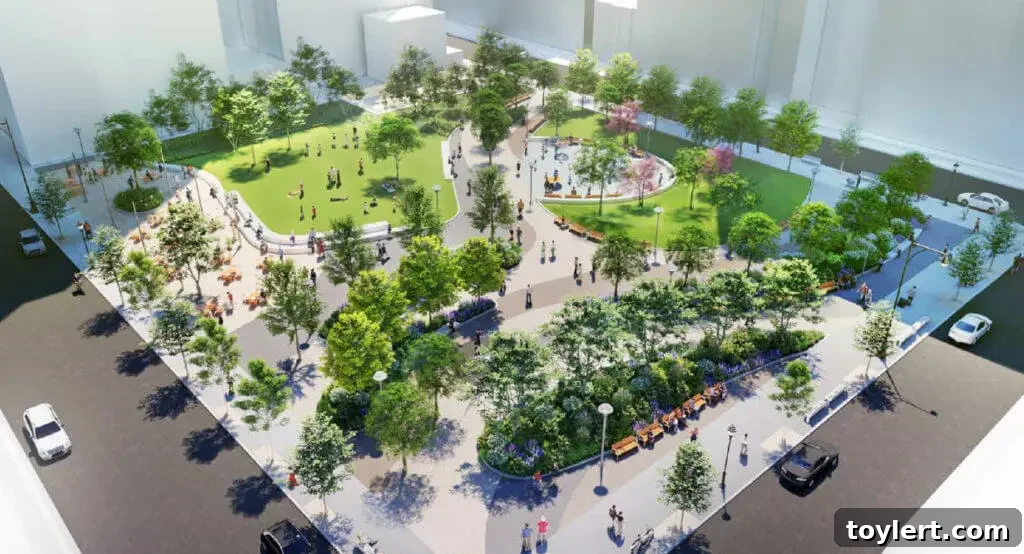
The choice of Willoughby Square Park as the site for this significant installation is no mere coincidence; it is deeply symbolic and historically resonant. Located in the bustling heart of Downtown Brooklyn, the 1.15-acre park, a project decades in the making, now stands as a modern green oasis surrounded by towering developments. However, beneath its contemporary façade lies a profound connection to Brooklyn’s storied past, particularly its pivotal role in the anti-slavery movement.
Brooklyn, a borough known for its diverse communities and progressive spirit, was a hotbed of abolitionist activity in the 19th century. Long before the Civil War, New York City and its surrounding areas, including Brooklyn, served as crucial junctions on the Underground Railroad, a clandestine network that aided enslaved people in their journey to freedom. While specific historical accounts directly linking Willoughby Square Park’s immediate footprint to these activities can be elusive, the broader Downtown Brooklyn area was a vital center for abolitionist meetings, printing of anti-slavery pamphlets, and the establishment of safe houses.
Prominent figures of the abolitionist movement, both black and white, lived and organized within Brooklyn. Churches, meeting halls, and private residences became clandestine hubs for activism. The presence of a significant free Black community in Brooklyn, including many formerly enslaved individuals, provided fertile ground for the movement to flourish. They formed vigilance committees, organized boycotts, and passionately advocated for the immediate end of slavery, often at great personal risk.
By placing Rasheed’s installation here, the city is deliberately reclaiming and highlighting this vital history. Willoughby Square Park, with its capacity to draw diverse crowds from residents to office workers and tourists, becomes an ideal public classroom. It offers an opportunity to educate and remind visitors of the sacrifices made and the battles fought for basic human dignities right in their immediate environment. The park transforms from a simple recreational space into a powerful memorial and a constant reminder of the enduring fight for freedom and justice that defines a significant part of Brooklyn’s identity.
The Installation’s Design and Enduring Impact
Kameelah Janan Rasheed’s plan for the Willoughby Square Park installation outlines an innovative approach to public commemoration. The artist intends to engrave text directly into the park’s seating and ground surfaces, creating an intimate, interactive experience for visitors. Imagine pausing on a park bench, only to find thought-provoking questions about liberation or snippets of abolitionist rhetoric beneath your fingertips. Or perhaps, as you stroll along a pathway, powerful affirmations about equity emerge from the very ground you tread.
Beyond these integrated textual elements, Rasheed also plans to incorporate some form of free-standing structure. This could be a sculptural element, a series of panels, or an architectural feature that further emphasizes the chosen texts and themes. Such a structure would provide a focal point within the park, acting as a beacon for reflection and discussion, drawing visitors into a deeper engagement with the historical narrative and its contemporary relevance. The materials chosen for these elements, though not yet specified in detail, would likely be durable, weather-resistant, and aesthetically complementary to the park’s modern design, ensuring the installation’s longevity and legibility.
The intended impact of this installation is far-reaching. It seeks to foster a profound sense of reflection among park-goers. By integrating historical narratives and philosophical questions into the everyday environment, Rasheed compels individuals to pause, consider, and connect with the past. This act of reflection is designed to spark dialogue, encouraging conversations about slavery, abolition, freedom, and equity among diverse community members. It is an opportunity for collective learning and shared understanding in a society that often grapples with how to confront its difficult histories.
Furthermore, the installation directly addresses the concept of “equity” and “the future,” as highlighted by Rasheed. It aims to demonstrate that the struggle for emancipation was not an isolated historical event but a foundational step in the ongoing quest for social justice. By posing questions about equity, the artwork challenges visitors to consider their own roles in shaping a more just and inclusive future, drawing a direct line from the abolitionist movements of centuries past to the civil rights and social justice movements of today. This public art piece is thus more than a monument; it is a catalyst for ongoing civic engagement and a testament to the enduring power of historical memory to inspire collective action.
Community Engagement and Project Development
The journey of this public art installation began with significant community engagement, notably through the presentation by Kameelah Janan Rasheed to Community Board 2’s Parks and Recreation Committee. Such interactions are crucial for public art projects, ensuring that the artwork resonates with the local community and addresses their concerns and aspirations. Community boards serve as vital links between city agencies and local residents, providing a forum for feedback and ensuring that public spaces are developed in a way that truly serves their constituents.
The fact that Willoughby Square Park itself has been “decades-in-the-works” underscores the long-term vision and commitment required for urban development projects in a dense metropolitan area like Downtown Brooklyn. This prolonged development period speaks to the complexity of urban planning, encompassing land acquisition, design, funding, and public review. The park’s eventual completion and its designation as a site for such a significant art installation reflect a concerted effort by the city to not only create green spaces but also to imbue them with cultural and historical meaning.
The development of Rasheed’s installation will involve a collaborative process. Beyond the initial approval from the Community Board, it will likely necessitate coordination with the NYC Parks Department, urban planners, engineers, and fabricators. Funding for such a project typically comes from a combination of public and private sources, reflecting a shared investment in public art and historical preservation. The timeline, though not yet fully disclosed, will undoubtedly involve detailed design phases, material sourcing, fabrication, and careful installation, all while minimizing disruption to park users.
This comprehensive approach to project development, from initial artistic concept to community review and meticulous execution, highlights the city’s commitment to creating public spaces that are both functional and deeply meaningful. It showcases a dedication to fostering cultural enrichment and historical awareness within the bustling urban environment, ensuring that the legacy of freedom fighters continues to inspire new generations in Brooklyn.
The Broader Significance of Public Art in Urban Spaces
Kameelah Janan Rasheed’s installation at Willoughby Square Park extends beyond a singular artistic endeavor; it is emblematic of a broader, increasingly vital trend in public art: the use of urban spaces to engage with social justice, historical memory, and civic identity. In cities across the globe, public art is moving beyond purely decorative functions to become a powerful medium for storytelling, activism, and community building.
Public art plays a crucial role in shaping the identity of urban spaces. It provides unique landmarks, fosters a sense of place, and distinguishes one neighborhood from another. More profoundly, when art addresses complex historical narratives, as Rasheed’s work does, it encourages residents and visitors to understand the layers of history beneath their feet. It transforms seemingly ordinary locations into sites of learning and reflection, making history tangible and accessible to everyone, regardless of their background or educational attainment.
Moreover, art in public spaces can be a powerful catalyst for civic engagement. By presenting questions about emancipation, liberation, and equity, the Willoughby Square Park installation invites active participation rather than passive observation. It encourages critical thinking about societal structures, prompts discussions among diverse groups, and can even inspire community action. Such art becomes a shared cultural asset, reflecting the values of a community and challenging it to aspire to higher ideals.
In an era where urban development often prioritizes commercial interests, projects like Rasheed’s underscore the enduring importance of cultural enrichment and historical consciousness. They remind us that cities are not just collections of buildings and infrastructure, but living tapestries of human experience, struggle, and triumph. By integrating profound artistic statements into public parks, cities create invaluable spaces where history is honored, dialogue is fostered, and the collective memory of a community is continuously renewed and celebrated.
A Lasting Legacy for Brooklyn
The upcoming public art installation by Kameelah Janan Rasheed at Willoughby Square Park represents a monumental step in intertwining Downtown Brooklyn’s vibrant present with its profound past. By transforming a modern urban park into an interactive canvas of textual art, Rasheed is poised to create a lasting legacy—a space that not only beautifies the environment but also profoundly educates, inspires, and provokes thought.
This project embodies more than just an artistic vision; it is a declaration of commitment to remembering, understanding, and learning from the crucial role Brooklyn played in the abolition of slavery. It acknowledges that the fight for freedom and equity is an ongoing journey, and that public spaces can serve as powerful platforms for these vital conversations. As visitors walk through Willoughby Square Park, they will be invited to engage with history not as a distant echo, but as a living, breathing presence woven into the very fabric of their surroundings.
Ultimately, Rasheed’s abolitionist art installation promises to be a powerful testament to the resilience of the human spirit and an enduring symbol of Brooklyn’s dedication to justice, liberation, and the continuous pursuit of a more equitable future for all. It stands as a beacon, inviting reflection, sparking dialogue, and ensuring that the crucial lessons of the past continue to illuminate our path forward.