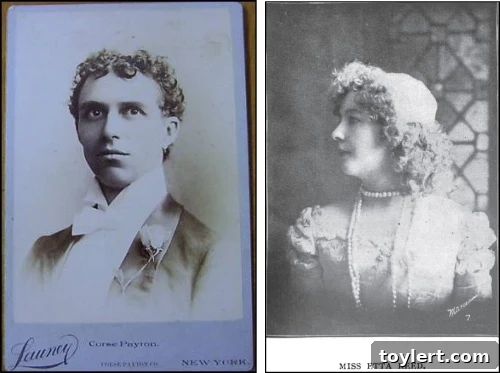
Corse Payton: The Unforgettable ‘Bad Actor’ Who Captivated Brooklyn and Beyond
In the grand tapestry of American theater history, some stars shine brightest for their exceptional talent, while others carve out a unique niche through sheer, undeniable personality. Corse Payton belongs firmly in the latter category, a theatrical force often described as “America’s best bad actor.” For those familiar with Jon Lovitz’s iconic “Master Thespian” sketches on Saturday Night Live, envisioning Payton becomes remarkably easy. Lovitz’s character, an outrageous ham, over-enunciating every syllable, gesticulating broadly, affecting a comically bad upper-crust accent, embodied everything one might desire in a truly terrible actor, all while exuding an irresistible charm in his dapper smoking jacket. Corse Payton was, without a doubt, the living embodiment of this Master Thespian—a man whose peculiar genius lay not in subtle nuance, but in the spectacular, unapologetic embrace of melodrama.
The Golden Age of Melodrama: A Stage Set for Payton
To truly appreciate Corse Payton, we must first understand the theatrical landscape of the late 19th and early 20th centuries. This was the golden age of melodrama, a genre where emotion was writ large, villains were hissable, heroes were noble, and heroines were perpetually in distress. Audiences of the era craved clear-cut morality tales, dramatic plot twists, and emotionally charged performances that left little to the imagination. Subtlety was not a virtue; grandiosity was. In this environment, traveling stock companies were the lifeblood of regional theater, bringing a constant stream of new (or at least newly presented) plays to towns and cities across America. These companies relied on versatile actors who could quickly learn multiple roles, often performing a different play every night.
It was within this vibrant, expressive, and somewhat less refined theatrical world that Corse Payton found his true calling. He wasn’t aiming for the nuanced interpretations of Broadway’s elite; he was performing for the masses, delivering exactly the kind of larger-than-life spectacle they demanded. His performances were a spectacle in themselves, a masterclass in what many modern critics would deem overacting, but what his audiences adored as pure, unadulterated entertainment. He didn’t just play a character; he *became* an event, an experience that transcended the plot of any given play.
Corse Payton’s Signature Style: The Art of the Exaggerated
Payton’s acting style was legendary for its audacious exaggeration. Imagine an actor who didn’t just cry, but sobbed convulsively, tearing at his hair with histrionic abandon. An actor who didn’t merely express anger, but roared with a fury that seemed to shake the very foundations of the theater, veins bulging and fists clenched tight. His voice, often described as booming and resonant, would soar to dramatic heights or plummet to hushed, stage-whispered depths, all for maximum emotional impact. Every gesture was amplified, every facial expression painted broadly for the furthest seats in the house. He wasn’t afraid to chew the scenery; he relished it.
This deliberate grandiosity was not a flaw but a feature of his performances. In an era before film and television brought close-ups and quiet naturalism into living rooms, stage acting needed to project. Payton took this need and magnified it exponentially. His audiences weren’t there for quiet introspection; they were there for a show, for heightened drama, for a communal experience of emotional release. Payton delivered in spades, making every moment on stage an unforgettable display of human passion, albeit through a highly stylized lens. His ability to elicit strong reactions, whether tears, laughter, or even jeers, was a testament to his undeniable stage presence and understanding of his audience’s desires.
The Payton Stock Company: A Brooklyn Institution
Corse Payton wasn’t just an actor; he was an entrepreneur and a theatrical visionary in his own right. He established and managed his own immensely successful stock company, a venture that became synonymous with affordable, thrilling entertainment for working-class audiences. For many years, his company held court in various theaters across Brooklyn, turning them into cultural hubs where families could gather for an evening of thrilling melodrama. Brooklyn, a borough burgeoning with diverse communities and a thirst for accessible entertainment, provided the perfect backdrop for Payton’s populist appeal.
Central to the success of the Payton Stock Company was his leading lady and wife, Etta Payton. A talented actress in her own right, Etta was the perfect foil to Corse’s over-the-top antics. While Corse commanded the stage with his boisterous energy, Etta brought a necessary grounding, often playing the beleaguered heroine with a compelling blend of pathos and fortitude. Their partnership was a dynamic one, both on and off stage, and audiences flocked to see the beloved couple perform together. Etta’s presence not only balanced Corse’s flamboyant style but also added an element of romantic intrigue and theatrical chemistry that further cemented their popularity.
The Payton Stock Company provided a stable and popular form of entertainment, changing plays frequently to keep audiences coming back. Their repertoire was vast, encompassing everything from classic melodramas to adaptations of popular novels and original works. Payton’s genius lay in his ability to identify what his audience wanted – spectacle, emotion, and clear-cut good versus evil – and deliver it with unwavering commitment, even if his methods defied conventional notions of “good acting.” He created a loyal following, turning theater-going into a cherished ritual for countless Brooklynites.
The Enigmatic Appeal: Why Love a ‘Bad Actor’?
The question inevitably arises: if Corse Payton was considered a “bad actor,” why was he so incredibly popular? The answer lies in several factors unique to his era and his particular brand of charisma. Firstly, the concept of “good acting” itself is fluid and culturally defined. What might be considered subtle and realistic today could have been perceived as boring or understated by audiences accustomed to more overt theatricality. Payton’s exaggerated style resonated deeply with an audience that valued spectacle and clear emotional cues.
Secondly, there’s the undeniable charm of the “so bad it’s good” phenomenon. Payton’s performances likely teetered on this edge, offering a thrilling blend of genuine emotion and unintentional comedy. Audiences might have come to genuinely engage with the drama, but also to marvel (and perhaps secretly chuckle) at Payton’s extravagant delivery. It was an interactive experience; the audience wasn’t just watching a play, they were engaging with a personality, almost participating in the performance through their reactions.
Moreover, Payton cultivated a larger-than-life persona that extended beyond the stage. He was a recognizable figure in Brooklyn, a local celebrity whose presence alone guaranteed an interesting evening. His relentless energy and dedication to his craft, no matter how unconventional, commanded respect. He wasn’t a pretender; he was genuinely committed to entertaining his audience, and that sincerity, even in the midst of theatrical excess, was palpable and endearing. He understood that theater was about connection, about creating a shared experience, and he excelled at fostering that bond with his patrons.
A Lasting Legacy in American Theater
Corse Payton’s legacy extends beyond mere anecdotal recollections of a flamboyant actor. He represents a significant chapter in American theatrical history, a time when live performance was king and accessibility was paramount. He demonstrated that commercial success and artistic integrity could exist even outside the hallowed halls of high-brow theater. His stock company provided employment for numerous actors and stagehands, and his theaters served as vital community spaces. He kept the spirit of live performance vibrant and relevant for a broad audience, fostering a love for theater in countless individuals who might never have stepped foot into a more elite establishment.
In a world increasingly dominated by the nuanced performances of film and television, Corse Payton stands as a vibrant reminder of a bygone era, an age when the stage was a place for grand gestures, booming voices, and emotions worn proudly on one’s sleeve. His story challenges our modern perceptions of what constitutes “good” acting, reminding us that entertainment, at its core, is about connection, captivation, and the ability to transport an audience, no matter the stylistic approach. He was not just an actor; he was a cultural phenomenon, a master of his domain, and indeed, America’s best bad actor.
Today, as we look back at the figures who shaped our entertainment landscape, Corse Payton emerges as a fascinating character. He defied convention, embraced his unique style, and left an indelible mark on the hearts of his audiences, particularly in the bustling theaters of early 20th-century Brooklyn. His story is a testament to the diverse forms that theatrical genius can take, proving that sometimes, being gloriously, unabashedly “bad” can, in fact, be absolutely brilliant.