The Enduring Legacy of the Brooklyn-Queens Expressway: Robert Moses’s Ambitious Vision and Brooklyn’s Transformation
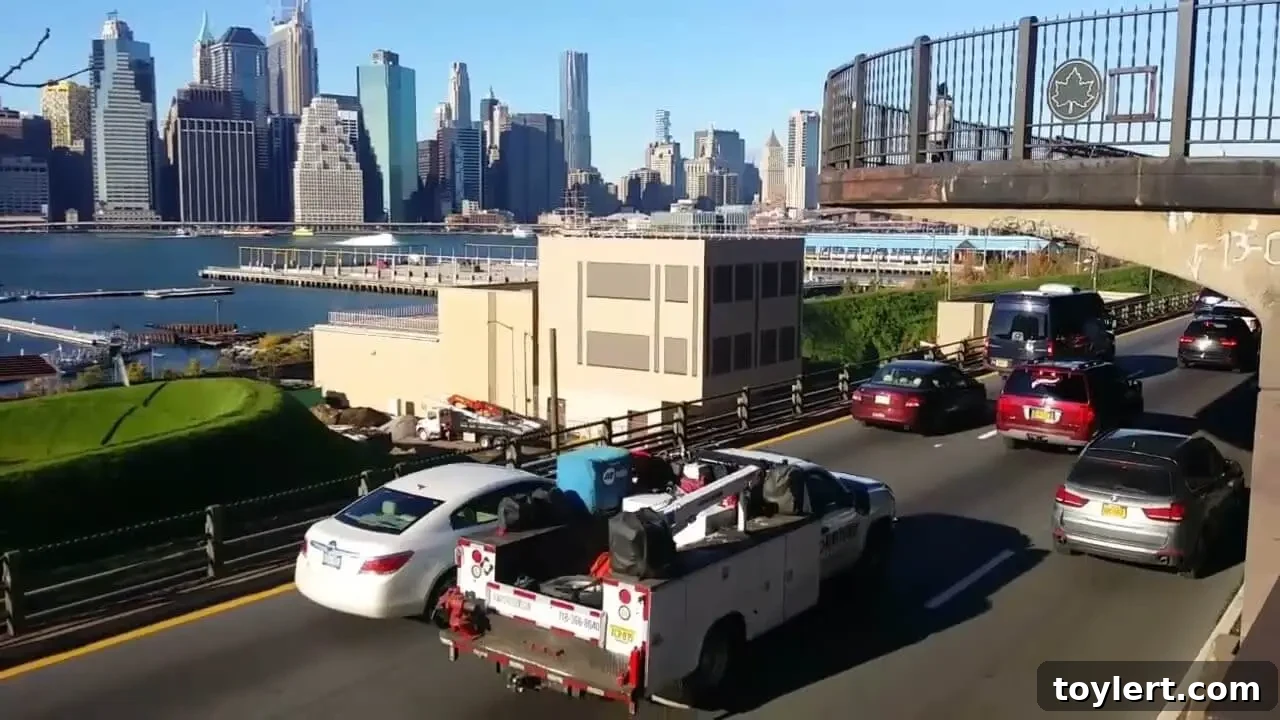
The Brooklyn-Queens Expressway (BQE) stands as a monumental testament to the ambition and transformative power of mid-20th-century urban planning. Conceived and championed by New York City’s formidable infrastructure builder, Robert Moses, the BQE irrevocably reshaped the borough of Brooklyn, leaving an indelible mark on its landscape, communities, and identity. Far from being a mere roadway, this complex infrastructure project became a physical and symbolic divider, forging new pathways for automotive traffic while simultaneously severing historic connections and setting the stage for one of Brooklyn’s most significant preservation movements.
Robert Moses: The Architect of Modern New York
To understand the BQE, one must first grasp the colossal influence of Robert Moses. A figure of immense power, Moses wielded control over countless public works projects across New York for decades, earning him a reputation as both a visionary and a ruthless master builder. His philosophy centered on the primacy of the automobile and the need for efficient transportation arteries to propel the city into the modern age. During an era of unprecedented growth and a booming post-World War II economy, Moses’s grand schemes often bypassed traditional democratic processes, allowing him to push through projects like the BQE with remarkable speed and minimal opposition.
The BQE was a cornerstone of his vision for a connected New York, designed to link the boroughs of Brooklyn and Queens with major highways, facilitating trade, commerce, and daily commutes. It promised to alleviate congestion and modernize the city’s infrastructure, an appealing prospect in a rapidly expanding metropolis. However, the realization of this vision came at a profound cost to the communities it bisected.
Forging Pathways and Fracturing Communities
Construction of the BQE, beginning in the late 1940s and continuing through the 1960s, was a monumental undertaking that cut a wide, concrete swath through diverse Brooklyn neighborhoods. The expressway was designed to provide crucial transportation links, allowing for the rapid transit of goods and people across the city. Before its construction, Brooklyn’s waterfront was a bustling industrial hub, vital to the city’s economy, yet intricately connected to the residential areas further inland. Moses’s design, however, prioritized speed and efficiency over neighborhood cohesion, effectively creating a stark barrier.
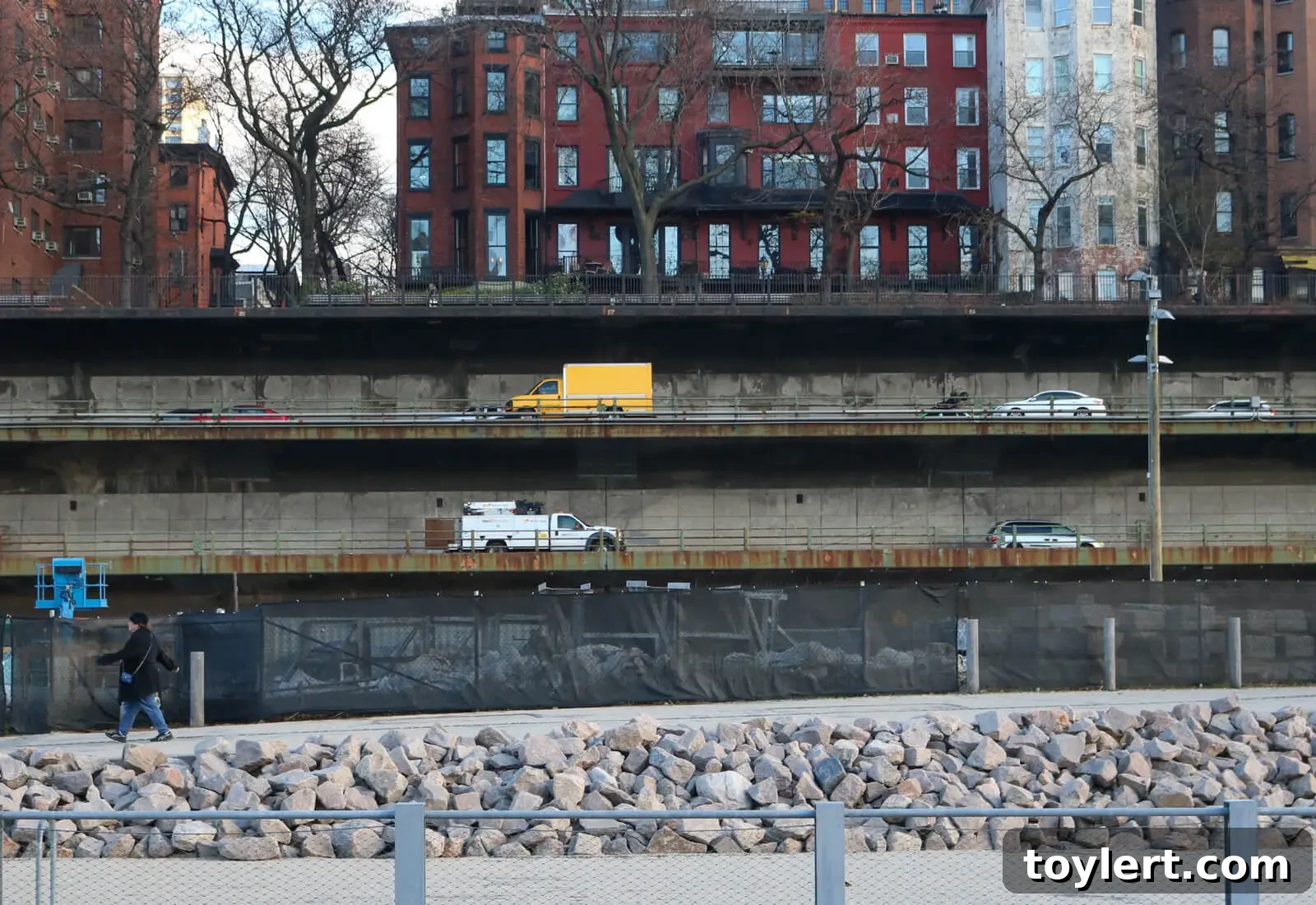
The path of the BQE carved a deep fissure between the industrial waterfront and the charming, historic brownstone districts further east. This physical separation had profound sociological implications. What had once been a fluid, if sometimes gritty, interface between working-class docks and residential blocks became an unbridgeable chasm. The expressway effectively isolated the waterfront, contributing to its eventual decline as a primary economic engine, while simultaneously pushing the brownstone neighborhoods into a new, more insulated existence. This literal cementation of the landscape served to reinforce existing, and in some cases, create new, class inequalities, profoundly impacting the social fabric of Brooklyn for generations to come.
The Brooklyn Heights Promenade: An Unintended Preservation Catalyst
Perhaps one of the most remarkable and ironic outcomes of the BQE’s construction was its direct role in the preservation of Brooklyn Heights, one of New York City’s most picturesque and historically significant neighborhoods. Moses’s initial plans for the expressway called for an elevated highway that would have obliterated large sections of the Brooklyn Heights waterfront, destroying its iconic views of the Manhattan skyline and New York Harbor. This sparked fierce opposition from local residents, who, armed with passionate arguments and a unified voice, mounted one of the earliest and most successful urban preservation campaigns in American history.
The compromise reached was ingenious: instead of an elevated highway destroying the neighborhood’s integrity, a cantilevered structure would be built below the existing grade, with a scenic pedestrian promenade constructed on top. This “triple cantilever” section, a marvel of engineering, effectively buried the noise and visual blight of the expressway while simultaneously creating the iconic Brooklyn Heights Promenade. This beloved public space offers unparalleled vistas of the Manhattan skyline, the Statue of Liberty, and the Brooklyn Bridge, becoming a quintessential New York experience for residents and tourists alike.
The struggle to save Brooklyn Heights from the BQE’s initial design served as a powerful precedent. It demonstrated that organized community activism could successfully challenge the seemingly unstoppable force of Moses’s urban renewal agenda. The eventual construction of the Promenade not only preserved Brooklyn Heights physically but also galvanized the landmarking movement. In 1965, Brooklyn Heights became the city’s first historic district, directly influenced by the community’s successful defense against the BQE, setting a template for neighborhood preservation that would be adopted across New York City and beyond.
Social and Economic Ramifications: A Double-Edged Sword
While the BQE brought undeniable benefits in terms of transportation efficiency, its social and economic impacts were far more complex and often contentious. The expressway facilitated suburbanization, making it easier for residents to commute from outlying areas into the city, but it also contributed to urban decay in some of the neighborhoods it traversed. Communities already struggling with economic hardship often bore the brunt of highway construction, experiencing displacement, noise pollution, and diminished property values.
The BQE’s path through areas like Red Hook and Williamsburg, for instance, further isolated these working-class and immigrant communities, hindering their integration with more affluent parts of Brooklyn. The physical barrier of the highway often coincided with existing socio-economic divides, deepening them and making cross-neighborhood interaction more challenging. This design philosophy, prioritizing vehicular flow over human-scaled urban fabric, is a hallmark of Moses’s approach and a subject of ongoing critical analysis by urban planners and historians.
On the other hand, the improved connectivity offered by the BQE also contributed to Brooklyn’s overall economic dynamism, allowing businesses to transport goods more efficiently and enabling a broader workforce to access job opportunities. The expressway became an indispensable artery for commerce, demonstrating the dual nature of such massive infrastructure projects: simultaneously fostering growth and inflicting damage.
The BQE’s Enduring Legacy and Future Challenges
Decades after its completion, the Brooklyn-Queens Expressway remains an indispensable, yet highly problematic, part of New York City’s infrastructure. It continues to carry immense volumes of traffic daily, serving as a critical link in the regional transportation network. However, the BQE is also a prime example of the long-term consequences of mid-century urban planning. It faces significant challenges related to its aging infrastructure, particularly the triple cantilever section beneath the Brooklyn Heights Promenade, which is in urgent need of repair or replacement.
The debates surrounding the BQE’s future are as intense as those that accompanied its construction. Proposals range from radical redesigns and partial demolition to complete reconstruction. Modern urban planners and community advocates are pushing for solutions that prioritize sustainability, pedestrian and cyclist access, and neighborhood integration, a stark contrast to Moses’s car-centric vision. The BQE now represents a complex nexus of transportation needs, historical preservation, environmental concerns, and community aspirations.
In conclusion, the Brooklyn-Queens Expressway is far more than just a road; it is a living monument to Robert Moses’s audacious vision and his profound, often polarizing, impact on New York City. It transformed Brooklyn by creating vital arteries for cars, yet in doing so, it physically divided communities, particularly cutting off the industrial waterfront from brownstone Brooklyn, thereby cementing class inequalities within the very landscape. Paradoxically, its intrusive presence also catalyzed one of the city’s most successful preservation efforts, leading to the landmarking of Brooklyn Heights. The BQE stands as a powerful symbol of urban development’s double-edged sword, a testament to how infrastructure can both connect and divide, shape progress, and leave an enduring, complex legacy on the urban experience.