The Enduring Legacy of the Eberhard Faber Pencil Factory in Greenpoint, Brooklyn
In the vibrant tapestry of Brooklyn’s industrial past, few names resonate with the unique blend of innovation, community, and economic impact quite like the Eberhard Faber Pencil Factory. Nestled in the heart of Greenpoint, this sprawling complex was once a cornerstone of American manufacturing, a major employer, and a significant force in shaping the lives of countless Brooklynites, particularly women, throughout the late 19th and early 20th centuries. Its story is not just about pencils; it’s about the very fabric of an evolving city and the people who built it, one graphite line at a time.
A Visionary’s Journey: From Germany to Greenpoint
The saga of the Eberhard Faber company began long before its Brooklyn tenure. Its roots trace back to the venerable Faber family of Stein, Germany, renowned for their centuries-old tradition of pencil making. Eberhard Faber himself, a scion of this illustrious lineage, brought his entrepreneurial spirit and expertise to the United States in the mid-19th century. He established his own independent company, Eberhard Faber, in 1861, initially setting up manufacturing operations in Manhattan.
However, fate had a different plan for the company’s permanent home. A devastating fire in 1872 tragically destroyed the Manhattan factory, prompting Faber to seek a new, larger, and more resilient site for his expanding enterprise. This pivotal moment led him across the East River to Greenpoint, Brooklyn – a burgeoning industrial hub with excellent access to shipping lanes and a growing workforce. The move marked the beginning of an extraordinary chapter for both the company and the neighborhood, transforming a quiet waterfront into a dynamic center of production.
The Heartbeat of Greenpoint: Women at Work in the Early 20th Century
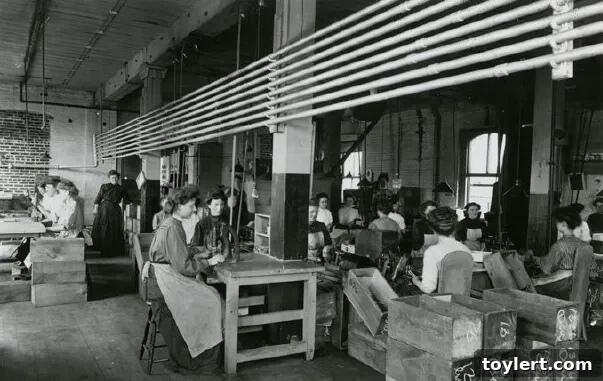
From its establishment in Greenpoint in 1872 until its eventual closure in 1956, the Eberhard Faber Pencil Factory became synonymous with industrial prowess and community prosperity. During its heyday, particularly in the early 20th century, the factory was a bustling hive of activity. Historic images, such as a captivating circa-1915 view preserved by the Brooklyn Historical Society, offer a rare glimpse into the daily operations. These photographs vividly portray rows of women diligently engaged in various stages of pencil production, their focused expressions a testament to their skill and the importance of their labor.
The factory provided crucial employment opportunities for thousands of Brooklyn residents, offering a pathway to economic independence, especially for women. In an era when options for female employment were often limited, the Eberhard Faber Pencil Factory stood out as a significant employer of women, from assembly lines to quality control. The image of a female supervisor, perhaps dressed in black and overseeing the industrious scene from the background, underscores the hierarchical structure and the advancement possibilities within the factory. These women were not merely workers; they were integral to the product’s success, contributing to household incomes and carving out vital roles for themselves in the urban industrial landscape. Their collective work ethic and dedication were a fundamental part of the factory’s legendary output, churning out millions of pencils and other stationery items that became staples in homes, schools, and offices across America.
The Art and Science of Pencil Manufacturing
Manufacturing pencils in the early 20th century was a sophisticated process that combined precision engineering with skilled craftsmanship. At the Eberhard Faber factory, raw materials arrived from various corners of the globe: graphite, clay, wood (often high-quality cedar), and various dyes and lacquers. The process involved several intricate steps, beginning with the meticulous blending of graphite and clay to create the lead, which was then extruded into thin rods, fired in kilns for hardness, and finally soaked in wax for smoothness.
Concurrently, cedar slats were grooved to snugly hold the lead cores. These slats were then glued together, encapsulating the lead, before being shaped, sanded, painted, and stamped with the iconic Eberhard Faber name. The final touch often involved attaching an eraser, a feature that Faber himself is credited with popularizing. Each stage required attention to detail and a keen eye, ensuring the quality and consistency that made Eberhard Faber pencils renowned. The factory’s scale allowed for a highly efficient division of labor, a hallmark of early 20th-century industrial production, transforming raw materials into everyday necessities with remarkable speed and precision.
The Factory’s Footprint: Shaping Greenpoint’s Identity
Beyond its walls, the Eberhard Faber Pencil Factory exerted a profound influence on the development and character of Greenpoint. Its presence attracted a diverse population of workers, leading to the construction of housing, the establishment of local businesses, and the growth of a vibrant community around the factory gates. The factory complex itself was a monumental presence, a collection of red-brick buildings that became an architectural landmark in the neighborhood. It was more than just a workplace; it was an anchor, providing stability and identity to the surrounding streets.
The factory’s operations contributed significantly to Greenpoint’s reputation as a bustling industrial district, alongside other major industries like shipbuilding and oil refining. This concentration of manufacturing provided a powerful economic engine for Brooklyn, drawing in immigrants and new residents seeking opportunity and a better life. The rhythms of the factory — its morning whistle, the hum of machinery, the shift changes — became an intrinsic part of Greenpoint’s daily soundtrack for decades.
From Manufacturing Hub to Historic Landmark: A New Chapter
The mid-20th century brought significant changes to American manufacturing, and the Eberhard Faber Pencil Factory was not immune. Facing shifting economic landscapes, increased global competition, and evolving production methods, the factory ceased operations in Greenpoint in 1956, marking the end of an era for both the company and the neighborhood. While the physical production ceased, the legacy of the Eberhard Faber name continued through various corporate evolutions. In the 1980s, the company was eventually sold to A.W. Faber-Castell, another legendary German pencil manufacturer with its own deep historical roots, bringing the two historic families, in a sense, full circle.
However, the story of the Greenpoint site did not end with the departure of manufacturing. Recognizing the profound historical and architectural significance of the factory complex, preservation efforts began to take shape. Today, eight of the original buildings from the plant, dating from the 1860s to the 1920s, have been meticulously preserved and are now proudly included in the Eberhard Faber Pencil Factory Historic District. This designation, located on Greenpoint Avenue and Kent Street between West and Franklin streets, protects these magnificent industrial structures for future generations.
The district serves as a tangible link to Brooklyn’s rich industrial heritage. These architecturally distinct buildings, with their sturdy brickwork, large windows, and robust construction, now stand as a testament to a bygone era of American ingenuity. Many of these historic structures have found new life through adaptive reuse, transforming into residential lofts, creative workspaces, and commercial establishments, blending seamlessly into Greenpoint’s modern urban fabric while preserving their historical integrity. They symbolize the district’s continuous evolution, from a manufacturing powerhouse to a vibrant residential and cultural hub.
An Enduring Symbol of Brooklyn’s Resilience
The Eberhard Faber Pencil Factory’s journey from a leading industrial enterprise to a cherished historic district encapsulates the broader narrative of Brooklyn’s transformation. It stands as a powerful reminder of the borough’s pivotal role in American industry, its capacity for reinvention, and its deep respect for its past. The factory’s legacy lives on not only in the well-preserved buildings that dot the Greenpoint landscape but also in the countless stories of the men and women whose dedication and labor shaped both the company and the community around it. It is a beacon of industrial history, a symbol of economic progress, and an enduring monument to the enduring spirit of Brooklyn.