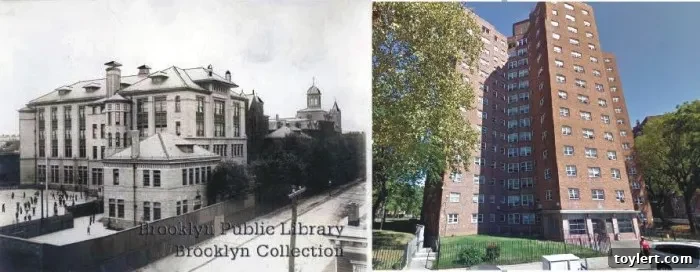
A Journey Through Time: Brooklyn’s Shifting Urban Landscape from Victorian Institutions to Modern Living
Brooklyn, a borough renowned for its dynamic character and rich history, has undergone countless transformations. From its humble beginnings as a Dutch settlement to its current status as a global cultural hub, the face of Brooklyn is constantly evolving. This article delves into a fascinating segment of this evolution, exploring how specific neighborhoods in Central Brooklyn, particularly those radiating north and south of Atlantic Avenue, transformed from havens of charitable institutions in the late 19th century into the vibrant, modern communities they are today, exemplified by the site of the former St. John’s Home for Boys, now home to the Albany Houses.
The Brooklyn of Yesteryear: A Hub for Philanthropy and Social Welfare
The latter half of the 19th century marked a period of rapid urbanization and social change in Brooklyn. As the borough’s population swelled with immigrants and migrants seeking new opportunities, the need for social services became increasingly pressing. In response, charitable organizations, often driven by religious groups and civic-minded citizens, began establishing various institutions to address poverty, illness, and homelessness. Central Brooklyn, with its burgeoning communities and available land, became a prime location for these endeavors.
Central Brooklyn’s Emergence as a Social Welfare Center
The area around Atlantic Avenue, a major artery connecting different parts of Brooklyn, proved strategically ideal for these large-scale charitable undertakings. Its accessibility and developing infrastructure made it suitable for institutions that required space for dormitories, schools, infirmaries, and recreational facilities. Hospitals, orphanages, homes for the elderly, and reformatories dotted the landscape, each serving a specific segment of the population in need. These institutions were often grand, imposing structures, reflecting the Victorian era’s architectural sensibilities and the importance placed on their benevolent missions.
They weren’t merely functional buildings; they were designed to inspire hope and convey a sense of permanence and order. Their architectural style, frequently Romanesque Revival or Gothic Revival, spoke to the prevailing cultural values of the time – a blend of moral earnestness, civic pride, and a belief in structured charity. These institutions were foundational to Brooklyn’s social fabric, providing essential support systems long before government-funded social welfare programs became widespread. They represent a significant chapter in the history of social welfare and urban development in Brooklyn.
St. John’s Home for Boys: A Sanctuary in Victorian Brooklyn
Among the most prominent of these institutions was the St. John’s Home for Boys. Established to care for orphaned, abandoned, or destitute boys, it played a crucial role in providing shelter, education, and moral guidance to countless young lives. For decades, this institution served as a beacon of hope for many families and children facing hardship in Brooklyn.
Architectural Grandeur and Social Purpose
The original building of St. John’s Home for Boys would have been a quintessential example of Victorian institutional architecture. Imagine a sprawling brick or stone edifice, perhaps adorned with intricate detailing, tall windows, and a commanding presence. Such structures were built to last, conveying stability and a sense of authority. Inside, the layout would have been practical, designed to accommodate large numbers of boys, with dormitories, classrooms, dining halls, and chapels, all meticulously organized to foster discipline and learning. These homes were more than just shelters; they were comprehensive environments aimed at preparing boys for productive lives.
The philosophy behind such homes often emphasized Christian values, self-reliance, and vocational training, equipping the boys with skills necessary for employment. The scale and permanence of St. John’s Home reflected not only the dire need it addressed but also the community’s commitment to supporting its most vulnerable members. Its location in Central Brooklyn placed it within reach of the communities it served, making it an integral part of the neighborhood’s identity and story for many generations.
Life Within the Walls: Daily Routines and Mission
Life within St. John’s Home for Boys was structured and disciplined. Boys would wake early, attend religious services, engage in lessons covering basic literacy and arithmetic, and participate in chores contributing to the upkeep of the home. Vocational training was often a key component, with older boys learning trades such as carpentry, printing, or shoemaking, skills that would serve them well upon leaving the institution. Recreational activities, though perhaps limited compared to modern standards, were also part of the routine, fostering camaraderie and a sense of normalcy.
The institution’s mission extended beyond mere sustenance; it aimed to instill values, foster character development, and provide a stepping stone for these boys into mainstream society. For many, St. John’s Home was the only family they knew, offering a sense of belonging and stability in uncertain times. Its impact on the lives of its residents was profound, shaping the futures of thousands of young men who passed through its doors during its operational years.
A New Era Dawns: The Rise of Public Housing in Brooklyn
As the 20th century progressed, societal views on welfare, urban planning, and institutional care began to shift dramatically. The Great Depression highlighted systemic issues of poverty and inadequate housing, leading to a nationwide movement towards public housing initiatives. Brooklyn, like many American cities, grappled with overcrowding, deteriorating housing stock, and the need for modern, affordable residential solutions. This confluence of factors led to the eventual transformation of many charitable institution sites, including that of St. John’s Home for Boys.
Urban Renewal and the Birth of Albany Houses
By the mid-20th century, many of the grand Victorian institutions, despite their noble intentions, were seen as outdated and inefficient in addressing contemporary urban challenges. The philosophy of institutionalized care gave way to a focus on community-based solutions and integrated urban planning. This shift paved the way for ambitious urban renewal projects spearheaded by entities like the New York City Housing Authority (NYCHA).
The site of the St. John’s Home for Boys, with its significant land area in a developing part of Brooklyn, became a prime candidate for such a transformation. The venerable Victorian edifice was eventually demolished to make way for a new vision: modern, publicly funded apartment complexes designed to provide safe, affordable housing for working-class families and those in need. This marked the birth of the Albany Houses, a key development in NYCHA’s efforts to rebuild and modernize Brooklyn’s urban landscape.
The Vision of NYCHA: Addressing Modern Needs
NYCHA’s mission was to address the acute housing shortage and improve living conditions for thousands of New Yorkers. The Albany Houses, constructed in the post-war era, embodied this vision. They were designed as multi-story residential buildings, often incorporating green spaces, playgrounds, and community facilities, aiming to create self-contained, supportive neighborhoods within the larger urban fabric. The architecture of these new public housing projects stood in stark contrast to the ornate Victorian styles they replaced, favoring functionality, efficiency, and modern design principles. The transition from a single-purpose institution like St. John’s Home for Boys to a multi-family public housing complex like Albany Houses reflected a broader societal commitment to providing housing as a fundamental right and a strategy for urban improvement.
This period represented a significant pivot in how cities managed their populations and resources, moving from private, often sectarian charity to large-scale government programs. The development of Albany Houses was not just about building structures; it was about building communities, offering stability, and improving the quality of life for its residents in Central Brooklyn. It symbolized a shift from addressing individual cases of destitution to tackling systemic issues of poverty and housing at a municipal level, leaving an indelible mark on Brooklyn’s social and architectural history.
Albany Houses: A Community Reimagined
Today, the Albany Houses stand as a testament to this profound transformation. They represent an enduring effort to provide accessible housing and foster community spirit in one of New York City’s most vibrant boroughs. The complex is more than just buildings; it is home to thousands of Brooklynites, a place where families grow, children play, and neighbors connect, continuing the legacy of community service in a new form.
Impact on the Local Community
The establishment of Albany Houses significantly impacted the surrounding neighborhoods. It provided much-needed housing, stabilizing communities and offering opportunities for social mobility. Over the decades, generations have called Albany Houses home, contributing to the rich tapestry of Brooklyn’s diverse population. The complex has become a focal point for local life, with residents forming strong bonds and creating a unique community identity. Despite the challenges often associated with public housing, Albany Houses has persevered, adapting to changing times and continuing to serve its fundamental purpose.
Its presence underscores the ongoing need for affordable housing and the complex interplay between urban development, social welfare, and community resilience. The transformation from an institution dedicated to a specific vulnerable group to a broad public housing complex illustrates the evolving approaches to social support and urban planning over more than a century in Brooklyn.
Navigating Legacy and Progress
The story of Albany Houses, built on the grounds of the former St. John’s Home for Boys, is a microcosm of urban change. It highlights the constant negotiation between preserving historical legacy and pushing forward with progress. While the Victorian architecture of the past is gone, the spirit of providing for those in need continues in a different form. This transformation is a powerful reminder that cities are living entities, constantly reshaping themselves to meet the demands of their inhabitants.
It also invites reflection on the efficacy and challenges of both historical charitable models and modern public housing solutions. The narratives embedded in these sites are crucial for understanding Brooklyn’s journey, offering insights into societal values, economic pressures, and architectural trends that have shaped the borough into what it is today.
Brooklyn Today: Bridging Past and Present
Brooklyn continues to be a borough of contrasts and dynamism. Historic brownstones stand beside modern high-rises, and diverse communities thrive, each with its unique stories. The area around Atlantic Avenue remains a bustling thoroughfare, a commercial and residential corridor that reflects the borough’s ongoing evolution. The memory of institutions like St. John’s Home for Boys, though perhaps no longer visible in brick and mortar, lives on in the historical records and the collective memory of the community, informing our understanding of Brooklyn’s foundational values and its commitment to caring for its residents.
Preserving Heritage Amidst Constant Change
The narrative of St. John’s Home for Boys transforming into Albany Houses is not unique in Brooklyn or New York City. It is a recurring theme in urban history, where older structures and institutions are repurposed or replaced to serve new social and economic functions. This constant cycle of demolition and construction, preservation and innovation, is what makes Brooklyn’s urban landscape so rich and layered. Efforts to document and remember these historical transitions are vital, ensuring that the past remains connected to the present and future development of the borough.
Understanding these historical layers enriches our appreciation for Brooklyn’s character, demonstrating how the decisions of yesteryear continue to influence the lives of its residents today. It emphasizes the importance of balancing modernization with a deep respect for the architectural heritage and social history that define the borough.
The Enduring Spirit of Central Brooklyn
The Central Brooklyn area, specifically the Atlantic Avenue corridor, has always been a place of resilience and adaptation. From a 19th-century hub for philanthropy to a 20th-century center for public housing, and now a 21st-century melting pot of cultures and commerce, its spirit of community and social responsiveness endures. The Albany Houses, standing on what was once the ground of St. John’s Home for Boys, symbolize this enduring spirit – a commitment to providing shelter, fostering community, and continuously adapting to the evolving needs of Brooklyn’s vibrant population.
Conclusion: A Tapestry of Transformation
The journey from the St. John’s Home for Boys to the Albany Houses encapsulates over a century of profound transformation in Brooklyn. It illustrates how urban spaces evolve, reflecting changes in societal values, economic conditions, and approaches to social welfare. This historical arc, stretching from the philanthropic endeavors of the Victorian era to the comprehensive public housing initiatives of the mid-20th century, highlights Brooklyn’s enduring capacity for adaptation and its continuous effort to build a better future for its residents. The story of this site is more than just a historical account; it is a vivid testament to the ongoing narrative of Brooklyn, a borough constantly reinventing itself while honoring the foundations laid by generations past. It is a powerful reminder of how “then” shapes “now,” creating a rich, evolving tapestry that continues to define one of the world’s most iconic urban landscapes.