Crown Heights Real Estate Market: Unpacking Key Trends and Property Values (2006-2012)
Crown Heights, a vibrant and historically rich neighborhood in the heart of Brooklyn, has long captivated residents and investors alike with its distinct character, tree-lined streets, and iconic brownstones. As one of Brooklyn’s most dynamic areas, understanding its real estate pulse is crucial for anyone looking to buy, sell, or invest. We’re diving deep into the market numbers, thanks to a comprehensive analysis provided by the experts at PropertyShark, focusing on trends between 2006 and the close of 2012. This report offers invaluable insights into the ebb and flow of property values, providing a clear snapshot of where Crown Heights stood in the early 2010s amidst a recovering national economy.
The analysis defines Crown Heights’ boundaries clearly: bordered by Atlantic Avenue to the north, Ralph Avenue to the east, Empire Boulevard to the south, and Washington Avenue to the west. This specific geographical scope ensures a focused and accurate examination of the market dynamics within this sought-after Brooklyn enclave. By understanding these parameters, we can better appreciate the nuances of the data presented, which reflects a unique blend of historic charm and ongoing modernization.
Navigating the Market: A Decade of Price Fluctuations (2006-2012)
The period between 2006 and 2012 represents a tumultuous yet ultimately resilient journey for the Crown Heights real estate market. The PropertyShark data highlights a significant pattern: a gradual decline in median sales prices for homes following the robust peak years of 2006-2007. This trajectory mirrored broader national economic trends, as the housing bubble burst and the global financial crisis took hold. However, the story doesn’t end there; the market showed clear signs of recovery, with median prices on a noticeable upswing in the last two quarters of 2012, signaling renewed confidence and demand.
Single to Three-Family Homes: Peaks, Troughs, and Recovery
For one- to three-family homes, a cornerstone of Crown Heights’ residential appeal, the market experienced a dramatic ride. Prices for these cherished properties, which often include the neighborhood’s iconic brownstones and limestones, reached their zenith in 2007. During this pre-recession boom, the median price for such homes soared to approximately $700,000. This period was characterized by intense buyer interest, speculative investment, and a general sense of optimism regarding real estate as a stable asset.
However, the subsequent economic downturn led to a sharp correction. By the third quarter of 2009, when the effects of the recession were deeply felt across the nation, the median price for one- to three-family homes in Crown Heights had plummeted to $300,000. This represents a substantial decrease, reflecting tightened lending standards, reduced buyer confidence, and an increase in distressed sales. The dip underscored the vulnerability of even resilient markets like Brooklyn’s to larger economic forces.
Despite this significant decline, the market began to stabilize and show signs of recovery in the years that followed. The latter half of 2012, as indicated by PropertyShark’s analysis, marked a turning point, with prices beginning to edge upwards. This re-emergence signaled a renewed interest from both owner-occupants and investors, drawn back by more attainable prices and the inherent value of Crown Heights properties.
(Image 1: Illustrates the historical trend of median sales prices for single to three-family homes in Crown Heights, showcasing the 2007 peak and 2009 trough.)
Apartment Sales: A Story of Robustness and Recovery
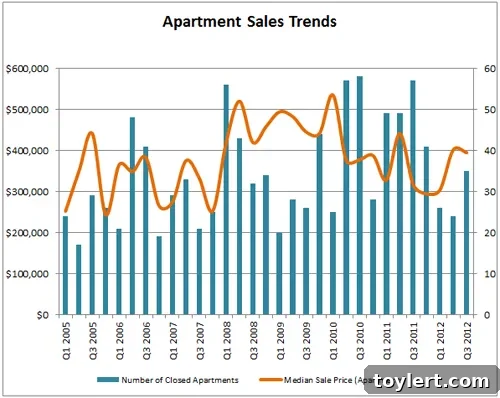
In contrast to the more volatile ride of single-family homes, apartment sales in Crown Heights exhibited a somewhat stronger and more consistent performance during this period. While not entirely immune to market pressures, the apartment segment demonstrated notable resilience. The median sales price for apartments impressively topped out above $500,000 in 2010, an indication that this sector was quicker to rebound from the recessionary dip. This strength could be attributed to several factors, including the relative affordability of apartments compared to multi-family homes, sustained demand from a growing urban population, and potentially, a more diverse range of inventory including co-ops and condominiums.
The upward trajectory continued, with apartment sales experiencing a healthy rise in the lead-up to the end of 2012. By the third quarter of that year, the median price for apartments had reached approximately $400,000. This robust recovery highlights the enduring appeal of apartment living in Crown Heights, catering to a demographic seeking both value and access to Brooklyn’s vibrant lifestyle. The steady performance of the apartment market often serves as a key indicator of overall neighborhood stability and desirability.
(Image 2: Depicts the median sales price trends specifically for apartments in Crown Heights, highlighting their comparatively stable and recovering trajectory.)
Spotlight on Specifics: Pockets of Value and Significant Sales
Beyond broad market trends, PropertyShark’s analysis unveils fascinating specificities within Crown Heights, pointing to particular blocks and properties that stand out for their value and unique characteristics. These details provide a granular view of the neighborhood’s real estate landscape and offer clues as to where the highest demand and premium pricing reside.
The Most Expensive Block: St. Francis Place
Intriguingly, the data identifies St. Francis Place as the most expensive block in Crown Heights. With a median price of $740,000 based on seven sales recorded since 2005, this street clearly commands a premium. What makes St. Francis Place so desirable? Often, such blocks are characterized by exceptionally well-preserved historic architecture, larger lot sizes, superior access to neighborhood amenities, or a particular sense of tranquility and community. Buyers are frequently willing to pay more for homes on streets known for their aesthetic appeal, quiet atmosphere, and strong community fabric. This data point underscores the enduring value of classic Brooklyn charm and prime location within the neighborhood.
A Landmark Sale: 914 Pacific Street
Adding to the intrigue is the most expensive residential sale recorded in the neighborhood: a glassy three-family home located at 914 Pacific Street. The description “glassy three-family home” suggests a departure from the traditional brownstone, hinting at a modern architectural style or a significant contemporary renovation. Such a high-value transaction, especially for a multi-family property, indicates a strong market for upscale, possibly newly constructed or thoroughly modernized residences. It also points to the evolving real estate landscape of Crown Heights, where modern luxury can coexist and thrive alongside historic charm, appealing to a diverse range of sophisticated buyers and investors looking for unique opportunities.
(Image 3: Provides a more detailed breakdown of median sales prices across various segments or periods within Crown Heights, offering granular market insights.)
Crown Heights: A Neighborhood of Enduring Appeal and Growth
The real estate market, as detailed by PropertyShark, is only one facet of Crown Heights’ broader appeal. This neighborhood continues to attract a diverse array of residents, from long-time families to new arrivals drawn by its unique blend of history, culture, and convenience. Its proximity to iconic Brooklyn landmarks such as Prospect Park, the Brooklyn Museum, and the Brooklyn Botanic Garden significantly enhances its desirability. Excellent public transportation options, including multiple subway lines, connect residents seamlessly to Manhattan and other parts of Brooklyn, making it an ideal location for commuters.
Furthermore, Crown Heights boasts a thriving and evolving culinary scene, charming local businesses, and a palpable sense of community. The ongoing gentrification and development in surrounding areas also contribute to a halo effect, steadily increasing property values and demand within Crown Heights itself. These factors collectively underscore why the neighborhood has shown such robust recovery and sustained interest, even after significant market downturns.
Visualizing the Market: Maps and Comprehensive Data
To further enhance understanding, PropertyShark’s comprehensive report includes detailed graphs and a specialized map. This map visually represents the median sales prices not only for Crown Heights but also for its surrounding neighborhoods for the first three quarters of 2012. Such visual tools are invaluable for illustrating geographical variations in property values and for identifying potential areas of growth or comparative affordability. They offer a powerful way for prospective buyers and sellers to gauge local market conditions at a glance and make informed decisions about their investments within the larger Brooklyn context.
(Image 4: A geographical map displaying median sales prices for Crown Heights and neighboring areas during Q1-Q3 2012, offering a broader market comparison.)
The map above clearly illustrates the median price for all sales across Crown Heights and adjacent communities in the first through third quarter of 2012, providing a consolidated and comparative view of the market’s performance.
Conclusion: Crown Heights – A Resilient and Evolving Real Estate Landscape
The PropertyShark analysis of the Crown Heights real estate market from 2006 to 2012 paints a compelling picture of resilience and evolution. Despite facing the significant challenges of a global financial crisis, the neighborhood demonstrated a remarkable capacity for recovery, particularly in its apartment sector, and a steady rebound in single-family home values towards the end of the period. The detailed insights into specific blocks like St. Francis Place and landmark sales such as 914 Pacific Street further illustrate the diverse opportunities and enduring appeal within this Brooklyn gem.
For anyone considering entering the Crown Heights real estate market, whether as a first-time homebuyer, a seasoned investor, or a seller looking to capitalize on appreciating assets, understanding these historical trends is paramount. The data from PropertyShark serves as a foundational guide, highlighting Crown Heights not just as a location but as a dynamic investment landscape poised for continued growth and desirability in the vibrant tapestry of Brooklyn.