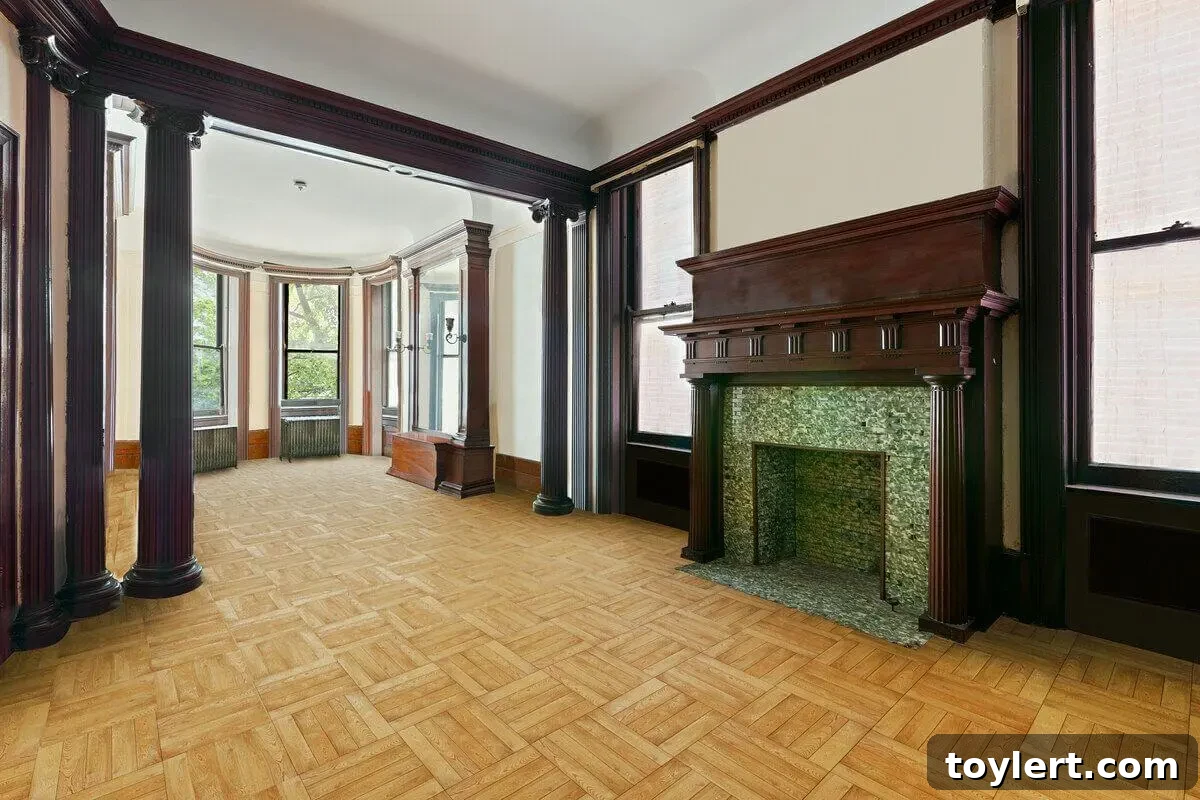
Nestled within the distinguished Crown Heights North Historic District, a remarkable testament to early 20th-century grandeur stands proudly at 903 St. Marks Avenue. This magnificent residence, part of an elegant pair, has retained an extraordinary array of its original details, a rare feat attributable to its ownership by just two families since its construction at the turn of the 20th century. From meticulously crafted mantels and intricate woodwork to a captivating pier mirror and luminous stained glass, every corner of this Brooklyn gem whispers tales of a bygone era, offering a unique glimpse into the sophisticated tastes of its original inhabitants.
The story of 903 St. Marks Avenue is inextricably linked to the vision of its builder, Bernard Gallagher, a name synonymous with prominence in late 19th and early 20th-century Brooklyn. Gallagher was not merely a contractor; he was a significant local political figure and a shrewd businessman who left an indelible mark on the borough’s landscape. In 1901, with a keen eye for architectural excellence and a desire to establish a lasting legacy for his family, Gallagher embarked on the construction of these two magnificent Renaissance Revival houses. St. Marks Avenue, at that time, was rapidly emerging as the fashionable thoroughfare for Brooklyn’s burgeoning wealthy elite, making it the perfect canvas for such an ambitious project.
While Bernard and his wife, Mary Gallagher, established their primary residence at the adjacent 905 St. Marks Avenue, the equally splendid 903 was destined to be the home of their son, George Gallagher, who followed in his father’s footsteps as a contractor, and his new wife, Agnes. This familial arrangement underscores a period where multi-generational living, often in close proximity, was a cherished social norm, fostering strong community and familial bonds. The architectural brilliance behind these mirrored masterpieces is credited to the esteemed design duo Ephraim Johnson and Frank Helmle. Their collaborative genius is evident in the houses’ harmonious symmetry, featuring elegant paired Ionic-columned porticos, gracefully bowed corners extending the full height of the structures, and a distinguished modillioned cornice that crowns the facades with classical sophistication. Renowned architectural historian and Brownstoner columnist Suzanne Spellen accurately characterized these dwellings as “solid, sturdy, upper-middle class houses,” a description that perfectly encapsulates their enduring quality and refined aesthetic.
The construction of these residences generated considerable excitement and garnered significant attention from the local press. As they neared completion in 1902, the Brooklyn Daily Eagle, a leading newspaper of its time, featured a prominent write-up accompanied by a photograph. The article lauded the houses, noting that their exteriors presented a style that “borders on the colonial,” a fascinating observation considering their primary Renaissance Revival influence. This suggests a subtle blend of architectural elements, perhaps reflecting a desire for both classical grandeur and a touch of familiar American historical charm. Internally, while not perfectly identical, the two houses shared a remarkably similar high standard of craftsmanship and luxurious amenities. The Eagle specifically highlighted the presence of exquisite “fine woods” throughout the interiors, indicative of the era’s appreciation for rich, natural materials, and baths designed “in the Roman style,” suggesting lavish fixtures and perhaps even tiling or marblework reminiscent of ancient Roman opulence.
A particularly charming and insightful detail mentioned in the Brooklyn Daily Eagle article was the inclusion of connecting doors on the top floors of the two houses. This architectural feature speaks volumes about the Gallagher family’s desire for both proximity and privacy, allowing for easy visitation between the senior and junior households while maintaining independent living spaces. It symbolizes the close-knit family structure that was common among affluent families of the period, where family ties were not just social but often built into the very fabric of their homes.
The Renaissance Revival style, prominently displayed in 903 St. Marks Avenue, drew inspiration from the Italian Renaissance, a period celebrated for its harmonious proportions, classical details, and emphasis on order and symmetry. Architects like Johnson and Helmle translated these principles into American urban dwellings, favoring robust masonry construction, often incorporating rich materials like brick and limestone, as seen here. The Ionic columns, a hallmark of classical architecture, lend a sense of dignified elegance to the porticos, inviting residents and guests alike. The modillioned cornice, with its series of small, ornamental brackets, adds a decorative flourish, enhancing the visual weight and sophistication of the roofline. These architectural choices not only spoke to the wealth and social standing of the owners but also contributed to the dignified streetscape that St. Marks Avenue sought to cultivate.
Beyond its architectural merits, the story of 903 St. Marks Avenue is also a narrative of preservation. The rarity of a property remaining within the stewardship of only two families for over a century is truly exceptional. This continuity of ownership has played a crucial role in safeguarding the house’s original features, preventing the kinds of extensive renovations or alterations that often strip historic homes of their authentic character. The mantels, for instance, are not merely decorative elements but works of art, likely carved from wood or marble, reflecting the prevailing styles of the early 1900s, perhaps showcasing intricate carvings or classical motifs. The woodwork, encompassing everything from staircases and banisters to wainscoting and door frames, would have been meticulously crafted, likely from rich hardwoods such as oak or mahogany, exuding warmth and quality. A pier mirror, typically a tall, grand mirror placed between windows or on a wall, would have dramatically enhanced the sense of space and light in a formal parlor or reception area, often framed by elaborate decorative elements that complement the room’s overall design. And the stained glass, whether gracing transoms, stairwell landings, or windows, would have diffused natural light into vibrant hues, adding a layer of artistry and privacy to the home.
The inclusion of 903 St. Marks Avenue within the Crown Heights North Historic District is a testament to its architectural and historical significance. The district was established to protect and celebrate the unique character of this Brooklyn neighborhood, which boasts a remarkable concentration of late 19th and early 20th-century residential architecture. Being part of such a district means that the house’s exterior is subject to specific preservation guidelines, ensuring that its historical integrity is maintained for future generations. This designation not only recognizes the building’s intrinsic value but also underscores its contribution to the broader cultural and architectural tapestry of Brooklyn.
The meticulous craftsmanship evident throughout the house extends to its interior spaces, as highlighted by the “fine woods” and “Roman style” baths mentioned in the 1902 newspaper account. Imagine grand reception rooms adorned with ornate plasterwork ceilings, perhaps featuring medallions or cornices that echo the exterior’s classical motifs. The rich, polished wood floors, complemented by wainscoting and built-in cabinetry, would have created an atmosphere of understated elegance and comfort. The “Roman style” baths would have been a luxurious indulgence for the time, likely featuring claw-foot bathtubs, pedestal sinks, and perhaps intricate tiling patterns or marble surfaces, offering a sanctuary of relaxation and refinement. Such details collectively paint a vivid picture of the sophisticated domestic life enjoyed by the Gallagher family.
The historical context of St. Marks Avenue at the turn of the century is crucial to understanding the prominence of homes like 903. As Brooklyn grew into a major urban center, successful merchants, professionals, and industrialists sought elegant residential enclaves that reflected their prosperity and social standing. St. Marks Avenue, with its wide streets, mature trees, and proximity to cultural institutions and transportation links, became a preferred address. Builders like Bernard Gallagher played a pivotal role in shaping these neighborhoods, constructing homes that not only met the practical needs of affluent families but also embodied their aspirations for beauty, comfort, and social prestige. The decision by Gallagher to build two grand homes for himself and his son on this avenue was a powerful statement of his own success and his family’s established place within Brooklyn society.
Today, 903 St. Marks Avenue continues to captivate with its timeless appeal. It stands as more than just a house; it is a living artifact, a tangible link to Brooklyn’s rich past, offering a narrative of family, ambition, and architectural enduring beauty. Its remarkably preserved original details, coupled with its historical significance within the Crown Heights North Historic District, make it an exceptional example of early 20th-century residential architecture in New York City. For those who appreciate the legacy of craftsmanship and the stories embedded within historical structures, this house represents a truly unparalleled opportunity to own a piece of Brooklyn’s architectural heritage, a home that has gracefully weathered the passage of time and continues to inspire awe with its intricate details and robust construction.