Bushwick Community Rises: Demanding a Fair Deal for the Rheingold Brewery Redevelopment
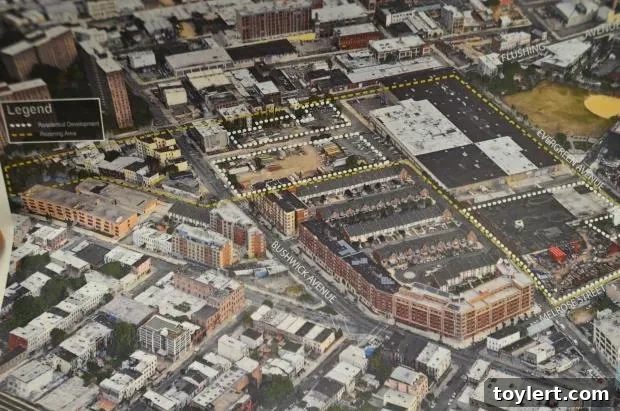
The transformation of urban landscapes often brings both promise and peril. In the heart of Bushwick, Brooklyn, the redevelopment of the historic Rheingold Brewery site stands as a testament to this duality. While promising modern residences and new amenities, the project by Read Property Group has sparked a powerful coalition of local residents and groups, spearheaded by Bushwick’s Community Board 4. This coalition is not merely observing the changes; it is actively shaping them, circulating a vital petition and calling upon Council Member Diana Reyna to facilitate a comprehensive Community Benefits Agreement (CBA) with the developer. This agreement is envisioned as a safeguard, ensuring that the development genuinely serves the long-term needs and preserves the unique character of the Bushwick community.
At its core, a Community Benefits Agreement is a legally binding contract between a developer and a coalition of community groups that ensures a development project provides specific benefits to the local neighborhood. For the Rheingold Brewery site, the demands are clear, comprehensive, and rooted in the lived experiences of Bushwick residents, covering everything from housing affordability to environmental sustainability and local economic support.
The Fight for Truly Affordable Housing in Bushwick
One of the most pressing demands from the Bushwick coalition is a significant increase in the number of “permanently affordable” housing units within the new development. Crucially, the community insists that this affordability be benchmarked against Bushwick’s annual median income, rather than the broader, often higher, citywide average. This distinction is paramount. New York City’s diverse economic landscape means that a citywide median income can dramatically skew what is considered “affordable” in a specific neighborhood like Bushwick, where many long-term residents earn far less than the city average. By tying affordability to local income levels, the community aims to ensure that the new housing truly benefits existing residents, preventing displacement and fostering a more inclusive future for the neighborhood.
The concern over genuine affordability highlights the ongoing struggle against gentrification that many Brooklyn neighborhoods face. As property values rise, original residents, often from lower-income brackets, find themselves priced out of their homes and communities. A robust CBA, with clearly defined local affordability metrics, provides a critical mechanism to counteract these pressures, ensuring that the Rheingold development does not exacerbate existing housing crises but rather contributes to a more equitable housing landscape.
Embracing Sustainability: Green Roofs and LEED Certification
Beyond housing, the coalition is also championing environmental stewardship, advocating for a green roof and LEED (Leadership in Energy and Environmental Design) building certification for the Rheingold development. These demands are not merely aesthetic; they represent a forward-thinking approach to urban development with tangible benefits for both residents and the environment.
Green roofs offer a multitude of advantages: they help manage stormwater runoff, reducing the burden on municipal drainage systems; they combat the urban heat island effect, leading to cooler ambient temperatures in the surrounding area; and they provide valuable urban green space, enhancing biodiversity and contributing to residents’ well-being. Furthermore, LEED certification signifies a commitment to high standards of energy efficiency, water conservation, and sustainable material use throughout the building’s lifecycle. By integrating these features, the Rheingold Brewery site could become a model for sustainable urban living, contributing to a healthier, more resilient Bushwick.
Fostering Local Economy and Preserving Industrial Heritage
The Bushwick community’s vision for the Rheingold site extends to the economic fabric of the neighborhood. The coalition is requesting that local manufacturing businesses and other community-oriented enterprises be given priority in the retail spaces within the new complex. This initiative aims to ensure that the economic benefits of the development circulate within Bushwick, supporting existing businesses, creating local job opportunities, and preventing the homogenization of retail offerings that often accompanies large-scale developments.
Another crucial demand related to economic preservation is the call to maintain the M3 manufacturing zoning status of the adjacent Mademoiselle industrial building. M3 zoning is typically reserved for heavy industrial uses, offering protection for manufacturing businesses that require specific infrastructure and separation from residential areas. Preserving this status is vital for retaining Bushwick’s diverse economic base, preventing the encroachment of purely residential or commercial uses that could displace industrial jobs and erode the neighborhood’s unique character. It’s a testament to the community’s understanding that a vibrant neighborhood needs a mix of residential, commercial, and industrial activity.
Dedicated Community Spaces and Participatory Planning
The coalition also emphasizes the creation of “permanently devoted to mixed intergenerational needs” community space. In rapidly developing urban areas, public and community spaces are often at a premium. Dedicated spaces that cater to diverse age groups—from children to seniors—are essential for fostering social cohesion, supporting community programs, and providing venues for cultural and recreational activities. Such spaces are vital for a neighborhood to thrive beyond just housing and commerce; they are the arteries of community life.
Complementing this is the demand for robust community input and participatory budgeting regarding the programming for the park and public spaces that are part of the Rheingold development. This approach goes beyond mere consultation; it empowers residents to have a direct say in how their shared public amenities are designed, utilized, and maintained. Participatory budgeting, in particular, allocates decision-making power over public funds directly to the community, fostering a sense of ownership and ensuring that these spaces truly reflect local priorities and desires. This democratic process ensures that the new public spaces are not just an add-on, but an integral part of Bushwick’s social infrastructure.
Addressing Concerns: No Hotels in the Complex
Lastly, the community has explicitly stated that there should be no hotels within the Rheingold complex. This demand reflects a strategic choice about the type of development Bushwick wants to encourage. Hotels, while sometimes seen as economic boons, can bring a different set of challenges, including increased traffic, noise, and a focus on transient visitors rather than long-term residents. The community’s preference is clearly for a residential-centric development that prioritizes the needs of its inhabitants and strengthens the existing community fabric, rather than catering to short-term tourism or corporate travel.
The Role of Council Member Diana Reyna and the Path Forward
The involvement of Council Member Diana Reyna is crucial in this negotiation process. As an elected representative, her support and advocacy can provide the necessary political leverage to ensure that Read Property Group genuinely engages with the community’s demands. A successful CBA often requires a strong mediator and a commitment from local government to uphold community interests in the face of large-scale development.
The Bushwick Community Board 4 and its allied neighborhood groups are setting a precedent for how communities can proactively engage with and influence major urban redevelopment projects. Their efforts for a Community Benefits Agreement at the Rheingold Brewery site underscore a broader movement in urban planning: one where community voices are not just heard, but are instrumental in shaping the future of their neighborhoods. This is a story of empowerment, resilience, and a community’s unwavering commitment to building a Bushwick that is equitable, sustainable, and truly reflective of its residents’ aspirations.