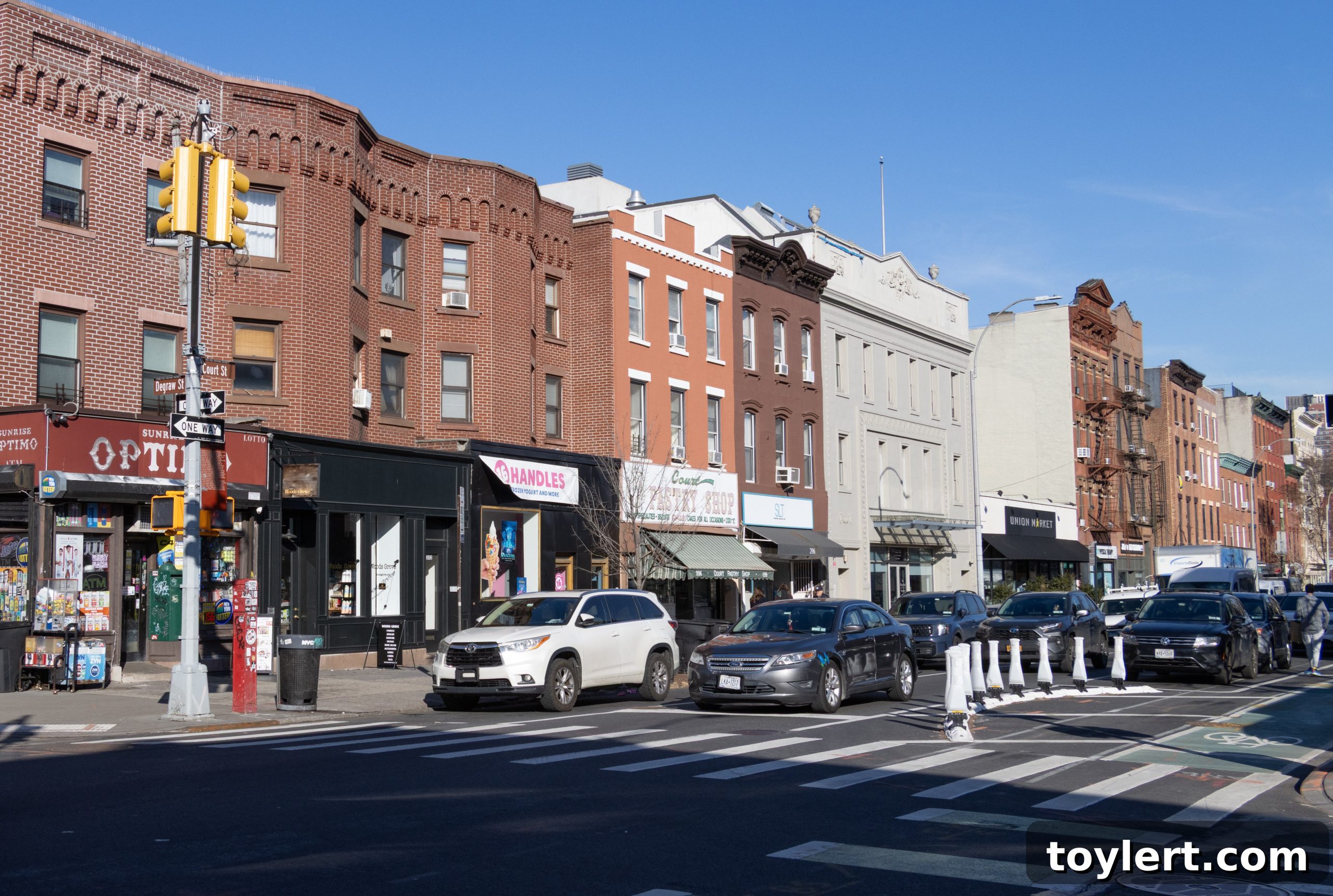
by Kirstyn Brendlen, Brooklyn Paper
Court Street Bike Lane Lawsuit Dismissed: A Landmark Victory for Urban Mobility in Brooklyn
A significant legal challenge against Brooklyn’s controversial Court Street bike lane has reached a definitive conclusion. In a ruling that reinforces the city’s authority in urban planning and transportation initiatives, a judge has dismissed the lawsuit seeking to remove the new protected bike lane. The decision, handed down by Brooklyn Supreme Court Justice Inga M. O’Neale, effectively rejects claims that the Department of Transportation’s (DOT) project was “arbitrary and capricious” or violated the constitutional rights of local shopkeepers.
Justice O’Neale’s ruling underscores the city’s “rational basis” for implementing the bike lane, asserting that its opponents failed to provide sufficient factual evidence to substantiate their arguments against the project. This dismissal marks a crucial moment for sustainable transportation advocates and urban planners, affirming the legality and legitimacy of infrastructure designed to promote cycling and enhance street safety.
The Genesis of the Court Street Bike Lane Debate
The installation of the Court Street bike lane, like many urban infrastructure projects, was met with a mix of enthusiasm and opposition. Designed to create a safer, more efficient corridor for cyclists in a bustling Brooklyn neighborhood, the lane aimed to integrate active transportation into the fabric of daily life. Proponents hailed it as a vital step towards reducing traffic congestion, improving air quality, and offering a healthier commute option for residents and visitors alike. The DOT emphasized that such initiatives are part of a broader vision for a greener, more accessible New York City, aligning with global trends in urban development that prioritize pedestrian and cyclist safety.
However, the project was not without its critics. A group of local shopkeepers and some residents voiced concerns primarily revolving around the perceived loss of parking spaces, which they argued would deter customers and negatively impact their businesses. The conversion of parking spots to make way for the bike lane sparked debates over economic viability versus public good, igniting a passionate discourse within the community. These concerns, while understandable from a localized perspective, often clash with the city’s mandate to plan for comprehensive, long-term urban mobility solutions that serve a diverse population.
Legal Challenge: Allegations and Arguments
The lawsuit brought against the Court Street bike lane sought its complete removal, citing several grievances. The plaintiffs contended that the Department of Transportation’s decision-making process was “arbitrary and capricious,” implying that the project lacked proper rationale, objective data, or thorough consideration of community input. This legal term suggests that a governmental agency acted without reasonable grounds or in disregard of facts and circumstances.
Furthermore, the lawsuit alleged that the bike lane violated the constitutional rights of local shopkeepers. While the specific nature of these constitutional claims was not fully detailed in the initial reports, such arguments often touch upon property rights, due process, or the right to pursue a livelihood, asserting that government actions unduly infringe upon these fundamental protections. The plaintiffs argued that the lane’s presence caused significant economic hardship by reducing customer access and thereby impeding their ability to conduct business effectively. They sought to demonstrate that the DOT had not adequately balanced the needs of all stakeholders, particularly the small businesses that form the backbone of the neighborhood’s economy.
These legal battles over urban infrastructure are not uncommon in densely populated cities like New York, where competing interests often converge on limited public space. Such lawsuits typically require plaintiffs to present compelling evidence that a municipal agency overstepped its authority, acted irrationally, or caused demonstrable harm. The burden of proof lies with the challengers to dismantle the presumption of validity often afforded to governmental actions.
The City’s Stance: A Rational Approach to Urban Mobility
In response to the lawsuit, the City of New York and its Department of Transportation maintained that the Court Street bike lane was the result of careful planning, extensive research, and a clear “rational basis.” This legal standard is crucial: for a government action to be deemed lawful, it must serve a legitimate government purpose and be reasonably related to achieving that purpose. The city argued that the bike lane project was designed to address multiple legitimate objectives, including enhancing public safety, reducing traffic fatalities and injuries, promoting sustainable transportation modes, and contributing to overall public health.
The DOT likely presented data supporting the increased demand for cycling infrastructure, statistics on cyclist injuries on unprotected streets, and the environmental benefits of encouraging fewer car trips. They would have highlighted the broader network of bike lanes across the city, positioning the Court Street lane as an integral part of a comprehensive strategy to create a safer, more connected urban environment. Furthermore, the city would have asserted that its planning process involved due diligence, including traffic studies, environmental reviews, and public outreach efforts, even if those efforts didn’t satisfy all dissenting voices.
The city’s defense underscored its commitment to Vision Zero, an initiative aimed at eliminating traffic fatalities and serious injuries on New New York City streets. Protected bike lanes are a cornerstone of this strategy, providing dedicated space for cyclists that physically separates them from vehicle traffic, thus significantly reducing the risk of collisions. This focus on safety and public welfare often serves as a strong “rational basis” for implementing such infrastructure improvements, even in the face of localized opposition concerning parking or traffic flow.
Justice O’Neale’s Decisive Ruling
Justice Inga M. O’Neale’s decision to dismiss the lawsuit was a comprehensive affirmation of the city’s position. Her ruling dissected the plaintiffs’ claims and found them lacking in factual and legal merit. She meticulously evaluated whether the DOT’s actions fell within the bounds of reasonable governmental conduct, ultimately concluding that they did.
Upholding the “Rational Basis” Standard
Central to Justice O’Neale’s judgment was her finding that the city indeed had a “rational basis” for installing the bike lane. This means that the DOT’s decision was not arbitrary but was grounded in legitimate governmental objectives and supported by reasonable considerations. The court recognized that urban planning decisions often involve balancing various public interests and that agencies are typically afforded considerable discretion in how they achieve their goals, provided their actions are not utterly without reason or fact.
Justice O’Neale acknowledged the city’s stated objectives for the bike lane—such as promoting safety, reducing congestion, and encouraging environmentally friendly transportation—as valid and within the scope of the DOT’s mission. The ruling implies that the court would not substitute its judgment for that of the city planners and transportation experts, as long as the city’s approach was logical and pursued a permissible public purpose. This judicial deference to expert agency decision-making is a common principle in administrative law.
Lack of Factual Evidence from Plaintiffs
A critical component of the dismissal was the court’s determination that the opponents of the bike lane “failed to provide factual evidence to back up their arguments against it.” In legal proceedings, allegations must be supported by verifiable facts, data, or expert testimony. The plaintiffs’ claims of “arbitrary and capricious” actions and constitutional violations, while strongly asserted, evidently lacked the concrete proof required to sway the court.
This absence of factual backing could stem from various factors: insufficient data on actual business impact, a failure to demonstrate a direct and undeniable causal link between the bike lane and alleged economic losses, or an inability to prove that the DOT acted outside its procedural mandates or without any reasonable justification. The ruling effectively communicates that mere dissatisfaction or perceived inconvenience, without substantial empirical evidence of egregious wrongdoing or irreparable harm, is not enough to overturn a municipal infrastructure project.
Implications for Brooklyn and Beyond
The dismissal of the Court Street bike lane lawsuit carries significant implications, not only for Brooklyn but for urban planning and transportation policy across New York City and other municipalities grappling with similar issues.
Impact on Local Businesses and Commuters
For the businesses along Court Street, the ruling means the bike lane is here to stay, prompting them to adapt to the new streetscape. While some may continue to grapple with changes to parking and customer access, others might explore new strategies, such as promoting bike-friendly services or highlighting their accessibility to cyclists. The long-term economic impact of bike lanes on local businesses remains a subject of ongoing study, with some research suggesting positive effects due to increased foot traffic and diverse modes of customer arrival. Commuters, particularly cyclists, will continue to benefit from the enhanced safety and dedicated infrastructure, reinforcing cycling as a viable and encouraged mode of transport.
A Precedent for Urban Planning and Sustainable Transport
More broadly, this decision sets a clear precedent. It signals to future challengers that legal actions against well-reasoned urban infrastructure projects, particularly those aimed at sustainability and safety, will require substantial and compelling factual evidence to succeed. This ruling empowers city agencies, like the DOT, to move forward with plans that align with modern urban development principles, confident that their rationally based decisions will withstand judicial scrutiny.
The case underscores the judiciary’s role in upholding the balance between individual concerns and the collective public interest. It validates the legitimacy of prioritizing public safety, environmental benefits, and alternative transportation options as sound governmental purposes, even when they necessitate changes to established urban patterns.
The Future of Active Transportation in NYC
New York City, like many global metropolises, is continually evolving its transportation infrastructure to meet the demands of a growing population and the imperative of climate resilience. The victory for the Court Street bike lane serves as a reaffirmation of the city’s commitment to active transportation modes.
This decision will likely embolden the DOT to continue expanding its network of protected bike lanes, pedestrian improvements, and other initiatives aimed at making the city more walkable and bikeable. It reinforces the idea that strategic urban planning must embrace multimodal transportation solutions, moving beyond a sole reliance on automobile traffic. As cities strive for greater sustainability and livability, legal precedents like this one become instrumental in paving the way for progressive urban development. The Court Street bike lane will now continue to serve its intended purpose, contributing to a safer, healthier, and more accessible Brooklyn for all its residents.