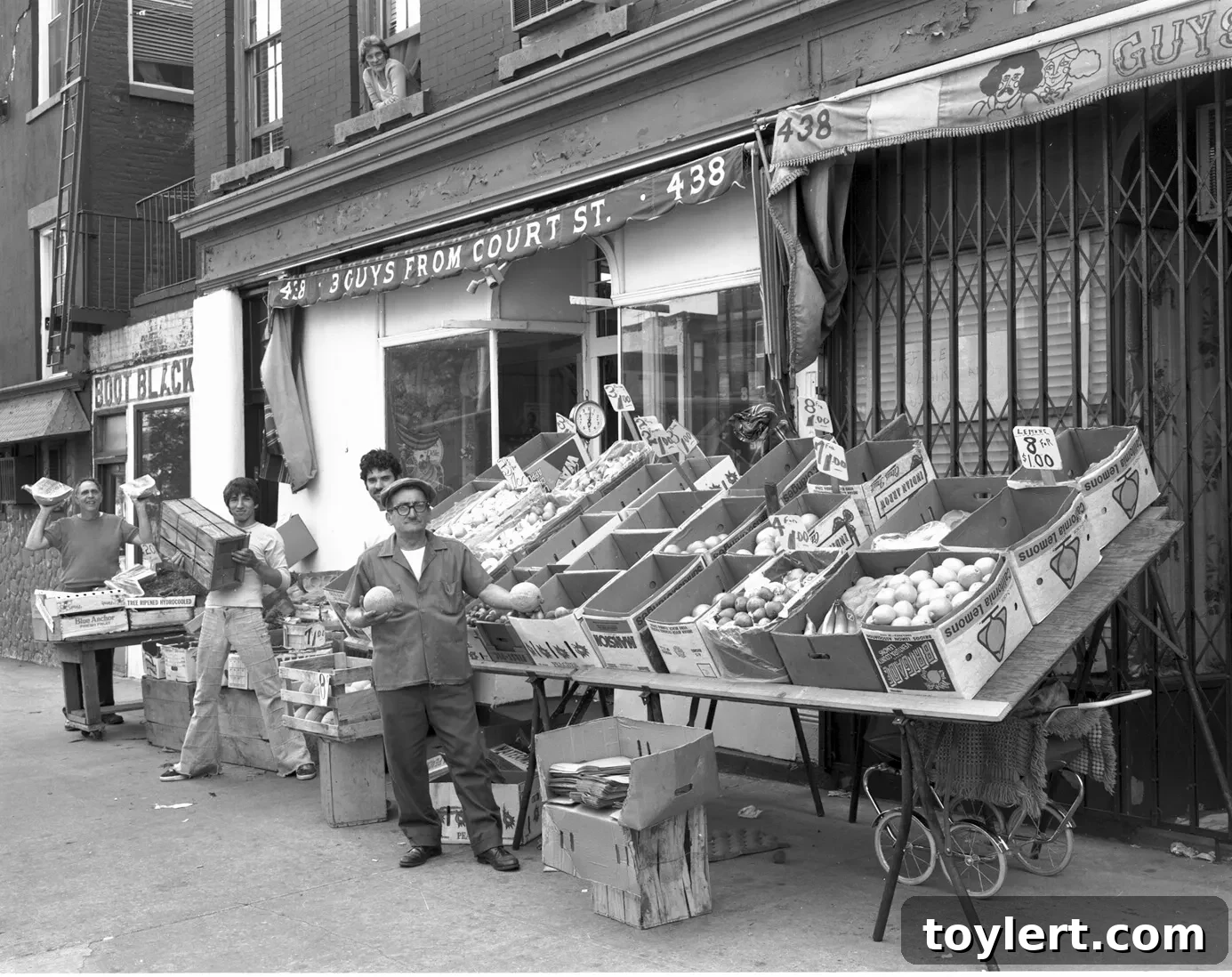
The 1970s marked a distinctive epoch for Brooklyn, an era characterized by a unique blend of urban grittiness, vibrant community spirit, and an undeniable sense of place. From the ubiquitous graffiti adorning brownstone stoops and brick walls to the distinct sartorial choices of its residents, Brooklyn in this decade presented a visually rich tapestry. It was a time before the widespread proliferation of towering high-rises, where the skyline remained relatively low, allowing the architectural heritage of its neighborhoods to truly shine. Crucially, the borough’s economic and social fabric was deeply woven with the presence of countless mom-and-pop shops, serving as the heartbeat of every block and fostering a strong sense of local identity. It was against this evocative backdrop that Peter Bellamy, then a keen-eyed student at Pratt Institute, meticulously documented the raw essence of Brooklyn on film, offering us an invaluable window into a bygone yet influential period.
Bellamy’s striking photographic archives serve as a powerful testament to the enduring character of Brooklyn, illustrating the intriguing paradox that while much changes, some fundamental elements remarkably persist. His lens captured the iconic row houses, many still standing proud today, and the familiar streetlights that continue to illuminate the borough’s intricate streetscapes, reminding us of the architectural continuity that anchors Brooklyn’s identity. Yet, these images are also subtle time capsules, revealing details that unmistakably root them in the 1970s. A verdant open field, for instance, might now be the site of a bustling residential complex, a testament to Brooklyn’s relentless development. Classic car models, now collector’s items, cruise down avenues, and even the placement or design of a simple traffic light offers a fleeting glimpse into the urban planning and infrastructure of yesteryear, inviting viewers to ponder the profound transformations the borough has undergone.
The era Bellamy captured was one of significant social and economic flux for Brooklyn. The late 1960s and 1970s saw New York City grapple with financial crises and shifting demographics, and Brooklyn, in many ways, mirrored these broader urban trends. Despite the challenges, a resilient community spirit thrived, particularly within its diverse neighborhoods. The prevalence of graffiti, often seen as a symbol of urban decay by some, was also emerging as a powerful, albeit often unsanctioned, art form, reflecting the voices and creativity bubbling up from the streets. This vibrant, sometimes chaotic, energy was precisely what Bellamy, with his student’s perspective and outsider’s curiosity, was uniquely positioned to document. His photographs move beyond mere snapshots; they are socio-cultural documents, preserving the atmosphere, the textures, and the very soul of a city in transition.
Bellamy’s unique position as a Pratt student afforded him an intimate access to the borough’s street life that a professional, commissioned photographer might not have achieved. His work feels unfiltered and authentic, capturing candid moments that reveal the everyday lives of Brooklynites. He didn’t just photograph buildings; he captured the human element that animated them—children playing hopscotch on sidewalks, adults congregating on stoops, and shopkeepers tending to their customers. This focus on the ordinary elevates his work, transforming mundane scenes into poignant historical records. Through his lens, we can almost hear the cacophony of street sounds, smell the diverse aromas wafting from local eateries, and feel the pulse of a borough brimming with unpolished charm.
During an exclusive interview, Bellamy offered profound insights into the evolving landscape of Brooklyn and the methodological choices he made four decades ago. His reflections highlight the foresight involved in selecting specific neighborhoods for his photographic expeditions—areas like Gowanus, Carroll Gardens, Flatbush, and Greenpoint, which then possessed distinct characteristics that hinted at both their past and their future trajectories. His anecdotes often underscore the dramatic shifts, yet also the stubborn continuities, within these communities. One particularly vivid memory involved the surreal sight of people riding horses through the overgrown, semi-industrial stretches of Gowanus. This peculiar detail speaks volumes about the then-untamed fringes of urban Brooklyn, where remnants of a wilder, less developed landscape still intersected with pockets of human habitation, offering a stark contrast to the highly developed, gentrified Gowanus of today.
The phenomenon of mom-and-pop shops, so central to Bellamy’s depiction of 1970s Brooklyn, represented more than just commercial entities; they were vital community hubs. These local businesses—greengrocers, bakeries, hardware stores, corner delis—were often family-owned and operated for generations, fostering deep-rooted relationships with their customers. They were places where neighbors exchanged pleasantries, where news spread, and where the economic pulse of a block could be felt. The absence of large chain stores meant that commerce was highly localized and personalized, contributing significantly to the unique character and resilience of each neighborhood. Bellamy’s photographs subtly capture the quiet dignity and hard work inherent in these establishments, offering a poignant reminder of a retail landscape that has largely given way to larger, more impersonal ventures in the modern era.
Exploring the specific neighborhoods Bellamy frequented adds another layer to understanding his work. In Gowanus, he likely focused on its industrial character, the titular canal, and the working-class communities that lived alongside its factories and warehouses. His images from Carroll Gardens would have captured its distinctive brownstones, tree-lined streets, and the Italian-American heritage that was so prominent. Flatbush, a vast and diverse area, would have presented scenes of grand Victorian homes alongside bustling commercial strips and a mosaic of cultures. Greenpoint, with its Polish-American roots and industrial waterfront, would have offered yet another unique urban narrative. By traversing these varied landscapes, Bellamy created a holistic portrait of Brooklyn, showcasing its multifaceted identity rather than just a singular, monolithic image.
The “comparative lack of tall buildings” in Bellamy’s images is not merely an architectural observation but a reflection of a different urban planning philosophy and economic reality. The skylines of the 1970s lacked the dense clusters of skyscrapers that now define many parts of Brooklyn, particularly downtown areas. This lower profile meant that light reached the streets more readily, and the human scale of the borough’s architecture was more pronounced. It allowed for a greater sense of intimacy within neighborhoods and a clear visual demarcation between districts, preserving the distinct identities that Bellamy so meticulously documented. The evolution of Brooklyn’s skyline from the 1970s to today tells a story of intense development pressures, changing land values, and a global city’s continuous push towards vertical expansion, making Bellamy’s images all the more vital as historical benchmarks.
Peter Bellamy’s photographic legacy extends far beyond mere historical documentation. His work acts as a mirror, allowing contemporary Brooklynites to reflect on their borough’s past and understand the trajectory of its present. These images evoke a powerful sense of nostalgia for some, offering glimpses of childhood streets or family businesses. For others, they provide an educational journey into a Brooklyn they never knew, helping to contextualize the rapid changes witnessed in recent decades. His photographs are not just records of places and faces; they are narratives of urban evolution, cultural shifts, and the enduring human spirit that defines this iconic New York City borough. They remind us that while the physical landscape may transform, the essence of a community often finds ways to persist, subtly reshaping itself through generations.
In conclusion, Peter Bellamy’s photographs from the 1970s Brooklyn are more than just a collection of images; they are a profound visual anthology that captures the soul of an era. Through his lens, we are invited to witness a Brooklyn that was both familiar and startlingly different—a borough steeped in local character, resilient in the face of change, and rich with stories waiting to be rediscovered. His work not only preserves the architectural and social fabric of a pivotal decade but also encourages us to contemplate the delicate balance between preservation and progress, making these historic photographs an invaluable resource for anyone interested in urban history, the art of photography, or the ever-evolving story of Brooklyn.