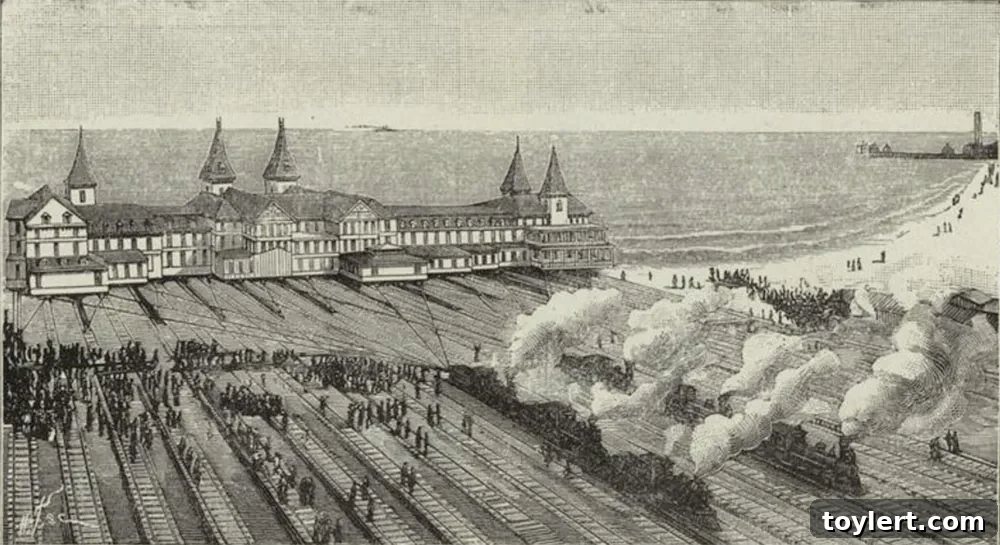
The Unforgettable Journey of the Brighton Beach Hotel: A Triumph Over Coastal Erosion
In the vibrant tapestry of Brooklyn’s rich history, certain events stand out not just as fascinating anecdotes but as profound testaments to human ingenuity in the face of nature’s formidable power. Among these, the remarkable story of the Brighton Beach Hotel’s relocation is a true marvel. This extraordinary feat, where a colossal structure was literally hauled 600 feet inland, not only preserved a cherished landmark from the relentless grip of coastal erosion but also serves as a poignant historical echo of the global warming and flooding concerns that dominate our discussions today.
This legendary hotel, once a jewel of the Brooklyn coastline, faced an existential threat that seemed insurmountable. Yet, through innovative engineering and unwavering determination, it embarked on an incredible journey, moving away from the encroaching waves that threatened to reclaim it. It’s a tale that encapsulates an era of bold vision, a deep appreciation for architectural preservation, and an early, audacious response to environmental challenges, long before “climate change” became a common phrase.
An Icon of Gilded Age Leisure: The Birth of the Brighton Beach Hotel
The year 1878 marked the grand opening of the Brighton Beach Hotel, a magnificent establishment designed to cater to the burgeoning middle class seeking respite and recreation by the sea. Stretching an impressive 170 yards long and 15 yards deep along the picturesque shore, this low-slung, 174-room hotel quickly became a symbol of luxury and leisure. Its architectural design embraced the seaside aesthetic, featuring broad verandas that offered panoramic views of the Atlantic Ocean, inviting guests to relax and soak in the coastal breeze.
Beyond its aesthetic appeal, the hotel offered unparalleled convenience. Recognizing the growing demand for easy access from the bustling metropolis, it provided private railroad transport directly from Manhattan. This exclusive service transformed Brighton Beach into an accessible and highly desirable resort destination for New Yorkers. Guests, primarily prosperous borough residents, reveled in the opulent surroundings, the fresh ocean air, and the sophisticated atmosphere that defined Gilded Age seaside resorts. The Brighton Beach Hotel was more than just a place to stay; it was an experience, a retreat from urban life, and a testament to the era’s pursuit of refined pleasure.
During its early years, Brighton Beach flourished as a premier resort area, attracting thousands of visitors who came for the cool ocean breezes, the grand hotels, and the vibrant boardwalk atmosphere. The Brighton Beach Hotel stood proudly amidst this lively scene, a cornerstone of the community and a beloved destination for families and individuals alike, all seeking the restorative power of the sea. Its reputation for elegance and hospitality was firmly established, drawing guests year after year to its comfortable rooms and charming verandas.
Nature’s Relentless Advance: The Erosion Crisis Unfolds
However, the idyllic setting of the Brighton Beach Hotel, so integral to its charm, soon became its greatest vulnerability. Barely a decade after its celebrated opening, a formidable adversary emerged from the very ocean that had drawn so many to its shores: relentless coastal erosion. The waves, once a soothing backdrop, began to transform into a destructive force, inching closer and closer to the hotel’s foundation with each passing tide. The once expansive beach, which had served as a protective buffer, dwindled alarmingly, bringing the roaring Atlantic to the very doorstep of the grand establishment.
The situation escalated rapidly. Storm surges and constant wave action started to undermine the structural integrity of the building, eroding the earth beneath its foundations. Cracks appeared, and the very ground the hotel stood upon began to shift precariously. What was initially a minor concern quickly spiraled into a full-blown crisis. The hotel, once a beacon of stability, now faced the grim prospect of being literally swallowed by the sea. The threat was not just to the building itself, but to the significant financial investment it represented, and the livelihoods of those who worked there.
The management and owners were confronted with an agonizing dilemma. Demolition seemed like a costly and heartbreaking inevitability, signaling the premature end of a promising enterprise. The relentless power of Mother Nature appeared to be winning, threatening to erase this architectural gem from the Brooklyn coastline forever. The community watched with bated breath, understanding that the loss of the Brighton Beach Hotel would signify not just the loss of a building, but a piece of their identity and a popular destination that brought life and vibrancy to the area.
An Engineering Marvel: The Great Relocation of 1888
In the face of what seemed like an insurmountable challenge, a audacious and truly groundbreaking plan began to take shape. Instead of surrendering to the sea, the decision was made to defy it: the Brighton Beach Hotel would be moved. This was no small undertaking. The structure, weighing an estimated 5,000 tons and sprawling across 170 yards, presented an engineering puzzle of unprecedented scale for its time. The task was entrusted to one of the era’s most ingenious minds, Colonel Richard K. Fox, an engineer renowned for his innovative problem-solving.
The method conceived for this colossal undertaking was as ingenious as it was daring. The entire hotel had to be lifted, placed on a complex network of tracks and rollers, and then painstakingly pulled inland. This wasn’t merely a matter of brute force; it required precision, careful planning, and a deep understanding of structural mechanics. Workers, under the meticulous supervision of engineers, began by digging trenches and installing thousands of heavy timber beams and rollers beneath the hotel’s foundation. Hydraulic jacks were used to slowly and steadily lift the immense structure just enough to slide the rolling mechanisms into place.
Once the hotel was balanced precariously on its temporary railway, a team of powerful steam locomotives and hundreds of laborers working in unison began the monumental task of hauling it. The hotel was moved approximately 600 feet inland, a journey that unfolded over a period of several weeks in 1888. The process was slow and methodical, moving mere feet per day. Sections of track had to be continuously laid ahead and then removed from behind, a constant dance of construction and deconstruction. The spectacle drew massive crowds, with thousands flocking to Brighton Beach to witness this extraordinary feat of human will and engineering prowess. It was a testament to the fact that with enough ingenuity and determination, even the seemingly impossible could be achieved.
A New Lease on Life: The Hotel’s Enduring Legacy
The successful relocation of the Brighton Beach Hotel was more than just an engineering triumph; it was a powerful statement about resilience and foresight. Once safely ensconced 600 feet from the encroaching waves, the hotel enjoyed a new lease on life. Its operations continued seamlessly, preserving a vital part of Brighton Beach’s appeal and maintaining its status as a premier resort destination. The move itself became part of the hotel’s mystique, drawing even more visitors eager to stay in the legendary establishment that had literally outmaneuvered the ocean.
The hotel continued to welcome guests for many decades, adapting to changing times and evolving tastes while retaining its historical grandeur. Its story became a beloved piece of Brooklyn folklore, celebrated as an example of human ingenuity confronting and overcoming natural challenges. The event solidified the Brighton Beach Hotel’s place in history, not just as a grand resort, but as a symbol of architectural preservation and engineering innovation. It demonstrated that significant investments could be protected through creative solutions, inspiring future generations of engineers and urban planners.
Though the original Brighton Beach Hotel eventually met its ultimate fate through other means (it was demolished in the 1920s to make way for new developments, a common end for many historic structures in rapidly developing areas), its legendary journey remains etched in the annals of New York City history. The precedent set by its relocation continued to influence how cities approached preserving valuable buildings and adapting to environmental shifts, leaving an indelible mark on the landscape of urban development and preservation efforts.
Echoes of the Past: Foreshadowing Modern Climate Challenges
The dramatic struggle of the Brighton Beach Hotel against coastal erosion in the late 19th century holds profound relevance for our modern world. In many ways, this historical event serves as a striking foreshadowing of the urgent concerns we face today regarding global warming, rising sea levels, and the increasing vulnerability of coastal communities worldwide. The forces that threatened the hotel over a century ago—powerful waves, shifting sands, and the relentless advance of the ocean—are precisely the same challenges that millions of people and countless coastal properties confront on an accelerating scale today.
While the causes of erosion in the 1880s might have been attributed solely to natural processes, our contemporary understanding of climate change adds a critical layer of complexity. Today, rising global temperatures contribute to melting glaciers and ice sheets, causing sea levels to climb at unprecedented rates. This exacerbates coastal erosion, intensifies storm surges, and increases the frequency and severity of flooding, making once-secure shorelines perilous. The Brighton Beach Hotel’s story reminds us that the battle between human habitation and the sea is ancient, but the stakes are higher than ever.
The solutions adopted then, like relocating an entire building, are being reconsidered and implemented today in various forms of “managed retreat” or “adaptive reuse” in vulnerable coastal zones. This historical parallel underscores the ongoing need for innovative engineering, proactive planning, and sustainable strategies to protect our invaluable coastal infrastructure and communities from the encroaching impacts of a changing climate. The Brighton Beach Hotel’s journey offers a powerful historical lesson, urging us to learn from the past to secure a more resilient future against the forces of nature amplified by human activity.
Brighton Beach: A History of Resilience and Adaptation
The story of the Brighton Beach Hotel is inextricably linked to the broader history of Brighton Beach itself, a community that has consistently demonstrated remarkable resilience and an enduring spirit of adaptation. From its inception as an elite resort in the late 19th century, drawing well-heeled vacationers with promises of fresh air and lavish amenities, Brighton Beach has continually reinvented itself. It transitioned from a playground for the wealthy to a beloved working-class getaway, and eventually evolved into a vibrant cultural melting pot, particularly known for its rich Eastern European heritage.
Through economic downturns, changes in transportation, and shifts in demographic makeup, Brighton Beach has maintained its unique character and its appeal as a seaside destination. Its residents have faced various challenges, from the initial threats of coastal erosion to later urban development pressures and the complexities of integrating diverse communities. Each era has brought its own set of trials, yet the community has consistently responded with innovation, solidarity, and a deep attachment to its coastal identity.
The Brighton Beach Hotel’s move symbolizes this inherent resilience, a pioneering act of adaptation that set a precedent for future generations. It stands as a powerful reminder that while the physical landscape may change and structures may come and go, the spirit of a place and its people can endure and thrive through ingenuity and determination. Brighton Beach remains a testament to the dynamic interplay between nature, human enterprise, and the ongoing evolution of urban coastal environments.
A Legacy of Vision and Defiance
The incredible saga of the Brighton Beach Hotel’s relocation is far more than a mere historical curiosity; it is an enduring narrative that speaks volumes about human determination and our complex relationship with the natural world. This monumental act of engineering, which saw a grand seaside resort literally picked up and moved to safety, stands as a testament to the boundless creativity and audacious spirit of an era. It epitomizes a moment when the seemingly insurmountable power of Mother Nature was met with an equally formidable display of human ingenuity and resolve.
Today, as we grapple with the escalating challenges of climate change and coastal vulnerability, the story of the Brighton Beach Hotel resonates with renewed significance. It serves as a potent reminder that adapting to environmental threats is not a new concept, but a continuous imperative. This historic episode offers valuable lessons in innovation, preservation, and the critical importance of foresight in safeguarding our built heritage against the relentless forces of nature. The legacy of the Brighton Beach Hotel continues to inspire, urging us to embrace bold solutions and unwavering determination in the face of our contemporary environmental challenges, ensuring that our communities can thrive for generations to come.