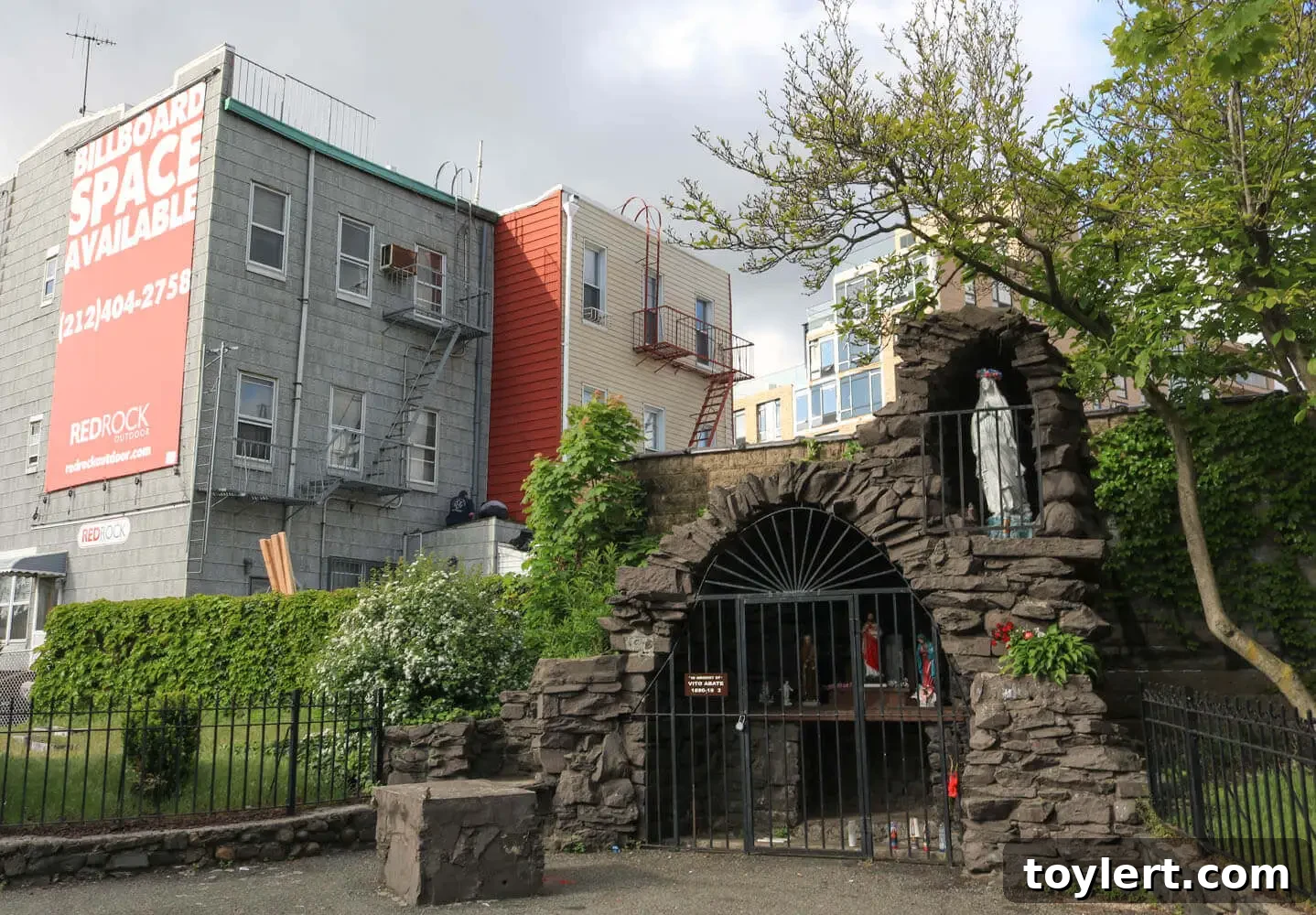
The Enduring Legacy of Williamsburg’s Abate Grotto: A Crossroads of History and Faith
At the bustling intersection of Woodpoint Road and Conselyea Street in the vibrant Brooklyn neighborhood of Williamsburg, a unique and unassuming structure stands as a testament to history, faith, and community resilience. This modest yet profoundly significant site is the Vito Abate Grotto, located specifically at 219 Woodpoint Road. While the grotto itself, constructed in the late 1930s, might appear to be a relatively recent addition to the urban landscape, its small plot of ground carries a much older and deeper historical resonance, connecting it to the earliest chapters of Brooklyn’s storied past. More than just a religious shrine associated with the historic St. Francis of Paola Church directly across the street, the Abate Grotto serves as a physical link to generations of residents and the rich tapestry of cultures that have shaped Williamsburg.
Its very presence invites curiosity, prompting passersby to ponder the origins and purpose of such an intimate devotional space nestled amidst the brick and brownstone of an ever-evolving city. The grotto’s construction was a project deeply rooted in the faith and communal spirit of the local Italian-American population, a vibrant and influential demographic that left an indelible mark on Williamsburg. Yet, its location is no mere coincidence; it occupies a space that has been a significant crossroads since the 1640s, dating back to the Dutch settlement known as Het Dorp. Understanding the Vito Abate Grotto means delving into a multi-layered history that spans centuries, encompassing early colonial life, immigrant journeys, and the enduring power of spiritual devotion.
The Enigmatic Grotto: A 20th-Century Devotion on Ancient Ground
The Vito Abate Grotto, a charming and intricate structure, emerged from the profound faith and dedication of its namesake, Vito Abate, and the parishioners of St. Francis of Paola Church. Built during the challenging era of the Great Depression, the grotto provided a spiritual haven and a symbol of hope for a community facing economic hardship and social upheaval. Grottoes, particularly in the Catholic tradition, are often miniature representations of sacred caves or holy sites, most famously the Grotto of Lourdes in France. They serve as places for prayer, meditation, and quiet reflection, offering a tangible connection to the divine outside the confines of a traditional church building.
Vito Abate and the Birth of a Shrine
Vito Abate, an Italian immigrant and a devout member of the St. Francis of Paola parish, spearheaded the construction of this unique shrine. His vision was to create a sacred space that would honor the Blessed Virgin Mary and provide a focal point for communal prayer and devotion. Abate, along with other dedicated volunteers and skilled craftsmen from the neighborhood, meticulously assembled the grotto using found materials and donations, reflecting a spirit of resourcefulness and shared purpose common during that era. This collective effort not only brought the grotto to life but also forged stronger bonds within the Italian-American community, who often found solace and identity in their shared faith and cultural traditions. The grotto became a symbol of their collective piety and a cherished landmark in their adopted homeland.
Architectural Details and Religious Symbolism
The design of the Vito Abate Grotto is characteristic of many folk religious shrines, often incorporating natural elements and classical motifs. Typically, such grottoes feature a niche or cave-like structure housing a statue of the Virgin Mary, sometimes accompanied by other saints or angels. The use of various stones, pebbles, and shells often creates a textured, organic appearance, evoking the natural beauty of sacred grottos found in nature. While specific details of its original construction materials might be modest, the craftsmanship and the symbolic intent behind each piece are paramount. The grotto was designed to be an accessible, open-air sanctuary, inviting contemplation and veneration from all who passed by. Its enduring presence, even decades later, speaks volumes about the spiritual significance it holds for the community and its connection to the traditions brought over by immigrants.
St. Francis of Paola Church: The Spiritual Anchor
Central to understanding the Vito Abate Grotto is its intimate relationship with the St. Francis of Paola Church. Located directly across Conselyea Street, the church has served as the spiritual heart of the Italian-American community in this part of Williamsburg for well over a century. The grotto was conceived not as an independent entity but as an extension of the church’s mission, a public demonstration of faith that complemented the sacred rituals performed within the church walls. The church and the grotto together formed a spiritual axis for parishioners, providing both formal and informal spaces for religious expression and communal gathering.
A Sanctuary for Immigrants
St. Francis of Paola Church was established to cater to the spiritual needs of the burgeoning Italian immigrant population in Williamsburg during the late 19th and early 20th centuries. For many, the church was far more than just a place of worship; it was a vital social hub, a source of cultural continuity, and a crucial support system in a new and often challenging environment. It offered masses in Italian, provided social services, and organized community events that helped new arrivals adapt while preserving their heritage. The church helped to foster a strong sense of identity and belonging among its congregants, becoming a cornerstone of the Italian-American experience in Brooklyn. The grotto, built years later, reinforced this sense of community and shared faith, acting as an outdoor chapel accessible to all.
The Patron Saint and the Community
St. Francis of Paola, the patron saint after whom the church is named, was a 15th-century Italian hermit and founder of the Order of Minims, known for his austerity, charity, and miracles. His devotion to the poor and his humble origins resonated deeply with the immigrant community, many of whom faced similar struggles and sought comfort in their faith. The selection of this patron saint underscored the values of the parish: humility, service, and unwavering belief. The grotto, by extension, became a tangible symbol of these values, an open invitation to prayer and reflection that mirrored the church’s welcoming embrace. Its placement at a prominent intersection ensured that the spiritual presence of the church extended beyond its physical walls, making faith visible in the daily lives of the neighborhood’s inhabitants.
Het Dorp: Unearthing Williamsburg’s Deepest Roots
What truly elevates the significance of the Vito Abate Grotto beyond its immediate religious and cultural context is the ground upon which it stands. This small parcel of land at the crossroads of Woodpoint Road and Conselyea Street is not just another city corner; it is a site steeped in centuries of history, tracing its lineage back to the very beginnings of European settlement in Brooklyn. This particular location was part of Het Dorp, one of the earliest Dutch settlements on Long Island, dating back to the 1640s. Understanding this ancient lineage provides a breathtaking perspective, transforming the grotto into a modern marker on a landscape that has witnessed profound transformations over nearly four centuries.
From Dutch Settlement to Urban Hub
Het Dorp, or “The Village” in Dutch, was one of the initial agricultural outposts established by Dutch colonists in what would become present-day Brooklyn. These early settlements were strategically located, often at natural crossroads or along waterways, to facilitate trade and communication. The intersection where the grotto now stands would have been a significant point in this nascent colonial landscape, a pathway connecting farms and hamlets. Over the centuries, as Dutch rule gave way to British, and as the American Revolution reshaped the nation, this rural outpost gradually evolved. Farmlands were subdivided, roads were formalized, and small communities began to coalesce, eventually leading to the urbanization that characterized 19th-century Brooklyn.
The Shifting Landscape of Williamsburg
The area now known as Williamsburg underwent dramatic changes from a collection of small farms and villages to a thriving urban center. By the mid-19th century, Williamsburg had become a distinct city before its eventual consolidation into Greater New York City. Its deep-water access attracted industries, and the demand for labor drew waves of immigrants from various parts of Europe. This transformation from “Het Dorp” to a bustling industrial and residential neighborhood speaks to the incredible dynamism of Brooklyn’s development. The Abate Grotto, standing on a plot whose history stretches back to these formative years, serves as an unexpected bridge across these vast temporal divides, linking the devout aspirations of 20th-century immigrants with the foundational acts of 17th-century colonists.
Italian-American Heritage: Shaping a Neighborhood
The construction of the Vito Abate Grotto cannot be fully appreciated without acknowledging the profound impact of Italian immigration on Williamsburg. In the late 19th and early 20th centuries, Brooklyn, like many American cities, experienced a massive influx of immigrants from Southern Italy. These new arrivals sought economic opportunity and a better life, often settling in tightly-knit communities where their language, customs, and religious practices could be preserved and nurtured. Williamsburg became one such vibrant Italian-American enclave, characterized by its bakeries, social clubs, festivals, and, crucially, its robust Catholic parishes.
Immigration Waves and Cultural Impact
Italian immigrants brought with them a deep-rooted Catholic faith, often expressed through elaborate public devotions, patron saint festivals, and the creation of sacred spaces like grottoes. These practices were not just religious; they were integral to their cultural identity and served as a powerful means of maintaining community cohesion in a new land. The presence of the Abate Grotto is a direct reflection of this cultural heritage. It represents a tangible manifestation of their desire to recreate elements of their homeland’s spiritual landscape within their new American home, providing comfort and continuity amidst change.
The Grotto as a Community Landmark
For the Italian-American families of Williamsburg, the grotto was more than just a place to pray; it was a community landmark. It was a place where children might gather, where neighbors exchanged greetings, and where the faithful could pause for a moment of quiet reflection during their daily routines. It spoke to the collective spirit of the neighborhood, reflecting the values of hard work, family, and unwavering faith that defined the community. The grotto thus transcended its purely religious function to become a significant cultural artifact, a touchstone for generations who remembered a time when the neighborhood was distinctly Italian-American, and faith was openly expressed on its streets.
The Grotto Today: A Testament to Time and Tradition
Today, the Vito Abate Grotto continues to stand at its historic crossroads, a silent witness to the ceaseless march of time and the ever-changing face of Williamsburg. While the demographics of the neighborhood have shifted dramatically over the decades, with new waves of residents bringing their own cultures and traditions, the grotto remains a poignant reminder of the community that built it and the spiritual values it represents. Its survival amidst extensive urban development and demographic transformation speaks to its inherent significance, not just as a religious relic but as a piece of living history.
Preservation Efforts and Modern Significance
The grotto’s continued existence is often a testament to ongoing, albeit perhaps informal, preservation efforts. Its upkeep, whether by the church, local community groups, or dedicated individuals, ensures that this unique piece of Williamsburg’s heritage endures. For contemporary residents, regardless of their own religious affiliations, the grotto serves as a quirky and charming historical landmark. It contributes to the rich, layered narrative of Brooklyn, offering a glimpse into the past and celebrating the diverse communities that have shaped the borough. It reminds us that history is not just found in grand buildings or official archives but also in the small, intimate spaces that tell powerful human stories.
A Living Connection to the Past
In a rapidly gentrifying neighborhood like Williamsburg, which is constantly reinventing itself, the Vito Abate Grotto provides an invaluable anchor to its past. It connects the present-day Brooklynite to the Dutch settlers of Het Dorp, to the industrial boom of the 19th century, and crucially, to the vibrant Italian-American community whose faith and dedication brought the grotto into being. It stands as a powerful symbol of continuity, demonstrating how a small, devotional structure can encapsulate centuries of history and remain relevant in a modern urban context. It encourages us to look beyond the surface and appreciate the deeper narratives embedded in our urban landscape.
Conclusion: More Than Just Stones and Mortar
The Vito Abate Grotto at Woodpoint Road and Conselyea Street is far more than just a collection of stones and statues; it is a profound historical artifact. It is a monument to faith, a testament to immigrant ingenuity, and a rare physical link to the earliest days of Brooklyn. From the ancestral grounds of Het Dorp to the spiritual heart of the St. Francis of Paola parish, the grotto encapsulates the rich and complex layers of Williamsburg’s identity. It reminds us that even the most unassuming structures can hold immense cultural and historical weight, serving as enduring symbols of human endeavor, devotion, and the timeless stories embedded in our urban fabric. As Williamsburg continues to evolve, the Abate Grotto stands as a quiet, yet powerful, sentinel, guarding the memories and traditions of all who have called this historic corner home.
Discover more about Brooklyn’s fascinating history.