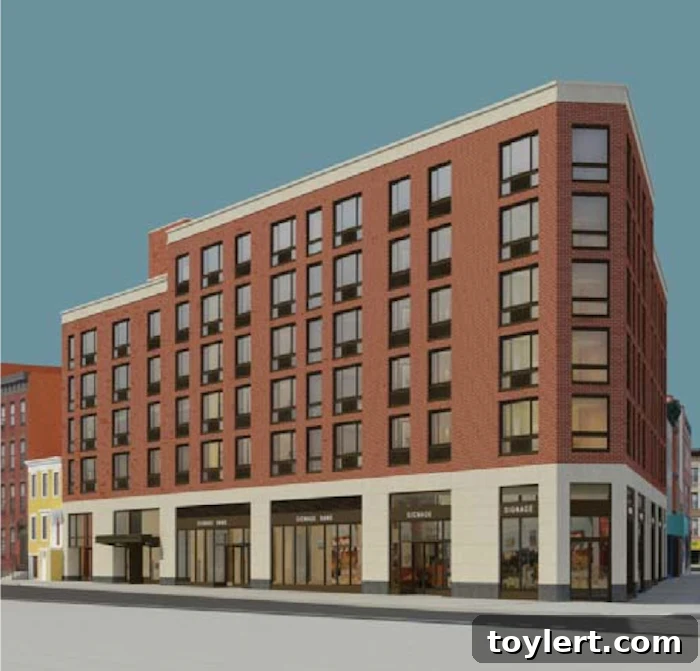
The urban landscape of Prospect Heights, Brooklyn, is on the cusp of a significant transformation, with the long-vacant Bergen Tile Building site finally stirring into action. Located at the prominent intersection of Flatbush and Dean Street, this key parcel of land, directly across from the iconic Barclays Center, has been a subject of local speculation and anticipation for years. The recent filing of a demolition application by developer PRD Realty marks a pivotal moment, signaling the imminent removal of the old structure and the dawn of a new era for this highly visible corner.
This development is not merely another construction project; it represents a crucial step in the ongoing evolution of Prospect Heights, a neighborhood known for its vibrant community, historic architecture, and strategic location within Brooklyn. The site’s unparalleled proximity to the Barclays Center, a major entertainment and sports venue, adds another layer of significance, promising to inject new life, services, and residential options into an already bustling area. As demolition prepares to commence, residents and urban planners alike are keenly watching how this prime location will be reimagined, anticipating the positive ripple effects it will have on the surrounding community and beyond.
A Strategic Location Poised for Transformation in Prospect Heights
The intersection of Flatbush and Dean Street is more than just a crossroad; it’s a gateway to some of Brooklyn’s most dynamic neighborhoods. For years, the Bergen Tile Building stood as a relic of a bygone era, its vacant facade contrasting sharply with the energetic pace of modern Brooklyn. This inactivity, however, belied the immense potential of the site. Strategically positioned, it offers direct access to major transit lines, a vibrant cultural scene, and the economic engine that is the Barclays Center. The vision for 215 Flatbush Avenue has long been in the making, with development plans carefully cultivated to maximize its value and contribute meaningfully to the urban fabric. The decision by PRD Realty to move forward with demolition underscores a renewed commitment to realizing these ambitions, paving the way for a modern, mixed-use development that aligns with the contemporary needs and aspirations of Prospect Heights.
The sheer visibility of the site makes any development here a landmark in its own right. With thousands of commuters and event-goers passing by daily, the new structure will not only serve its future residents and tenants but also act as a significant architectural statement. This prominent location demands a thoughtful and well-executed design that integrates seamlessly with the surrounding environment while offering distinct advantages. The upcoming development is therefore viewed as a critical piece of the puzzle, completing the revitalization narrative of this specific quadrant of Flatbush Avenue and providing essential services and housing to a continuously growing population base in Brooklyn.
Unveiling the Vision: Mixed-Use Development Plans at 215 Flatbush Avenue
Details regarding the ambitious plans for 215 Flatbush Avenue have been gradually emerging, offering a clearer picture of what the future holds. Ripco Real Estate, a prominent name in commercial real estate, has been instrumental in marketing the site, releasing exclusive flyers replete with renderings and comprehensive information about the proposed mixed-use development. The latest new building application, though initially filed and disapproved in February 2012, laid out the foundational vision: a six-story edifice designed to house a significant number of residential units atop vibrant ground-floor retail spaces.
Residential and Retail Synergy Near Barclays Center
The core of the development revolves around creating a dynamic synergy between residential living and commercial vibrancy. The plan proposes 53 rental apartments, providing much-needed housing options in a highly desirable, transit-rich area. These units are expected to cater to a diverse demographic, including young professionals, families, and individuals seeking the convenience of urban living coupled with proximity to cultural landmarks and employment centers. The modern amenities and thoughtful design inherent in new constructions will undoubtedly attract a wide array of tenants, contributing to the neighborhood’s ever-growing residential base and enhancing the appeal of Prospect Heights real estate.
Complementing the residential component is a substantial 9,875 square feet of ground-floor retail space. This commercial footprint is strategically designed to enhance the street-level experience, offering new shopping, dining, or service opportunities to both residents of the building and the wider Prospect Heights community. The inclusion of retail is crucial for fostering a lively streetscape, encouraging pedestrian activity, and providing essential conveniences. Its location directly opposite the Barclays Center means these retail establishments will benefit from significant foot traffic, particularly during events, concerts, and games, potentially attracting a mix of local businesses and national brands seeking to capitalize on the area’s high visibility and consumer engagement.
Architectural Vision and Scale of the Bergen Tile Redevelopment
The proposed six-story structure represents a careful consideration of urban density and neighborhood context. While integrating contemporary design elements, its height and massing are likely designed to be harmonious with the existing streetscape, bridging the gap between smaller historic buildings and the larger, more modern developments that have emerged around the Barclays Center. The overall scale of the 55,000-square-foot building suggests a significant contribution to the area’s built environment, promising a blend of functionality and aesthetic appeal that will define this corner for decades to come. The renderings, which sparked considerable interest upon their initial release, hint at a design that prioritizes natural light, modern finishes, and an efficient use of space, characteristic of high-quality urban developments in Brooklyn.
Navigating Urban Challenges: The Parking Predicament and Zoning Variances
One of the most significant hurdles faced by PRD Realty in bringing the 215 Flatbush Avenue project to fruition has been the stringent parking requirements mandated by New York City’s zoning laws. By legal decree, a building of this size and residential capacity would ordinarily be required to incorporate 26 parking spaces. In a dense urban environment like Prospect Heights, meeting such a requirement often presents immense logistical and financial challenges. Martin Domansky of PRD Realty articulated these difficulties last year, underscoring the impracticality of constructing such a large number of spaces on the site.
The Rationale Behind Parking Variances in New York City
Urban developers frequently encounter situations where standard zoning requirements, particularly those concerning parking, become unfeasible due to site-specific constraints, environmental considerations, or the evolving dynamics of urban transportation. The Bergen Tile Building site, nestled in a highly developed and transit-rich area, exemplifies this challenge. Constructing 26 individual parking spaces would likely necessitate extensive excavation for subterranean garages, significantly increasing construction costs, extending timelines, and potentially complicating structural integrity for the entire development. Moreover, in a neighborhood incredibly well-served by multiple subway lines (2, 3, 4, 5, B, Q, D, N, R, W at Atlantic Avenue-Barclays Center), the necessity for such a large number of private parking spaces is increasingly debatable.
Recognizing these complexities, PRD Realty pursued a parking variance through the Board of Standards and Appeals (BSA). The BSA is a vital body within New York City’s land use governance, tasked with reviewing appeals for exceptions to zoning resolutions where strict adherence would cause undue hardship or be impractical. Developers must present compelling arguments, often involving detailed engineering plans, financial analyses, and demonstrations of how the proposed deviation will not negatively impact the community. This process is rigorous and designed to balance development needs with the city’s broader planning objectives. Successfully obtaining a variance would allow PRD Realty to proceed with a more viable parking solution, potentially reducing the number of required spaces or proposing alternative strategies that better suit the urban context.
Rethinking Parking in a Transit-Oriented Brooklyn
The push for a parking variance at 215 Flatbush Avenue highlights a broader shift in urban planning philosophy, especially in cities like New York. There’s a growing recognition that mandatory minimum parking requirements, while historically aimed at reducing street congestion, can inadvertently inflate housing costs, discourage sustainable transportation, and consume valuable urban land that could otherwise be used for housing, retail, or public space. For a site directly across from a major transit hub like Barclays Center, which is serviced by 11 subway lines and numerous bus routes, the emphasis is increasingly shifting towards promoting public transportation, cycling, and pedestrianism. Modern developments in such areas often aim to reduce car dependency, aligning with broader city goals for sustainability and livability. The outcome of PRD Realty’s appeal to the BSA is therefore not just about one building; it’s a barometer for how New York City is adapting its zoning to foster more sustainable, transit-oriented development in its rapidly evolving neighborhoods.
Impact on the Prospect Heights and Barclays Center Ecosystem
The redevelopment of the Bergen Tile Building site will undoubtedly have a profound impact on its immediate surroundings and the broader Prospect Heights community. The area surrounding Barclays Center has undergone substantial changes since the arena’s opening, evolving into a dynamic hub of entertainment, commerce, and residential life. This new mixed-use development will further solidify that transformation.
Enhancing the Barclays Center Experience and Local Economy
Directly opposite the Barclays Center, the new retail spaces will offer convenient amenities for event-goers, complementing the existing offerings. Whether it’s pre-show dining, post-game drinks, or simply grabbing a coffee, these new establishments will enrich the overall experience for the millions who visit the arena annually. The increased residential density also means more local patrons for businesses, fostering a more vibrant economic ecosystem around the sports and entertainment venue. This synergistic relationship promises to elevate both the commercial appeal of the area and the quality of life for its residents, providing a significant boost to the local economy of Prospect Heights.
Contributing to Neighborhood Vibrancy and Housing Stock in Brooklyn
Prospect Heights is a highly sought-after neighborhood, characterized by its historic brownstones, cultural institutions, and convenient access to Manhattan. The addition of 53 new rental apartments, particularly in a modern, amenity-rich building, addresses a critical need for housing in the city. This influx of residents will further invigorate local businesses, parks, and community organizations, contributing to the neighborhood’s unique charm and dynamism. The development represents a significant investment in the future of Prospect Heights, reflecting confidence in its continued growth and appeal as a residential destination within Brooklyn’s competitive real estate market.
Furthermore, new construction often sets contemporary standards for energy efficiency and design, potentially influencing future developments in the area. By replacing a long-vacant structure with a vibrant, active building, the project will enhance street safety, visual appeal, and overall urban quality, transforming a dormant parcel into a thriving component of the streetscape. The anticipation generated by the demolition application and the proposed plans signals a positive trajectory for this vital corner of Brooklyn, solidifying its status as a prime location for living, working, and leisure.
Conclusion: A New Chapter for Flatbush and Dean Street
The impending demolition of the Bergen Tile Building and the subsequent construction of a six-story mixed-use development at 215 Flatbush Avenue heralds an exciting new chapter for Prospect Heights. This project, spearheaded by PRD Realty, promises to bring 53 rental apartments and nearly 10,000 square feet of ground-floor retail to a prime location directly opposite the Barclays Center. While navigating challenges such as complex zoning regulations and parking requirements, the developer’s commitment to creating a vibrant, functional, and aesthetically pleasing structure remains unwavering.
This development is more than just bricks and mortar; it’s a testament to Brooklyn’s continuous evolution, a reflection of its dynamic real estate market, and a significant contribution to the urban fabric of one of New York City’s most desirable neighborhoods. As the old makes way for the new, 215 Flatbush Avenue is poised to become a vital hub, enriching the lives of its future residents and contributing significantly to the economic and social vitality of Prospect Heights and the wider Brooklyn community. The transformation of this long-vacant site into a bustling urban asset underscores the enduring appeal and potential of Flatbush and Dean Street as a cornerstone of modern Brooklyn life.