Read Part 2 of this story.
The Erie Canal: A Journey Through New York’s Transformative History, Connecting Upstate to Brooklyn
For many who grew up in the vast and varied landscapes of New York State, the history of this remarkable place wasn’t just a subject in school; it was a living narrative. As someone who spent their formative years in Otsego County, deep in Upstate New York, I fondly recall seventh-grade history lessons that painted vivid pictures of the Empire State’s past. What made these studies truly come alive was the tangible connection to historical events – the ability to visit battlegrounds where pivotal moments unfolded, or to walk through the homes where great minds forged groundbreaking ideas. From the strategic forts of Ticonderoga to the bustling gateway of Buffalo, New York offers an unparalleled historical tapestry. This same rich tapestry extends profoundly to New York City, and more specifically, to Brooklyn, where echoes of grand engineering and economic revolution still resonate.
Among the countless tales that define New York’s legacy, few are as monumental and transformative as that of the Erie Canal. Often hailed as one of the most significant engineering feats of the 19th century, this artificial waterway didn’t just connect Lake Erie with the Hudson River; it fundamentally reshaped the economic, social, and political landscape of New York State and, indeed, the entire United States. Understanding the Erie Canal’s story is crucial to grasping how New York City ascended to its status as a global powerhouse and how Brooklyn played an indispensable role in that ascent.
The Vision: “Clinton’s Ditch” and the Dawn of an Idea
At the turn of the 19th century, America was a young nation with boundless potential but limited infrastructure. Transportation was slow, costly, and arduous, relying primarily on rough roads or unpredictable river systems. The vast agricultural bounty of the Great Lakes region and the Ohio Valley struggled to reach the burgeoning markets of the East Coast, while manufactured goods from the east faced similar hurdles in reaching western consumers. New York State, with its unique geography, presented both a challenge and an opportunity. While the Hudson River offered a natural highway inland, the Appalachian Mountains blocked direct access to the interior.
It was Governor DeWitt Clinton, a visionary statesman, who championed the audacious idea of constructing an artificial waterway across New York State. Skeptics derided it as “Clinton’s Ditch,” believing such a project to be an impossible dream, a monumental waste of resources. Yet, Clinton and his supporters saw beyond the immediate difficulties, envisioning a canal that would unlock the economic potential of the American interior, channeling trade and prosperity directly through New York. Their persistence laid the groundwork for a project that would forever alter the course of American commerce and settlement.
Engineering Marvels and Unwavering Determination
Construction of the Erie Canal began in 1817 and, against all odds, was completed in a remarkably swift eight years, opening in 1825. This achievement was nothing short of miraculous, especially considering the lack of civil engineers in America at the time. The project relied heavily on the ingenuity and practical skills of self-taught engineers, surveyors, and a massive workforce, including many recent immigrants.
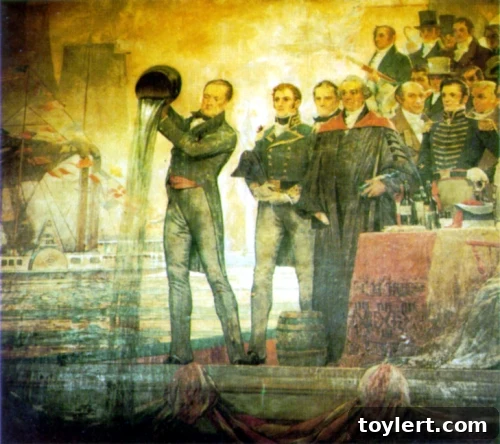
The challenges were immense: carving a 363-mile-long canal through dense forests, across treacherous swamps, and over rolling hills. Workers had to dig through rock, build intricate locks to overcome an elevation change of over 500 feet between the Hudson River and Lake Erie, and construct aqueducts to carry the canal over rivers. Using basic tools like shovels, picks, and wheelbarrows, alongside innovative solutions like stump pullers and explosive charges, the laborers transformed the landscape. The construction process itself fostered a new generation of American engineering expertise, setting precedents for future large-scale infrastructure projects across the nation. The canal’s opening, marked by the famous “Wedding of the Waters” ceremony where Governor Clinton poured a cask of Lake Erie water into the Atlantic Ocean, symbolized the successful union of the interior with the sea.
Economic Revolution: Fueling the “Empire State”
The impact of the Erie Canal was immediate and profound. Prior to its construction, transporting a ton of goods from Buffalo to New York City cost around $100 and took over two weeks. Post-canal, the cost plummeted to a mere $5-$10, and the journey was reduced to just five days. This dramatic reduction in time and expense revolutionized trade and commerce.
The canal transformed New York into the undisputed economic powerhouse of the nation. It provided an efficient, reliable, and affordable link between the agricultural heartland of the Midwest and the major international port of New York City. Grain, lumber, furs, and other raw materials flowed eastward, while manufactured goods, textiles, and imported luxuries traveled westward. Cities along the canal route, such as Rochester, Syracuse, and Buffalo, experienced explosive growth, becoming vibrant centers of industry and trade. The canal made New York City the busiest port in the United States, surpassing rivals like Philadelphia and Boston, firmly cementing its nickname as the “Empire State.”
Brooklyn’s Indispensable Role: The Gateway to a Nation
While the canal’s terminus was in Albany, where goods were transferred to Hudson River sloops and steamboats bound for Manhattan, its downstream impact on New York City was colossal, and Brooklyn was an integral beneficiary and facilitator of this boom. The sudden surge in trade volume overwhelmed Manhattan’s existing port facilities, necessitating expansion and specialized infrastructure across the harbor. Brooklyn, with its deep-water access, ample undeveloped waterfront, and strategic location directly across from Manhattan, became a crucial extension of New New York’s commercial empire.
The canal-driven prosperity led to the rapid development of Brooklyn’s waterfront. Areas like Red Hook, Dumbo (Down Under the Manhattan Bridge Overpass), and the Brooklyn Navy Yard flourished. Massive warehouses, granaries, and processing plants sprang up to handle the immense quantities of goods arriving via the canal and then being prepared for international shipment or distribution throughout the city. Brooklyn became a hub for storage, transshipment, and even manufacturing that capitalized on the raw materials flowing in. The bustling docks and piers of Brooklyn were teeming with activity, employing thousands of stevedores, longshoremen, and merchants. The canal thus played a direct role in Brooklyn’s growth from a collection of small towns into a significant urban center, laying the groundwork for its eventual consolidation into Greater New York City.
Social and Cultural Ripples: Shaping American Identity
Beyond economics, the Erie Canal had profound social and cultural ramifications. It facilitated westward expansion by providing an easy route for settlers to reach the Great Lakes region, fueling the growth of new territories and states. It attracted a wave of immigrants, particularly from Ireland and Germany, who sought work on the canal and then settled in the growing cities along its path, contributing to New York’s rich cultural diversity.
The canal also fostered a sense of national unity, physically connecting disparate regions and promoting a shared commercial and cultural exchange. It became a symbol of American ingenuity and determination, demonstrating the young nation’s capacity for large-scale public works. Its success inspired a flurry of canal-building projects across the country, though none matched the Erie’s scale or impact.
The Legacy of “Clinton’s Ditch”
The heyday of the original Erie Canal began to wane with the advent of railroads in the mid-19th century, which offered faster, year-round transportation. However, the canal system continued to evolve, eventually becoming the New York State Barge Canal System in the early 20th century, still used today for commercial shipping and, increasingly, for recreational boating.
The legacy of the Erie Canal is indelible. It cemented New York City’s status as America’s premier port and financial center, profoundly shaping the very fabric of the state and the nation. It reminds us that history is not just a collection of dates and names, but a continuous story of human endeavor, vision, and transformation. For those of us who grew up understanding New York’s history, the Erie Canal remains a testament to the power of big ideas and the enduring impact of infrastructure. Its journey from a ridiculed “ditch” to a mighty artery of commerce is a compelling narrative that continues to inspire and educate, vividly connecting the agricultural fields of Upstate New York to the bustling piers of Brooklyn, and the entire state to the global economy.