From Hops to Heritage: Tracing Brooklyn’s Illustrious Brewing History
Brooklyn, a borough renowned for its vibrant culture, innovative spirit, and architectural charm, harbors a captivating history deeply intertwined with the art of brewing. Long before the modern craft beer revolution, Brooklyn stood as a formidable hub for beer production, a frothy testament to the industriousness of its diverse immigrant communities and the relentless entrepreneurial drive that forged its identity. This journey through time explores the borough’s brewing narrative, from the pioneering German brewmeisters who first brought their craft to its shores, to the remarkable resurgence of local breweries in the contemporary era. It’s a story of how the simple yet profound combination of hops, malt, water, and yeast transformed Brooklyn’s landscape, economy, and social fabric.
The genesis of Brooklyn’s brewing prowess can be traced back to the mid-19th century, a period marked by significant immigration, particularly from Germany. These new arrivals brought with them not only their families and aspirations for a better life but also invaluable traditions and skills, foremost among them the intricate techniques of brewing authentic lager beer. The burgeoning demand for familiar tastes in a new homeland quickly spurred the establishment of numerous breweries. These operations were predominantly concentrated around the growing German communities in neighborhoods like Bushwick and Williamsburg, which soon became synonymous with “Brewers’ Row” – an industrial corridor where the sweet, earthy aroma of fermenting grains perpetually hung in the air.
The Golden Age of Brooklyn Beer: A Frothy Empire Takes Shape
By the late 19th and early 20th centuries, Brooklyn had firmly established itself as an unrivaled brewing powerhouse, producing more beer than any other district in the United States. Iconic names such as Schaefer, Rheingold, Trommer, and Liebmann (which later became Rheingold) dominated the scene. Their colossal brewhouses and vast network of cellars became defining features of the urban landscape. These breweries were far more than mere industrial facilities; they were vital community institutions, providing steady employment for thousands, fostering local agriculture, and serving as essential social gathering places where residents could unwind over a freshly poured pint. The scale of the industry was truly astonishing, with breweries employing cutting-edge machinery and sophisticated techniques to produce millions of barrels of beer annually, satisfying the thirst not only of New York City but also large swathes of the East Coast.
While Bushwick and Williamsburg formed the epicenter of this brewing phenomenon, the industry’s reach extended far beyond. As Brooklyn expanded and evolved, so too did its brewing footprint. Breweries began to emerge in other neighborhoods, occasionally outliving their peers as residential and commercial development altered the urban tapestry over the decades. A poignant example of Brooklyn’s enduring brewing past can be found in the historic Crow Hill section of Crown Heights North. Here, on the corner of Bergen Street and Franklin Avenue, a brewery has stood for over a century and a half, its foundations steeped in the borough’s rich history of lager production.
The Legacy of Bergen Street: A Glimpse into Brooklyn’s Brewing Evolution
The specific site at Bergen Street and Franklin Avenue holds a particularly storied past, mirroring the broader trends and transformations within Brooklyn’s brewing industry. Its narrative began in 1849 with the founding of the Liberger and Walter Brewing Company. In an era where local breweries catered directly to their immediate communities, Liberger and Walter swiftly became a cherished fixture, supplying fresh, high-quality lager to the residents of Crown Heights and surrounding areas. The success of such enterprises underscored the robust demand for local beer and highlighted the meticulous craftsmanship that went into its production.
Just seventeen years later, in 1866, the brewery experienced a significant shift in ownership and identity. Christian Goetz, a visionary businessman with ambitions for expansion, acquired the company and promptly rebranded it as the Bedford Brewery. Under Goetz’s shrewd leadership, the Bedford Brewery continued to flourish, adapting to the changing times and the increasing scale of the industry. This transition was a common characteristic of the era, as smaller, often family-run operations were consolidated or purchased by larger entities aiming to expand their market dominance and production capabilities. This evolution marked a shift from hyper-local craft to larger, more systematically managed enterprises, yet still with a strong community connection.
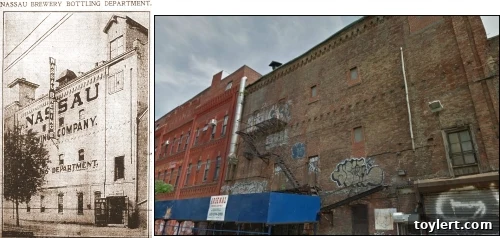
Over the ensuing decades, the Bedford Brewery would once again undergo changes in ownership, eventually gaining prominence under the name Nassau Brewery. The name “Nassau” itself resonated deeply with Brooklyn’s historical roots, harking back to the original Dutch designation for Long Island, ‘Nassau Island.’ This powerful name carried significant brand recognition and was a testament to the brewery’s deep connection to the borough’s heritage. The Nassau Brewery grew into a major producer, celebrated for its quality brews and its imposing architectural presence within the Crown Heights North neighborhood. Its formidable brick structure stood as a proud symbol of Brooklyn’s industrial prowess, a silent witness to the daily lives of its dedicated employees and the countless loyal patrons who savored its products, connecting generations through a shared appreciation for fine lager.
Prohibition’s Bitter Aftermath: The Decline of an Era
However, the glorious age of Brooklyn brewing was not destined to endure forever. The darkest shadow on the horizon for the industry arrived with the implementation of Prohibition in 1920. This nationwide constitutional ban on the production, sale, and transportation of alcoholic beverages dealt a catastrophic blow. Many breweries were compelled to shut their doors permanently, while others attempted to navigate the restrictive era by pivoting to produce “near beer,” soft drinks, or even ice cream – a stark and often unprofitable departure from their core craft. The entire vibrant ecosystem of suppliers, coopers, teamsters, and ancillary businesses that supported the breweries collapsed almost overnight, leaving economic devastation in its wake.
While a few resilient breweries, including some in Brooklyn, managed to limp through the thirteen dry years, the industry never fully regained its pre-Prohibition splendor. When Repeal finally arrived in 1933, the landscape had been irrevocably altered. Many skilled brewers had moved on to other professions, essential equipment had deteriorated, and market dynamics had fundamentally shifted. The decades that followed saw further consolidation within the brewing industry and intensified competition from large national brands. This relentless pressure led to the gradual decline and eventual closure of most of Brooklyn’s historic breweries. By the 1970s, the once-booming “Brewers’ Row” was a mere shadow of its former self, with many iconic brewery buildings either demolished or repurposed for alternative uses, their profound brewing heritage largely forgotten by the wider public.
Brooklyn’s Brewing Revival: A Modern Renaissance and Enduring Spirit
Yet, the narrative of Brooklyn brewing is not one of permanent decline. The borough, ever resilient and adaptable, witnessed a remarkable resurgence in the late 20th and early 21st centuries, largely fueled by the burgeoning craft beer movement. A new generation of brewers, inspired by historical traditions and driven by innovation, began the ambitious task of reclaiming Brooklyn’s rich brewing heritage. Pioneering establishments like Brooklyn Brewery, founded in the 1980s, spearheaded this renaissance, powerfully demonstrating that Brooklyn’s thirst for high-quality, locally produced beer was far from quenched. This new wave of brewers emphasized small-batch production, diverse beer styles, and a renewed connection to local communities, echoing the artisan spirit of the original brewmeisters.
Today, Brooklyn is once again a vibrant hub for brewing, albeit on a different scale and with a distinct character compared to its industrial past. Numerous craft breweries now dot the landscape, from well-established names to inventive newcomers, each contributing to a dynamic and richly diverse beer scene. Many of these modern breweries consciously draw inspiration from the past, sometimes even establishing their operations within old industrial buildings, inadvertently or intentionally connecting to the very spaces where beer was once brewed. The legacy of Liberger and Walter, Christian Goetz, and the Nassau Brewery lives on, not only in historical records or the surviving architectural remnants, but also in the enduring spirit of brewing that continues to flow vigorously through Brooklyn’s veins, a testament to its cyclical nature of decline and rebirth.
Brooklyn: Then and Now – The Enduring Spirit of Craft and Community
The journey from the horse-drawn delivery carts of the 19th century to the bustling taprooms of today’s craft breweries vividly illustrates Brooklyn’s incredible evolution. The image of the Nassau Brewery building, standing steadfast through the decades, serves as a poignant and powerful reminder of this profound transformation. It bridges the gap between an era when brewing was a colossal industrial enterprise and the present day, where it is celebrated as a meticulous craft. While the specific technologies, ownership structures, and market demands have shifted dramatically over time, the fundamental desire for a well-crafted beer, enjoyed within a strong, supportive community, remains an unwavering constant, uniting past and present.
Brooklyn’s brewing narrative is a compelling illustration of continuity amidst profound change. The borough has always been a place where innovation seamlessly meets tradition, where old stories provide the foundation and inspiration for new ones. The grand structures of the past, like the former Nassau Brewery, may no longer hum with the vibrant machinery of mass production, but their silent and dignified presence serves as a powerful reminder of a time when Brooklyn was a global brewing capital. And in the bustling, diverse, and innovative craft beer scene of today, one can undoubtedly taste the resonant echoes of those earlier days – a testament to Brooklyn’s indelible and flavorful connection to its frothy, deeply historical past. So, raise a glass to Brooklyn, then and now – a borough forever enriched and defined by its remarkable brewing heritage.