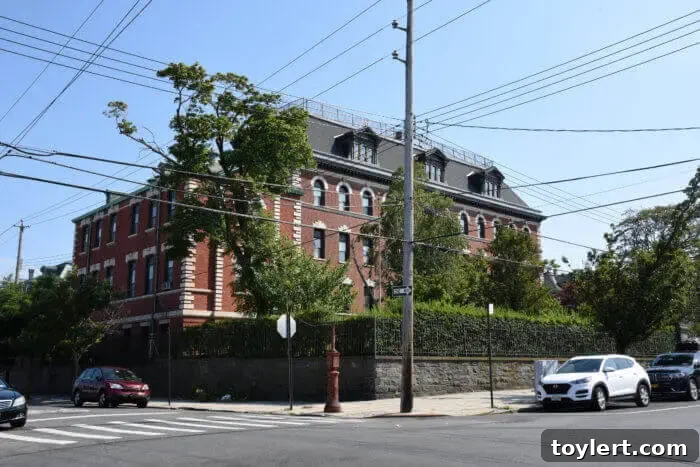
Preserving a Legacy: The Angel Guardian Home in Dyker Heights Nears Landmark Status
The venerable Angel Guardian Home, a beacon of history and architectural grandeur in Brooklyn’s charming Dyker Heights neighborhood, is currently at the forefront of a significant preservation initiative. Its century-old former orphanage building, a site imbued with decades of community memory and architectural splendor, is under serious consideration for landmark status by the City of New York. City officials have made it clear that the potential preservation of this embattled yet beloved site is a priority, signaling a commitment to safeguarding Brooklyn’s rich heritage.
This critical discussion culminated in a pivotal public hearing, allowing local residents and stakeholders to voice their perspectives on the future of this iconic structure. The journey towards landmark designation for the Angel Guardian Home is a testament to its profound impact on the area, not merely as a building but as a repository of shared history and a symbol of community resilience. The proposed landmarking seeks to protect its unique architectural character and ensure its continued presence for generations to come, standing as a proud testament to Dyker Heights’ enduring legacy.
A Glimpse into History: The Angel Guardian Home’s Enduring Legacy
The Angel Guardian Home, located on a sprawling, block-long property bounded by 63rd and 64th streets and 12th and 13th avenues, holds a deeply significant place in the annals of Brooklyn history. Established over a century ago, this institution began its life as an orphanage, dedicated to providing care, shelter, and education to countless children in need. Its foundation was laid with a noble purpose, serving as a haven for the vulnerable and offering them a chance at a brighter future. For decades, it was a vital part of the social fabric of Dyker Heights, touching the lives of generations of families and contributing profoundly to the community’s identity.
The institution’s long history is woven into the tapestry of the neighborhood, witnessing monumental shifts in New York City’s urban landscape while maintaining its steadfast commitment to its mission. The very walls of the Angel Guardian Home echo with stories of hope, resilience, and the tireless efforts of those who dedicated their lives to nurturing young lives. Understanding its past is crucial to appreciating the current efforts to preserve it, as its architectural form is inextricably linked to its humanitarian function and the historical context of early 20th-century social welfare in New York.
Architectural Significance and Monumental Presence
The Angel Guardian Home’s primary building is far more than just an old structure; it is a stunning example of early 20th-century institutional architecture, radiating a grandeur and dignity that commands attention. Sarah Carroll, Chairwoman of the Landmarks Preservation Commission (LPC), articulated the building’s exceptional qualities during a June 30 hearing, stating, “The building’s prominence derives from its architectural quality, as well as its monumental scale spanning the entire width of the block and its sighting back up on a hill.” This statement encapsulates the core reasons why the LPC deems its preservation essential.
Architecturally, the Angel Guardian Home is often recognized for its robust and dignified Renaissance Revival style, a popular choice for public and institutional buildings during its construction period in the early 1900s. Its design features often include classical elements such as grand facades, decorative cornices, rusticated stone bases, and symmetrically arranged windows, all contributing to an imposing yet elegant aesthetic. The sheer scale of the building is breathtaking; it occupies a significant portion of its block, creating a powerful visual statement within the residential landscape of Dyker Heights. This monumental presence is further enhanced by its strategic placement on a slight elevation, allowing it to loom majestically over its surroundings and command views from various vantage points in the neighborhood.
The materials chosen for its construction, typically durable brick and stone, speak to an era of craftsmanship and permanence. These elements not only contribute to its aesthetic appeal but also to its longevity, allowing it to stand strong for over a century. The intricate detailing, from the window surrounds to the roofline, tells a story of meticulous design and skilled artistry. Preserving such a structure is not just about saving a building; it’s about safeguarding a tangible piece of architectural history that reflects the aspirations and craftsmanship of a bygone era. The LPC’s recognition of these attributes underscores the building’s irreplaceable value to the architectural heritage of Brooklyn and New York City.
The Path to Preservation: LPC’s Role and Public Engagement
The journey towards landmark designation for the Angel Guardian Home is a structured process guided by the New York City Landmarks Preservation Commission (LPC). The LPC is the city agency responsible for protecting New York City’s architecturally, historically, and culturally significant buildings and sites. Their rigorous process involves several stages, beginning with research and evaluation of a site’s merits, followed by public hearings where community input is crucial.
The June 30 hearing saw Chairwoman Sarah Carroll strongly advocating for the main building’s preservation, highlighting its intrinsic value. Her declaration, “We felt that it was essential that the main building be preserved,” underscored the commission’s initial assessment of the building’s significance. This professional evaluation forms the bedrock of the landmarking effort, signaling that experts in preservation recognize its unique qualities.
Following this, the Aug. 11 public hearing was a vital opportunity for direct community engagement. This forum allowed locals to submit testimony, share personal anecdotes, and articulate their deep connection to the building and its history. Such public input is not merely ceremonial; it provides invaluable context, demonstrating the community’s collective memory and emotional attachment to the site. These testimonies often reveal the social and cultural significance of a place that might not be immediately apparent from architectural assessments alone. The robust participation of residents and local advocacy groups is often a decisive factor in successful landmark designations, showcasing broad support for preserving cherished neighborhood assets.
The LPC considers all factors, including architectural integrity, historical importance, and community sentiment, before making a final decision. This collaborative approach ensures that preservation efforts are holistic, taking into account both expert analysis and local perspectives. The public’s voice is instrumental in affirming that the Angel Guardian Home is not just an inanimate structure, but a living part of Dyker Heights’ identity.
Why Landmark Status Matters for Dyker Heights and Beyond
Granting landmark status to the Angel Guardian Home carries profound implications that extend far beyond the immediate protection of its physical structure. Landmark designation is a powerful tool for urban planning and cultural preservation, offering a multitude of benefits to Dyker Heights and the wider New York City landscape.
Firstly, and most crucially, landmarking provides robust legal protection against demolition or inappropriate alteration. This ensures that the building’s distinctive architectural features and historical integrity are safeguarded for future generations, preventing developers from significantly altering or replacing a structure that holds immense communal value. In a rapidly developing city like New York, such protection is invaluable.
Secondly, it preserves the historical narrative of the community. The Angel Guardian Home tells a compelling story of social welfare, architectural evolution, and the growth of Dyker Heights itself. By preserving it, the city ensures that this tangible link to the past remains, allowing residents and visitors alike to connect with the history of philanthropy and community support that defined the institution. This fosters a deeper sense of place and collective identity among residents.
Furthermore, landmarking often enhances neighborhood character and property values. Historic buildings contribute to the unique charm and aesthetic appeal of an area, making it more desirable. They can also become focal points for tourism and educational initiatives, drawing visitors interested in history and architecture, thereby potentially stimulating local businesses and fostering a vibrant cultural scene. The presence of well-maintained historic structures often leads to increased civic pride and a stronger community bond.
The decision to landmark also signifies a commitment to sustainable urban development. Instead of demolition and new construction, preservation encourages adaptive reuse, where historic buildings are given new purposes while retaining their original fabric. This reduces waste, conserves resources, and often results in unique and character-rich spaces that cannot be replicated by modern construction. It challenges communities to innovate and find new ways for old buildings to serve contemporary needs.
Finally, landmarking reinforces the idea that a city’s heritage is a public good, worthy of collective investment and protection. It acknowledges the emotional connection that residents have to these places, recognizing that history is not just found in textbooks but in the very streets and structures of their daily lives. The Angel Guardian Home’s potential landmark status is thus a victory for community identity, architectural preservation, and the enduring spirit of Dyker Heights.
The Future of the Angel Guardian Home: Hopes and Hurdles
As the Angel Guardian Home progresses through the landmark designation process, the community eagerly anticipates its future. Once officially landmarked, the building will enter a new phase of its existence, one where its historic integrity is protected, yet its utility can be reimagined. The designation itself does not dictate the building’s specific future use, but it mandates that any future alterations or developments must respect its architectural and historical significance, requiring approval from the LPC.
This opens the door to exciting possibilities for adaptive reuse. The large scale and robust construction of the former orphanage lend themselves to a variety of potential new functions. It could be transformed into affordable housing units, a community center, cultural spaces, educational facilities, or even a mixed-use development that balances commercial viability with public access and benefit. The challenge lies in finding a new purpose that is both economically feasible and respectful of the building’s heritage, ensuring it continues to serve the needs of Dyker Heights in a meaningful way.
Ongoing efforts will involve collaboration between the city, developers, and community groups to identify the most suitable and sustainable future for the site. This often requires creative thinking and innovative funding models to ensure that preservation is not just a protective measure but an opportunity for revitalization. The community’s active participation will remain crucial, guiding discussions and advocating for uses that align with neighborhood values and needs. The Angel Guardian Home, with its prominent location and rich history, has the potential to become a vibrant anchor for Dyker Heights once again, demonstrating how historic preservation can breathe new life into an area.
The successful landmarking and subsequent adaptive reuse of the Angel Guardian Home would serve as a powerful example of how New York City can honor its past while building for its future. It would stand as a testament to the fact that iconic structures, even those facing development pressures, can be preserved and repurposed, continuing to contribute to the unique character and quality of life in neighborhoods like Dyker Heights for generations to come. The hope is that this historic edifice will not only endure but thrive, evolving to meet contemporary demands while forever preserving its foundational legacy.