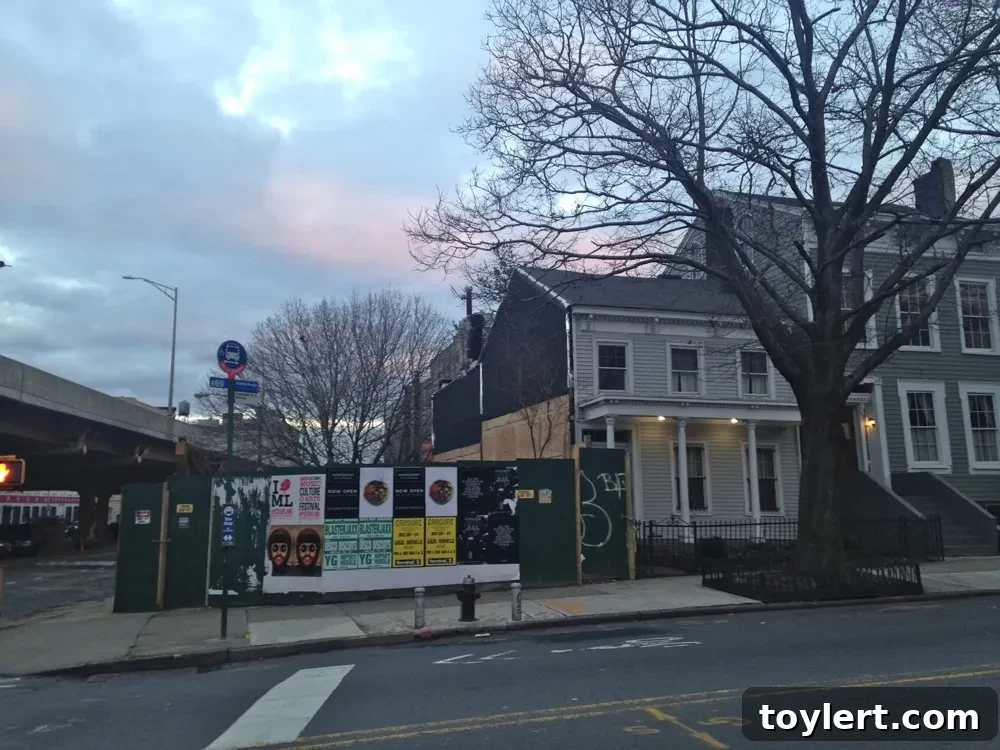
The Unraveling Saga of 69 Vanderbilt Avenue: A Brooklyn Landmark’s Demolition and Its Owner’s Enduring Struggle
Brooklyn, a borough celebrated for its rich history, vibrant neighborhoods, and iconic brownstones, often finds its past colliding with the relentless pace of modern development. Few stories illustrate this conflict as poignantly as the tragic tale of 69 Vanderbilt Avenue. Once a family home brimming with memories, it transformed into a symbol of urban decay, culminating in its controversial demolition and leaving behind a complex web of property rights, personal attachment, and financial distress.
The narrative of 69 Vanderbilt Avenue, brought to public attention by Matt Chaban’s insightful report in The New York Times, delves deep into the life of Louis Somma, an 85-year-old retired lawyer. Somma’s connection to the property was profound; he had grown up within its walls and lived there for decades, even as the once-proud structure succumbed to severe disrepair. The house, marked by a cracked foundation and surrounded by piles of refuse, became an increasingly prominent eyesore in a rapidly gentrifying neighborhood, raising questions about property ownership, community responsibility, and the fate of historic Brooklyn homes.
A Glimpse into the Past: The Life and Legacy of a Brooklyn Homeowner
Louis Somma’s story is intrinsically tied to 69 Vanderbilt Avenue. For over eight decades, this house was more than just a dwelling; it was the anchor of his life, a repository of family history and personal memories. His refusal to part with it, despite its deteriorating condition, speaks volumes about the deep emotional bond he harbored. As the property visibly declined, becoming an undeniable hazard, it contrasted sharply with the meticulously renovated brownstones that characterize much of the surrounding Vanderbilt Avenue landscape. This stark difference ignited a prolonged conflict between an individual’s right to their property and the city’s mandate to ensure public safety and maintain community standards.
The visible neglect of the property, including its structural vulnerabilities and the accumulation of debris, began to draw the attention of city authorities. While Somma continued to reside amidst these challenging conditions, the city’s concerns escalated, ultimately leading to official intervention. The plight of 69 Vanderbilt became a microcosm of the broader issues faced by long-term residents in desirable urban areas: the pressure to sell, the escalating costs of maintenance, and the emotional toll of letting go of a generational home in the face of overwhelming change.
The City’s Intervention: From Neglect to Demolition Order
The city’s involvement with 69 Vanderbilt Avenue reached a critical juncture in 2009 when, citing health and safety concerns, authorities ordered Louis Somma to vacate the premises. This was not a decision taken lightly; properties reaching such a state of disrepair often pose risks not only to their inhabitants but also to adjacent properties and the broader public. Structural instability, pest infestation, and general unsanitary conditions are typically the driving factors behind such drastic measures. The city’s Department of Buildings or similar agencies often follow a rigorous process involving inspections, violation notices, and opportunities for owners to rectify issues before resorting to eviction or demolition.
Despite the official order, Somma’s attachment to his home remained unwavering. However, the property’s condition continued to worsen, and the bureaucratic gears of urban planning and code enforcement continued to turn. Eventually, after years of failed attempts to resolve the situation, the city made the decisive move to demolish the structure. This action, while legally sanctioned for public safety, represented a heartbreaking conclusion for Somma, who saw his childhood home—and perhaps a significant part of his identity—reduced to rubble. The demolition of 69 Vanderbilt Avenue underscored the immense power the city wields in extreme cases of property neglect, balancing individual rights with the collective well-being of the community.
A Battle of Valuations: Somma’s Vision vs. Market Reality
At the heart of the 69 Vanderbilt Avenue saga lies a profound disagreement over the property’s true worth. Louis Somma consistently rejected multiple offers, reportedly as high as $800,000, for the dilapidated brownstone. His unwavering stance was rooted in a personal valuation that far exceeded what the market, or potential buyers, were willing to pay for a house in such a state. He famously told The New York Times he was holding out for $3,000,000, a figure that many real estate experts would consider highly optimistic given the property’s condition and the cost of extensive renovation required.
What makes Somma’s valuation even more astonishing is his belief, post-demolition, that the now-vacant lot could fetch an astounding $5,000,000. This perspective stands in stark contrast to the actual market data. For instance, the renovated twin house right next door, a comparable property, sold for $1,000,000 in 2013. This provides a crucial benchmark for property values in the immediate vicinity of Vanderbilt Avenue. Furthermore, the area’s designation, or implied presence, under Landmarks Preservation Commission rules plays a significant role in restricting development potential, specifically preventing new constructions taller than four stories. These regulations, while preserving the historic character of Brooklyn’s streetscapes, also cap the potential for maximizing development density and, consequently, land value for developers looking to build larger structures.
The vast disparity between Somma’s aspirations and the prevailing market realities highlights a common challenge in real estate: the emotional value of a property often far outweighs its objective market appraisal. While Somma envisioned his land as a prime development opportunity, market forces, zoning restrictions, and the inherent costs of developing a vacant lot in a historic district paint a much different, and often more conservative, financial picture for potential investors in Brooklyn real estate.
The Looming Financial Crisis: Back Taxes and Foreclosure Threats
Adding another layer of complexity and tragedy to Louis Somma’s predicament is the mounting financial burden he faces. Beyond his ambitious, yet unfulfilled, sales expectations, Somma had accumulated a substantial debt of $120,000 in back taxes. This significant amount represents years of unpaid property taxes, penalties, and interest, placing his ownership of the property in severe jeopardy. In New York City, and indeed in many municipalities, local governments rely heavily on property taxes to fund essential services. When these taxes go unpaid, cities have legal mechanisms to recover the revenue.
One such mechanism, and the one employed in Somma’s case, is the sale of a tax lien. A tax lien is a legal claim against a property for unpaid taxes. By selling this lien, the city transfers the right to collect the overdue taxes, plus interest and penalties, to a private investor or bank. This process allows the city to immediately recover its lost revenue, while the lien buyer then pursues payment from the property owner. For Somma, this means that if he fails to pay the $120,000 owed to the lienholder, the bank or investor holding the lien has the legal right to initiate foreclosure proceedings. Foreclosure would result in the forced sale of the property – or in this case, the vacant lot – to satisfy the debt, leaving Louis Somma with absolutely nothing from the sale of his ancestral land. This grim financial reality underscores the profound consequences of property ownership responsibilities and the unforgiving nature of tax laws, especially when combined with a property owner’s unyielding resistance to market forces.
69 Vanderbilt Avenue: A Microcosm of Brooklyn’s Real Estate Dynamics
The story of 69 Vanderbilt Avenue resonates far beyond its immediate boundaries, serving as a poignant microcosm of the broader real estate dynamics at play across Brooklyn. Vanderbilt Avenue itself is situated in a highly desirable part of the borough, often characterized by its charming streetscapes, historic architecture, and proximity to cultural landmarks and amenities. Properties in this area, particularly brownstones, command premium prices due to their architectural appeal, neighborhood walkability, and strong community identity. The consistent demand for Brooklyn real estate, driven by its vibrant cultural scene and strong job market, ensures that property values remain robust, even for those requiring significant renovation.
This escalating desirability, however, brings with it complex social and economic challenges, particularly themes of gentrification. The arrival of new residents and the renovation of dilapidated properties often lead to increased property values and property taxes, making it difficult for long-term residents, especially those on fixed incomes, to remain in their homes. The tragic outcome for Louis Somma’s property highlights the tension between private property rights and the collective good of a community seeking to maintain aesthetic standards and public safety. It forces a conversation about the balance between preserving the character of historic neighborhoods and the pressures of development and economic growth. The saga of 69 Vanderbilt Avenue thus becomes a symbol of the larger forces shaping Brooklyn, where history, personal legacy, and the relentless march of urban development frequently collide.
Beyond the Bricks: The Human Element of Property Disputes
While discussions around 69 Vanderbilt Avenue often focus on real estate values, demolition orders, and tax liens, it is crucial to remember the deeply human element at the core of this dispute. Louis Somma’s unwavering attachment to his family home, despite its advanced state of decay, speaks volumes about the profound emotional ties individuals form with their dwellings. For many, a home is not merely an asset or a structure; it is the physical embodiment of memories, family history, and personal identity. The concept of “holding out” for a higher price, even if unrealistic, can be interpreted not just as shrewd negotiation, but as a desperate attempt to assign a monetary value to the immeasurable emotional worth of a lifetime spent within those walls.
The challenges faced by Somma are not unique, mirroring those of countless long-term residents in rapidly transforming urban landscapes. As neighborhoods gentrify and property values soar, the pressure on individuals, particularly the elderly or those without significant financial resources, can become immense. The narrative of 69 Vanderbilt Avenue compels us to consider the ethical dimensions of property development and urban planning: at what point do community standards override individual property rights, and how can society better support individuals like Louis Somma, who find themselves caught between an emotional past and an unavoidable present? This story serves as a stark reminder that behind every property dispute lies a complex human narrative, often marked by loss, resilience, and a struggle to adapt to an ever-changing world.
The story of 69 Vanderbilt Avenue stands as a cautionary tale and a poignant reflection on the complexities of urban living. It encapsulates the challenging intersection of personal history, property law, and the inexorable forces of the Brooklyn real estate market. Louis Somma’s journey from a childhood home to facing potential homelessness over a tax lien, all while holding out for a dream valuation, leaves many questions unanswered and highlights the often-harsh realities faced by individuals in the path of urban progress. As Brooklyn continues to evolve, the memory of 69 Vanderbilt Avenue will likely endure as a powerful symbol of the constant tension between preservation, progress, and the deeply personal connection humans have to the places they call home.