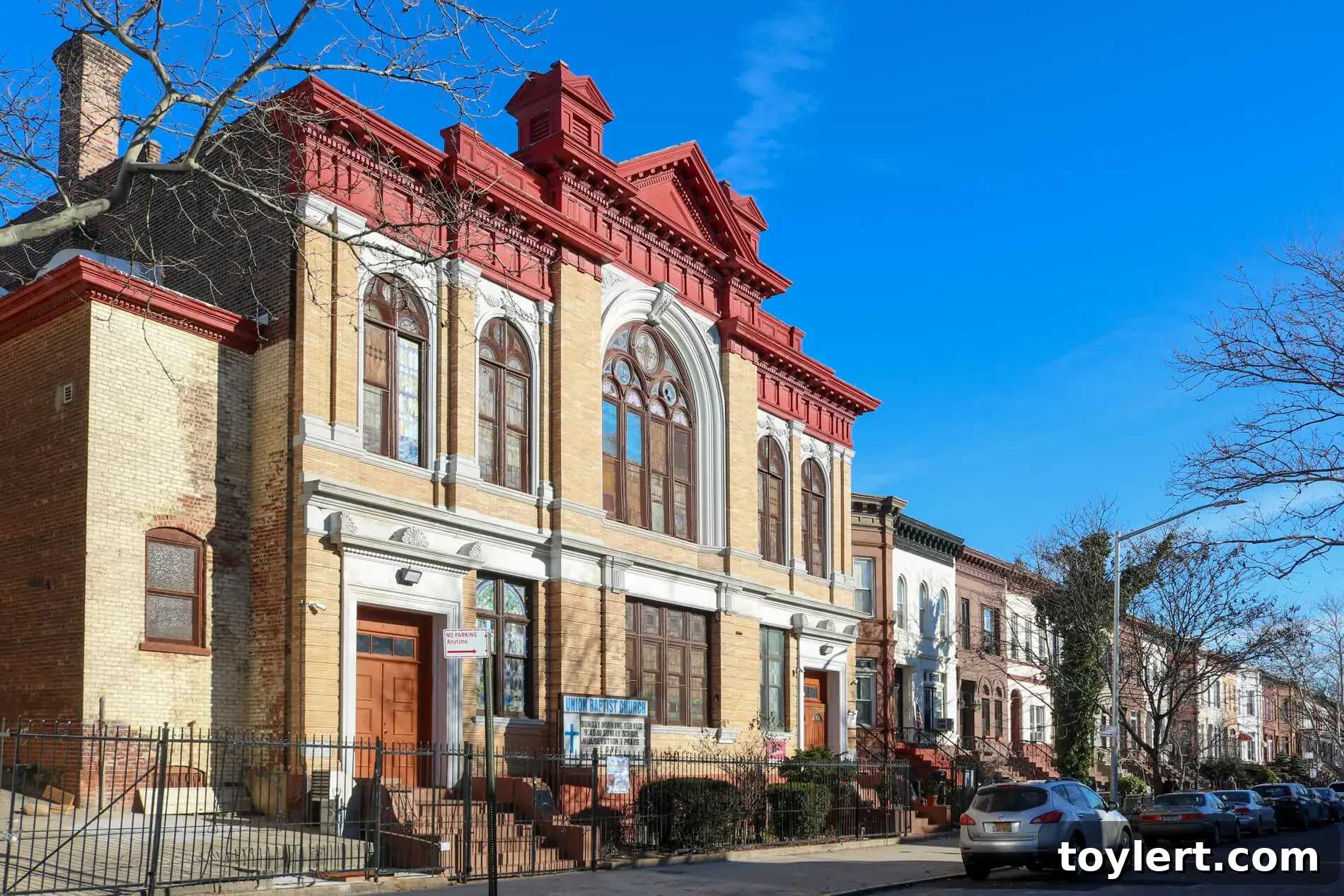
Axel Hedman: Master Architect of Brooklyn and the Grandeur of 461 Decatur Street
Axel Hedman is a name synonymous with the distinctive architectural fabric of Brooklyn. While his prolific career saw him design a myriad of structures, he is perhaps most celebrated for the elegant brownstones, stately row houses, and comfortable apartment buildings that line the borough’s historic streets. His residential designs, characterized by their thoughtful layouts, intricate detailing, and enduring quality, have cemented his legacy as a preeminent architect of his era. However, to truly appreciate the breadth of Hedman’s genius, one must look beyond the familiar residential façades and explore the lesser-known, yet equally significant, non-residential contributions to Brooklyn’s urban landscape. This exploration not only sheds light on his versatility but also highlights architectural gems like the magnificent church at 461 Decatur Street, a testament to his comprehensive design capabilities.
Axel Hedman: A Visionary in Brooklyn’s Golden Age of Architecture
Born in Sweden in 1861, Axel Hedman immigrated to the United States and quickly established himself in Brooklyn during a period of immense growth and architectural innovation. The late 19th and early 20th centuries were a golden age for Brooklyn, transforming from a collection of towns into a bustling urban center. This expansion fueled a demand for new buildings, offering architects like Hedman fertile ground for their talents. Hedman’s active career spanned several decades, allowing him to witness and adapt to evolving architectural trends while maintaining a distinctive personal style.
His work often showcased elements of Romanesque Revival, Neo-Renaissance, and Queen Anne styles, blended with a practical Scandinavian sensibility. He understood the nuances of urban living, creating spaces that were both aesthetically pleasing and highly functional. Whether designing a grand townhouse or a multi-family apartment building, Hedman’s meticulous attention to detail, from the choice of materials to the embellishment of cornices and stoops, set his work apart. His designs contributed significantly to the charm and character of neighborhoods such as Bed-Stuy, Park Slope, and Prospect Heights, where his brownstones remain highly sought after today.
The Residential Legacy: Crafting Brooklyn’s Iconic Homes
It’s no exaggeration to say that Axel Hedman helped define the look of classic Brooklyn residential architecture. His portfolio includes hundreds of homes, each contributing to the borough’s unique streetscapes. He mastered the art of maximizing space on narrow urban lots, creating inviting interiors and impressive exteriors. His brownstones frequently feature characteristic bay windows, providing light and views, and ornate brickwork that speaks to the craftsmanship of the era. The elegant stoops, often adorned with wrought iron railings, serve not only as entryways but also as social thresholds, connecting private homes to the bustling public realm.
Beyond individual homes, Hedman also designed numerous apartment buildings, responding to the growing demand for multi-family dwellings. These structures, while larger in scale, retained the same commitment to quality and aesthetic appeal found in his single-family residences. He seamlessly integrated these larger buildings into existing streetscapes, ensuring they complemented their surroundings rather than dominating them. His ability to produce a high volume of work without sacrificing quality or originality is a hallmark of his enduring success and the reason his residential designs are so widely recognized and admired today.
Beyond the Brownstone: Diversifying a Portfolio
While Hedman’s residential output was indeed prodigious, it merely scratches the surface of his capabilities. Like many prominent architects of his time, he undertook a variety of commissions that extended beyond private homes. These projects, though fewer in number and often less well-documented, reveal a versatile designer capable of tackling diverse functional and aesthetic challenges. Many of these non-residential structures have either been demolished over time or have undergone significant alterations, making their study all the more crucial to understanding Hedman’s full legacy.
Among his more intriguing non-residential projects was a firehouse in Red Hook. Firehouses of that era were often civic landmarks, designed with a blend of practicality and architectural flair to symbolize their vital community role. Hedman’s design likely incorporated robust materials and a sturdy aesthetic, reflecting the building’s purpose, while still maintaining elements of the decorative styles prevalent in his other works. Additionally, he designed a public bath in Brooklyn Heights, a type of facility that was crucial for public health and hygiene in an era before widespread indoor plumbing. These public baths were often grand, quasi-civic structures, designed to inspire cleanliness and provide a comfortable, albeit public, bathing experience. While this specific building is long gone, its existence points to Hedman’s engagement with essential public services and infrastructure.
Perhaps most strikingly, Hedman’s portfolio includes several religious buildings, encompassing both churches and synagogues. These commissions allowed him to explore different architectural typologies, requiring a distinct approach to space, symbolism, and community gathering. Unlike residential projects focused on individual families, religious structures demand designs that inspire reverence, accommodate large congregations, and convey spiritual meaning through their form and ornamentation. It is within this category that the magnificent church at 461 Decatur Street stands out as a prime example of his profound skill in designing sacred spaces.
The Grandeur of 461 Decatur Street: A Monument to Faith and Architecture
Nestled in the heart of Brooklyn’s historic Bedford-Stuyvesant neighborhood, the Union Baptist Church at 461 Decatur Street is Axel Hedman’s largest and arguably most impressive ecclesiastical work. Constructed in the early 20th century, this imposing structure stands as a powerful testament to the architect’s ability to transcend residential design and create a monumental public building. The church’s presence on Decatur Street is commanding, its robust form and intricate detailing drawing the eye and inviting contemplation.
The architectural style of Union Baptist Church can be broadly categorized as Romanesque Revival, a popular choice for churches during this period due to its historical associations with strength, dignity, and spiritual fortitude. Hedman employed materials like red brick and lighter stone or terracotta for accents, creating a striking contrast that emphasizes key architectural features. The façade is characterized by its heavy masonry, round arches, and often a prominent tower or belfry that punctuates the skyline. Detailed carved stone or brickwork can be found adorning cornices, window surrounds, and entryways, showcasing the craftsmanship typical of Hedman’s designs.
Large, arched stained-glass windows are integral to the design, not only allowing natural light to flood the interior but also serving as narrative elements, depicting biblical scenes or abstract patterns that contribute to the church’s spiritual ambiance. The overall massing of the building conveys a sense of permanence and solidity, reflecting the enduring faith it houses. Inside, one can imagine a grand sanctuary designed to accommodate a large congregation, with high ceilings, perhaps an elaborate altar, and acoustic properties carefully considered for sermons and musical performances.
A Community Landmark and Enduring Legacy
The Union Baptist Church is more than just an architectural marvel; it is a vital community institution that has served generations. Its construction reflected the growth and aspirations of its congregation and the surrounding neighborhood. In a time when communities often centered around their religious institutions, a building of this scale and architectural quality would have been a profound statement of faith, stability, and cultural pride. Its prominent location and imposing presence have made it a true landmark in Bed-Stuy, a focal point of Decatur Street.
Compared to his more numerous residential projects, 461 Decatur Street provided Hedman with a different kind of canvas. Here, the challenge was not merely to create comfortable living spaces, but to evoke a sense of the sacred, to inspire awe, and to build a lasting symbol for a community. His success in this endeavor highlights his versatility and deep understanding of architectural expression across various building types. The church stands today as a living monument, continuing to serve its congregation and remaining a proud example of Axel Hedman’s diverse and significant contribution to Brooklyn’s rich architectural heritage.
Axel Hedman’s Lasting Impact on Brooklyn’s Urban Fabric
Axel Hedman’s career spanned a transformative period for Brooklyn, and his work profoundly shaped the borough’s visual identity. While his residential designs are rightly celebrated for their elegance and contribution to the iconic brownstone aesthetic, it is imperative to acknowledge the full spectrum of his architectural achievements. His forays into civic and religious architecture, exemplified by projects like the firehouse in Red Hook, the public bath in Brooklyn Heights, and particularly the majestic Union Baptist Church at 461 Decatur Street, demonstrate an architect of immense talent and adaptability.
These diverse projects underscore Hedman’s mastery of different scales, functions, and stylistic requirements. They reveal an architect who was not merely repeating a successful formula but was genuinely engaging with the unique demands of each commission. Exploring these less-known works offers a richer, more complete understanding of Axel Hedman, not just as the “brownstone king” but as a comprehensive master builder whose vision helped forge the character of one of New York City’s most beloved boroughs. His buildings continue to tell the story of Brooklyn’s past, contributing timeless beauty and structural integrity to its vibrant present.