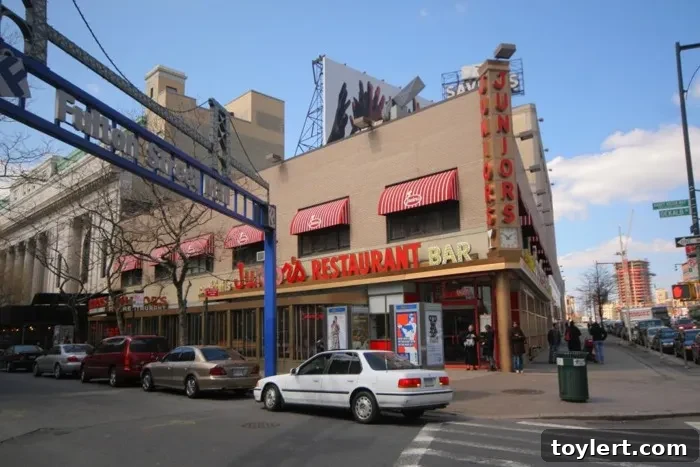
In a heartening turn of events that underscores the enduring value of history, identity, and profound community connection, Alan Rosen, the esteemed owner of Brooklyn’s legendary Junior’s Cheesecake, has unequivocally decided against selling the iconic building that has housed his family’s restaurant for generations. This pivotal decision, a testament to deep-rooted heritage over staggering financial gain, ensures that one of New York City’s most cherished culinary institutions will continue to thrive in its original, beloved home at Flatbush Avenue Extension. The news has sent a wave of relief and celebration through Brooklyn and beyond, affirming that some places, imbued with irreplaceable character and countless memories, are simply not for sale.
Rosen’s declaration puts to rest months of fervent speculation and palpable anxiety among loyal patrons, culinary enthusiasts, and preservationists alike. His reasoning, articulated with profound sentiment, resonates deeply with anyone who understands the power of place: “This is Junior’s identity, is this building,” he shared with The New York Times, emphasizing the irreplaceable bond between the establishment and its physical location. He elaborated further on the intensely personal significance of the site, reminiscing, “This is the one where I came on my first dates. Not the one down the street, not the one below 20 stories of condos. This one.” This heartfelt statement encapsulates the very essence of what makes Junior’s far more than just a restaurant; it’s a living monument to countless personal histories and collective memories, a true Brooklyn landmark.
The decision to reject the sale was not made lightly, nor was it without immense financial pressure, highlighting Rosen’s steadfast commitment to legacy. He revealed he had turned down a truly astonishing offer of $45 million from a developer eager to acquire the prime Brooklyn real estate. Crucially, this particular offer came with no provision whatsoever for Junior’s to retain any space within a prospective new development that would rise on the site. This fact alone speaks volumes about the magnitude of the personal and financial sacrifice involved in prioritizing the preservation of heritage over such a substantial windfall. In an era where iconic local businesses frequently succumb to the relentless march of urban redevelopment and soaring property values, Junior’s stands as a powerful symbol of resistance and an unwavering commitment to its deep roots in the community.
Furthermore, Alan Rosen also declined several other lucrative offers, each totaling approximately half the value of the initial $45 million proposal. These alternative bids, while significantly lower, did include a crucial concession: they would have guaranteed Junior’s a permanent home on the ground floor of any new high-rise structure built on the site. For many business owners facing similar pressures, such an arrangement might have seemed like a reasonable and attractive compromise, allowing them to capitalize on their property’s value while still preserving their brand name. However, for Alan Rosen and the spirit of Junior’s, even this compromise was deemed insufficient to capture the true essence, the irreplaceable character, and the rich history embedded within the existing building.
The illustrious story of Junior’s Cheesecake began in 1950 when Harry Rosen, Alan’s grandfather, first opened its doors. From its inception, the restaurant at Flatbush Avenue Extension quickly established an unparalleled reputation for its delectable cheesecakes, classic American diner fare, and its warm, inviting atmosphere. It swiftly became a quintessential Brooklyn gathering spot, a vibrant hub where generations celebrated milestones, shared everyday moments, and indulged in what many consider to be the world’s best cheesecake. Its distinctive orange and white exterior, coupled with its bustling, vibrant interior, became an instantly recognizable landmark, a comforting constant in the ever-evolving, dynamic landscape of New York City. The building itself is steeped in character, holding within its venerable walls the echoes of millions of conversations, laughter, and shared experiences.
For Alan Rosen, the ultimate decision wasn’t merely about brick and mortar; it was about safeguarding a generational legacy and preserving the very soul of his family’s enterprise. He deeply understood that Junior’s identity isn’t just tied to its revered recipes or its renowned brand name, but intrinsically linked to its physical space—the very walls that have witnessed decades of Brooklyn life unfold. Relocating, even to a purpose-built, modern space within a new development, would inevitably strip away a vital, irreplaceable layer of authenticity, history, and nostalgic charm. The unique character that defines Junior’s, the intangible feeling of stepping into a place where time seems to slow down, would be irrevocably altered, if not lost entirely, diminishing its status as a true New York icon.
This steadfast refusal to sell, particularly in the face of such astronomical figures, serves as a powerful message that resonates far beyond the culinary world. It highlights the growing tension and critical discussions between rapid urban development and the essential preservation of cultural heritage. In a borough like Brooklyn, which has experienced unprecedented growth, gentrification, and transformation over the past two decades, many beloved local establishments have been tragically forced out due to skyrocketing rents or enticing buyouts. Junior’s courageous decision to stay put offers a beacon of hope and a powerful example for other long-standing businesses facing similar existential dilemmas. It powerfully reminds us that some things are intrinsically worth more than any price tag, symbolizing resilience and commitment to a vibrant community.
The notion of “identity” that Alan Rosen speaks of extends far beyond a personal familial connection; it encapsulates the collective memory and shared experiences of an entire community. For countless Brooklynites and visitors from around the globe, Junior’s is not just a place to eat; it’s a cherished destination, a beloved tradition, and a comforting symbol of home and continuity. It’s where first dates blossom into lasting relationships, where families celebrate graduations and anniversaries, where tourists get a true, authentic taste of New York, and where locals simply know they can always find a slice of classic American comfort and hospitality. Its continued presence in its original, iconic building means these cherished traditions can carry on uninterrupted, preserving an invaluable piece of authentic Brooklyn for future generations to discover and enjoy.
Furthermore, the specific location on Flatbush Avenue Extension holds immense historical and practical significance. It’s a bustling artery connecting diverse parts of Brooklyn, making Junior’s easily accessible and a natural, enduring meeting point for people from all walks of life. The building itself, with its distinctive architectural style and enduring presence, acts as a visual anchor in a neighborhood constantly reinventing itself, a steadfast landmark against a backdrop of change. To replace it with a generic modern structure, however grand or architecturally impressive, would inevitably erase a significant piece of the city’s visual and cultural tapestry, diminishing the unique charm that draws people to Brooklyn in the first place. Rosen’s choice is a deliberate, powerful act of urban conservation, prioritizing character and soul over transient profit.
This courageous and deeply sentimental decision by Alan Rosen cements Junior’s Cheesecake’s status not just as a culinary icon, celebrated globally for its magnificent cheesecakes, but as a cultural touchstone and a powerful testament to the enduring power of family legacy and community loyalty. In a world increasingly homogenized by global chains and transient trends, Junior’s stands firm, a vibrant, authentic testament to Brooklyn’s rich past and its hopeful, unchanging future. Its original home, its storied history, and its warm, inviting heart remain inextricably intertwined on Flatbush Avenue Extension, ensuring that the next generation of New Yorkers and visitors will continue to create their own cherished memories within its iconic walls, perhaps even on their own first dates, just like Alan Rosen himself once did.