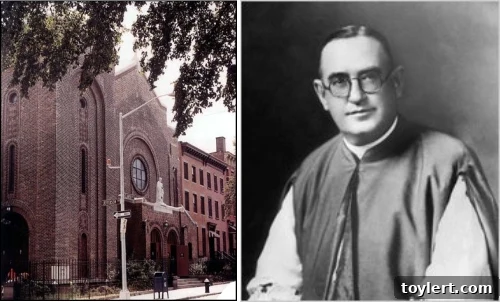
The Enduring Faith: Father Bernard Quinn and the Legacy of St. Peter Claver Church in Brooklyn’s Black Catholic History
This article continues our exploration into the profound contributions of African American Catholics to the American Church. If you haven’t yet, we invite you to read Part 1 of this story, which introduced foundational figures in this crucial narrative.
The journey of African American Catholics within the Church has been marked by both profound faith and persistent struggle. For centuries, black individuals have been an integral part of Catholicism in the Americas, their spiritual lives interwoven with the fabric of a nascent nation. Yet, this presence was often overshadowed by systemic racism and deep-seated intolerance, which relegated them to the periphery of parish life and denied them the full dignity afforded to their white counterparts.
Despite these immense challenges, a lineage of courageous black Catholics and their allies rose to make indelible marks on the American Church. In our previous installment, we celebrated the lives of Pierre and Juliet Toussaint, a remarkable couple in New York whose piety and charity left an enduring legacy. We also acknowledged the extraordinary achievements of the Healy brothers from Georgia, who, a century later, broke significant barriers to become prominent figures within the Church hierarchy. However, as the 19th century drew to a close, the dream of true integration and equality for black Catholics remained largely unfulfilled, setting the stage for new battles and new champions.
The Dawn of the 20th Century: A Growing Need for Inclusion
The turn of the 20th century brought significant demographic shifts across America. The Great Migration saw millions of African Americans move from the rural South to urban centers in the North and West, seeking economic opportunity and an escape from oppressive Jim Crow laws. Many of these migrants were Catholic, arriving in cities like New York and Brooklyn only to find the existing Catholic infrastructure ill-prepared or unwilling to welcome them as equals. Segregation was not just a Southern phenomenon; it permeated Northern institutions, including churches, schools, and hospitals.
Parishes across Brooklyn, once diverse or primarily serving specific immigrant groups, now faced the challenge of a growing black Catholic population. However, entrenched racial prejudices meant that many existing churches actively discouraged or outright denied full participation to African Americans. They were often relegated to separate pews, basement masses, or denied access to sacraments and educational opportunities. This era underscored a critical need for dedicated spaces where black Catholics could practice their faith without prejudice and build a vibrant community.
Father Bernard Quinn: A Visionary for Racial Justice
It was in this challenging landscape that Father Bernard Quinn emerged as a pivotal figure. Born in County Antrim, Ireland, in 1888, Quinn immigrated to the United States as a young man, eventually being ordained a priest for the Diocese of Brooklyn in 1912. From early in his ministry, he demonstrated an unwavering commitment to social justice and a profound concern for the plight of African Americans. Unlike many of his contemporaries, Father Quinn was deeply troubled by the racial discrimination he witnessed within his own Church and society.
His ministry began in various Brooklyn parishes, where he often encountered the institutional racism that marginalized black Catholics. Rather than accepting the status quo, Father Quinn felt a divine call to create a sanctuary where black Catholics could experience the love of Christ and the fellowship of the Church without the burden of racial prejudice. His vision was radical for its time: a dedicated parish and school for African Americans, led by a priest who truly believed in their equal dignity before God and humanity.
Founding St. Peter Claver Church: A Beacon of Hope in Brooklyn
Father Quinn’s vision materialized with the establishment of St. Peter Claver Church in the Bedford-Stuyvesant neighborhood of Brooklyn. Founded in 1921, St. Peter Claver was not merely another parish; it was a defiant statement against segregation and a powerful symbol of hope. Named after St. Peter Claver, the Spanish Jesuit priest who ministered to enslaved Africans in Cartagena, Colombia, the church carried a profound symbolic weight, signifying a commitment to justice and service for the oppressed.
The founding of St. Peter Claver was far from easy. Father Quinn faced significant opposition, both from those within the Church who preferred to maintain segregated structures and from white residents in the neighborhood who resisted the establishment of a black parish. Despite financial constraints and societal pressures, Quinn pressed forward with remarkable tenacity. He often appealed directly to the community, organizing fundraisers and galvanizing support from individuals who shared his belief in racial equality.
The church building itself, initially a modest structure, quickly became a bustling spiritual and social hub. It provided a much-needed haven where black Catholics could worship, receive sacraments, educate their children, and find community support free from the pervasive racism that characterized much of society. St. Peter Claver became a testament to Father Quinn’s unwavering faith and his conviction that racial equality was not just a social ideal, but a Christian imperative.
A Holistic Approach: Education, Community, and Activism
Father Quinn understood that true empowerment extended beyond spiritual nourishment. To serve the whole person and the entire community, St. Peter Claver also established a school. St. Peter Claver School became a cornerstone of the parish’s ministry, offering quality education to black children at a time when access to good schools was often limited and segregated. The school provided a nurturing environment where students could thrive academically and spiritually, fostering a sense of pride and identity.
Beyond the sanctuary and classrooms, St. Peter Claver Church actively engaged with the broader social issues affecting its congregants. It became a center for various community organizations, social services, and advocacy groups. The parish offered food programs, job placement assistance, and a safe space for dialogue and community organizing. Father Quinn himself was an outspoken advocate for civil rights, using his pulpit to challenge racial injustice and call for greater equity. His work at St. Peter Claver demonstrated a holistic approach to ministry, one that recognized the interconnectedness of faith, education, and social justice.
Facing Adversity: Defending the Parish and Its People
The very existence of St. Peter Claver, a thriving black Catholic institution, drew the ire of racist elements in society. Father Quinn and the parish faced numerous threats and acts of intimidation, including vandalism and even attacks orchestrated by the Ku Klux Klan. In an era when the KKK had a significant presence even in northern cities, such threats were not to be taken lightly. Yet, Father Quinn remained undeterred.
He famously stood guard at the church and school, often sleeping in the buildings to protect his flock and their sacred spaces. His courage in the face of such virulent hatred solidified his reputation as a true shepherd, willing to lay down his life for his sheep. This period of intense adversity only strengthened the resolve of the St. Peter Claver community and deepened their bond with their devoted pastor. They became a united front against racial oppression, a testament to the resilience of faith in the face of bigotry.
The Enduring Legacy of St. Peter Claver and Father Quinn
Father Bernard Quinn died in 1940, but his legacy and that of St. Peter Claver Church continued to thrive for decades. The church remained a vibrant center for Brooklyn’s black Catholic community, producing numerous vocations to the priesthood and religious life, fostering lay leadership, and serving as a model for inclusive ministry. It played a significant role in nurturing black Catholic identity and contributing to the broader Civil Rights Movement through its sustained advocacy for justice and equality.
Today, St. Peter Claver Church stands as a historic landmark and a living monument to the power of faith and the fight against racial injustice. It reminds us of the long and often arduous journey of African American Catholics towards full recognition and inclusion within the Church and society. The stories of figures like Pierre and Juliet Toussaint, the Healy brothers, and especially Father Bernard Quinn, underscore a powerful truth: that even in the face of immense prejudice, faith, courage, and a commitment to human dignity can forge paths of hope and build communities that endure. Their lives serve as an inspiration, urging us to continue the work of creating a truly inclusive and just world for all.